


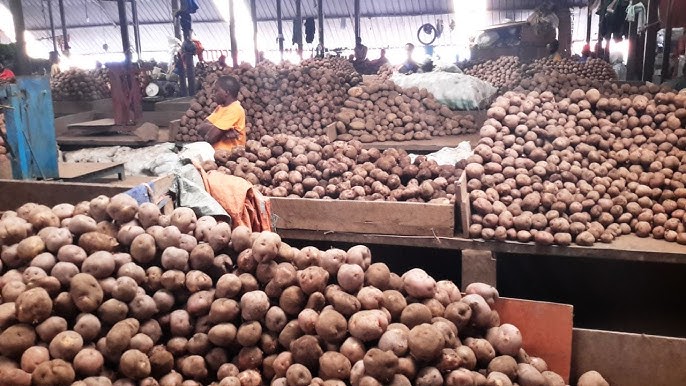
Production of Irish potatos has rebounded from the shortages that have happened previously
Kigali — Rwanda recorded an overall 2.6 percent increase in food production during the 2025 agricultural Season B, despite a decline in the total area of land under cultivation, according to the latest Seasonal Agricultural Survey (SAS) released by the National Institute of Statistics of Rwanda (NISR).
Total production for major crops—including maize, beans, cassava, bananas, Irish potatoes, and sweet potatoes—rose from 3.45 million metric tons in Season B 2024 to 3.54 million metric tons in Season B 2025, which covers months of March-June.
This growth occurred even as the overall cultivated area dropped slightly to 1.33 million hectares.
The NISR attributes this positive performance to improved crop yields, particularly among cassava, banana, and Irish potato farmers, who have adopted better inputs and more efficient cultivation practices.
Cassava production rose by nearly 9 percent, Irish potato by 10 percent, and banana by 2 percent, offsetting declines in crops such as sorghum and sweet potatoes.
“High yields from a smaller land base suggest a shift toward productivity-driven agriculture,” the report notes, highlighting increased use of improved seeds, fertilizers, and pesticides, especially among large-scale farmers.
In Season B of 2025, cassava averaged 14.4 tons per hectare, bananas 12.4 tons, and Irish potatoes 6.8 tons, placing them among Rwanda’s most productive crops.
By contrast, traditional cereals such as sorghum and maize recorded yield stagnation or decline, with sorghum production falling by over 10 percent due to reduced cultivation area.
Despite the land constraints, farmers are becoming more efficient, thanks to expanded use of organic fertilizers (80.8%), inorganic fertilizers (55.5%), and pesticides (36.6%).
Adoption of irrigation also rose modestly, with 11.5 percent of farmers now practicing some form of water management.
Interestingly, the report shows that land area dedicated to cassava and bananas decreased, yet their yields improved markedly.
NISR attributes this to intensified farming techniques, better agroecological targeting, and the dominance of intercropping systems, which allow multiple crops to be grown on the same plot.
The Eastern and Western provinces maintained their status as Rwanda’s main food baskets.
The Eastern Province led in banana and maize production, while the Western highlands—notably Nyabihu, Rubavu, and Musanze—dominated in Irish potatoes.
The data underline the country’s gradual shift from land expansion to productivity-focused farming, a key pillar of Rwanda’s agricultural transformation strategy.
The country is seeing a pattern where farmers are producing more from less land. This is the direction Rwanda must continue to take to achieve food security in the face of population growth and climate change.
Still, challenges persist. The report notes that only 18 percent of farmers used improved seeds, and mechanization remains minimal at 0.7 percent.
Moreover, many smallholders continue to rely on traditional methods, limiting potential yield gains.
Even so, the 2025 Season B survey results offer cautious optimism. Rwanda’s food production system is becoming more efficient and resilient, achieving higher output from shrinking farmland—an encouraging sign for a country striving to secure its food future.
