






Earlier this month, RwandAir CEO, Yvonne Makolo and members of management joined flight WB108 to Johannesburg to celebrate the people who make every journey special, its passengers.
For air travellers going for the upcoming festive season, RwandAir has cut it’s rates by 50%. The offer goes up to June 2026.
The strategy appears, not to get money, but to make the airline, the idea travel option. And the latest revenue data shows just that trend.
Rwanda’s national carrier, RwandAir, is quietly evolving into one of the country’s most strategic economic assets — a national symbol that not only connects Kigali to the world but also fuels Rwanda’s broader vision of becoming a regional hub for tourism, trade, and investment.
The airline’s steady growth has taken a significant leap this year with the addition of two modern Boeing 737-800 aircraft in August 2025, a move that reflects both ambition and preparation for a new aviation era anchored by the upcoming Bugesera International Airport.
A Fleet Ready for Expansion
With these latest additions, RwandAir’s fleet now stands at 16 aircraft, a balanced and efficient mix tailored to the airline’s growing network.
The fleet includes three Airbus A330s — the backbone of its long-haul operations connecting Kigali to Europe and Asia; six Boeing 737s — the workhorses for regional and medium-haul routes including the new -800 models; two Bombardier CRJ900s, which efficiently serve thinner regional routes; and two De Havilland Canada Dash 8-Q400s, turboprops used for short-haul flights within the East African region.
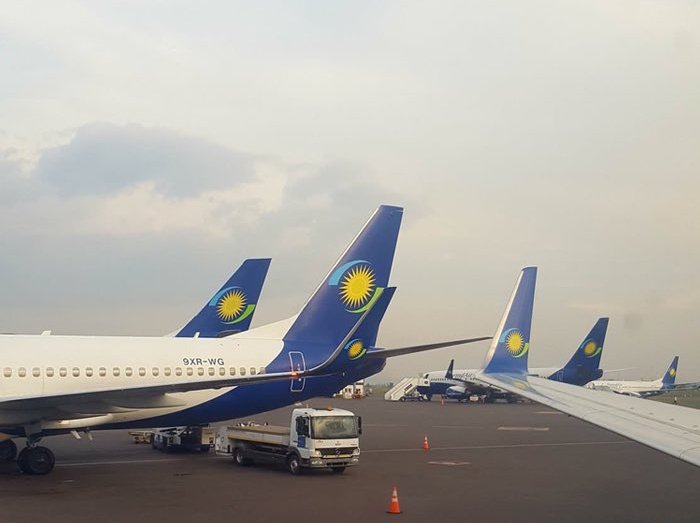
RwandAir currently operates flights to two domestic destinations and 25 international destinations across 18 countries, spanning Africa, the Middle East, Europe, and Asia.
Yet, this footprint is only a fraction of what the airline envisions.
Over the next five years, RwandAir plans to increase its fleet to 28 aircraft, expanding its reach to new long-haul markets while improving connectivity within Africa.
The expansion is not only timely but essential, as the airline positions itself for the anticipated traffic boom once the Bugesera International Airport becomes operational.
The justification for scaling up RwandAir is not theoretical — it is backed by hard evidence from the 2025 Semester 1 Travel Expenditure Survey (TES), released by the National Institute of Statistics of Rwanda (NISR).
The report, which tracks how travelers spend inside and outside the country, leaves no doubt about the central role air travel plays in Rwanda’s economy.
Air Travelers Drive Rwanda’s Foreign Earnings
According to the survey, in the second quarter of 2025, Rwanda earned USD 121.7 million from foreign visitors. Of that, a staggering USD 101.1 million — or 83 percent — came from air travelers.
By contrast, those arriving by land contributed only USD 20.7 million. The figures confirm that the skies, not the borders, are the main arteries through which Rwanda earns foreign exchange from travel.
Even more telling is where this money comes from. Holidaymakers contributed USD 50 million, almost half of all air-travel income, and an overwhelming 80.5 percent of that came from gorilla tourism — Rwanda’s flagship attraction.
The North American market alone accounted for USD 37.7 million in travel earnings, making it the top-spending region by far. Yet, direct connectivity between Rwanda and North America remains limited.
Every tourist who flies through Nairobi, Addis Ababa, or Entebbe to reach Rwanda represents lost value — in ticket revenue, airport fees, and related services that could have stayed in the national economy if RwandAir had direct links.
The same pattern applies to Rwandans traveling abroad. The survey found that in Q2 2025, Rwandans spent USD 89.3 million on travel abroad — nearly half of it (USD 59.1 million) by air travelers, mostly for business and education.
This means that even outbound spending can contribute to Rwanda’s economy if RwandAir carries those passengers instead of foreign airlines.
A strong national carrier ensures that a portion of outbound travel expenditure stays within Rwanda, supporting local jobs, maintenance contracts, and airport services.
A National Airline for a Global Future
RwandAir’s financial record also reinforces the case for continued government investment.
In 2023, the airline generated USD 464.2 million in revenue, marking a remarkable 80 percent jump from USD 255 million in 2022.
The growth reflects the airline’s recovery from the pandemic years and its ability to compete regionally despite global cost pressures.
The government continues to inject capital annually into the airline, but unlike in its early years, these investments are now yielding measurable economic and reputational returns.
As Rwanda moves closer to commissioning the Bugesera International Airport, the stakes are rising.
The new facility, designed to handle millions of passengers annually, will transform Rwanda into a key aviation hub in East and Central Africa. But infrastructure alone is not enough — an airport needs an airline capable of filling it.
RwandAir must therefore be ready: bigger, better connected, and financially stronger. Expanding routes to North America, Asia, and additional European cities will be vital to attracting high-value tourists, investors, and transit passengers.
For a landlocked country with limited natural resources, air connectivity is more than a convenience — it’s an economic necessity. It determines who visits, who invests, and how fast the country can trade.
The TES data clearly shows that Rwanda’s most lucrative travel earnings come from air arrivals, not land entries. Therefore, expanding RwandAir is not a matter of national pride but of economic strategy.
Each new aircraft strengthens Rwanda’s ability to compete in global tourism and logistics. Each new destination opens doors for trade, education, and diplomacy.
As RwandAir continues to grow its fleet and routes, it carries more than passengers — it carries Rwanda’s promise of transformation.
The numbers tell a simple story: the sky is where Rwanda’s economy soars. Government investment in RwandAir is not a subsidy — it’s a down payment on the country’s future connectivity, competitiveness, and prosperity.
With the right investment and planning, RwandAir can help ensure that when Bugesera Airport opens its doors, Rwanda will already be flying high.

1 comment
.
Comments are closed.