


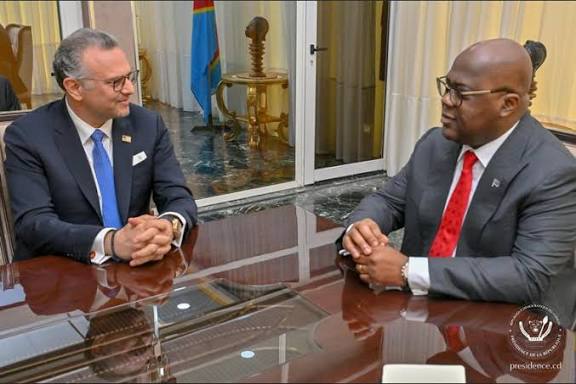
US President Donald Trump’s Senior Advisor for Africa, Massad Boulos meets President Félix Tshisekedi in Kinshasa at previous encounter
The Democratic Republic of the Congo (DRC) has pledged to tone down its rhetoric and refrain from hostile language or political attacks against Rwanda, in a move that marks a significant step toward easing tensions between the two neighboring countries.
The commitment was made during the fourth meeting of the Joint Oversight Committee for the Washington Peace Agreement, held this week in Washington, D.C.
The meeting brought together officials from the DRC, Rwanda, the United States, Qatar, Togo (as African Union mediator), and the African Union Commission.
According to a joint statement released by the U.S. State Department, the DRC reaffirmed commitment to refrain from hostile actions or rhetoric, particularly political attacks or language that would undermine or complicate the full implementation of the Peace Agreement, including in international fora.
The statement makes it a joint commitment, but largely concerns Kinshasa because President Felix Tshisekedi has personally, and in national addresses, vowed regime change in Rwanda.
The latest commitment signals a change in tone from Kinshasa, which has in recent months used strong language accusing Rwanda of backing armed groups in eastern Congo.
The new commitment is seen as part of a broader diplomatic effort to rebuild trust and implement the June 2025 Washington Peace Agreement, aimed at restoring stability in the region.
During the meeting, the two countries also initialed the Regional Economic Integration Framework (REIF), a pact designed to open economic cooperation, attract investment, and link peace with development.DR Congo Commits to “Refrain from Hostile Rhetoric” Against Rwanda
The framework’s success will depend on continued security progress, including neutralizing the FDLR and other armed groups operating in eastern Congo.
In another notable shift, the DRC delegation also agreed to take concrete steps toward neutralizing the FDLR, a militia long accused of fueling instability in eastern Congo and undermining regional peace.
This marks the first clear indication that Kinshasa has accepted direct responsibility for addressing the FDLR threat under the Washington Peace Agreement. The Joint Oversight Committee reviewed plans for these operations under the Concept of Operations (CONOPS) and Operational Order (OPORD) frameworks, signaling that the campaign will proceed within agreed parameters to ensure transparency and coordination.
The development represents growing international pressure on the Congolese government to act against the FDLR, whose continued presence inside Congo has been cited as a key obstacle to peace.
By committing to this course, Kinshasa appears to have acknowledged that effective implementation of the peace deal requires confronting the group directly and removing it as a destabilizing force in the region.
The statement acknowledged that progress has been slower than expected, but both sides agreed to redouble efforts and translate commitments into concrete actions on the ground.
The State of Qatar also reported progress in Doha-based peace talks between the DRC government and AFC/M23, including prisoner exchanges and the launch of a ceasefire monitoring mechanism.
By pledging to curb inflammatory rhetoric, analysts say Kinshasa is signaling a willingness to focus on implementing peace and security measures rather than public confrontation — a move welcomed by mediators and international partners supporting the Great Lakes peace process.
