





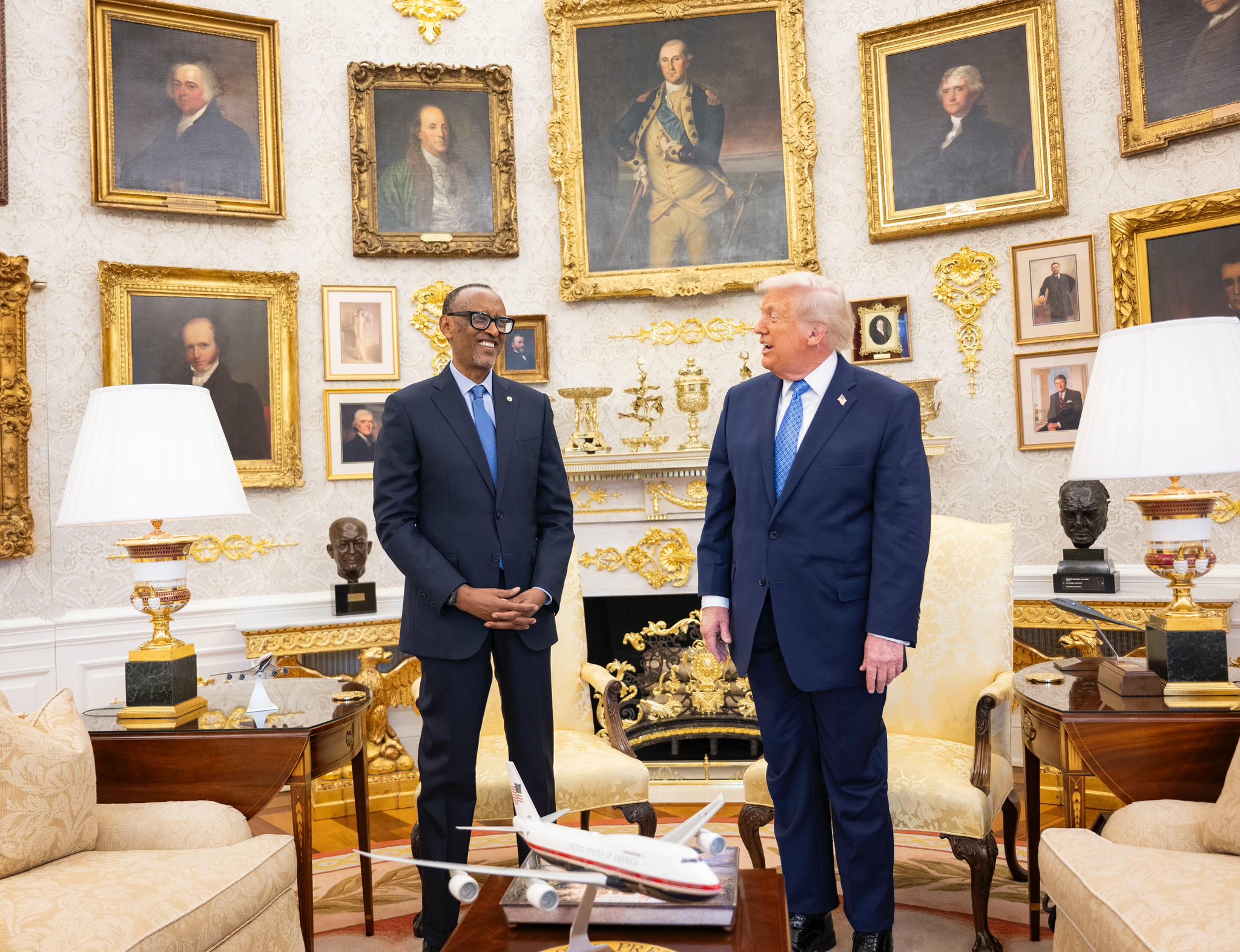
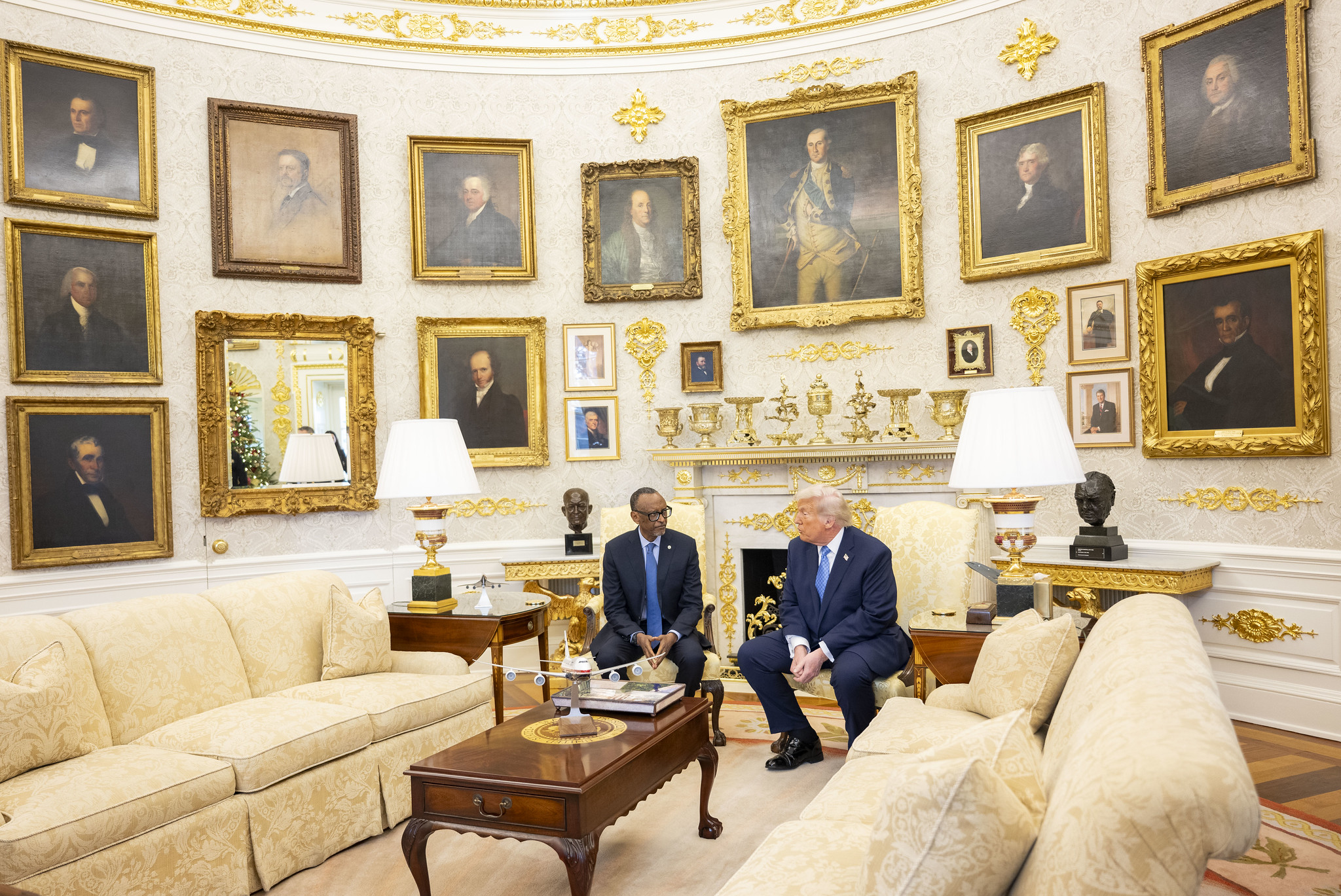
President Trump hosted President Kagame in the White House for a tete-a-tete meeting
Washington, D.C. — President Paul Kagame delivered a strikingly direct and reflective speech at the signing ceremony of the Washington Accord, praising U.S. President Donald J. Trump for taking an “even-handed, future-oriented, and pragmatic” approach that broke a decades-long deadlock in peace efforts between Rwanda and the Democratic Republic of Congo.
Speaking at the Donald J Trump Institute of Peace before a room filled with African heads of state, U.S. senators, diplomatic envoys, and senior American officials, Kagame said the significance of the moment could not be overstated.
“These accords provide everything needed to end this conflict once and for all,” Kagame declared. “This is the clearest and most viable path forward that we have ever had.”
“No one was asking President Trump to do this.”
Kagame emphasized that Trump intervened by choice, not obligation.
“No one was asking President Trump to take up this task,” Kagame said. “Our region is far from the headlines. But when the President saw the opportunity to contribute to peace, he immediately took it.”
MORE PHOTOS FROM PRESIDENT KAGAME U.S. TRIP
The Head of State noted that the eastern Congo conflict — one of the deadliest since World War II — had resisted mediation after mediation.
“This conflict has lasted for 30 years,” Kagame said. “We have seen countless mediation efforts, but none have succeeded in resolving the underlying issues.”
He implied that many past processes lacked enforcement, neutrality, and political courage.
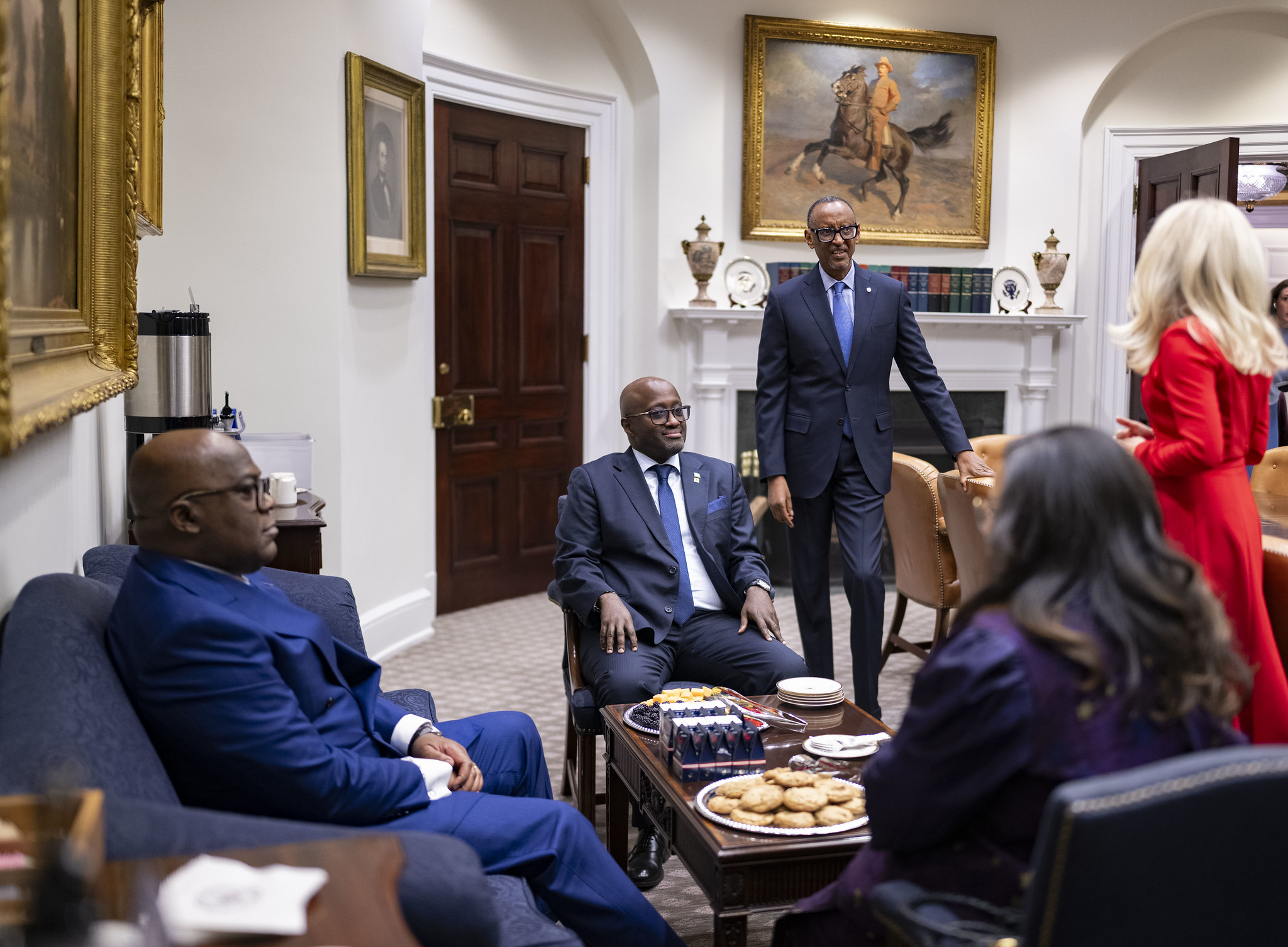
Before this address, Kagame had a private tete-a-tete with President Trump in the White House. It was followed by trilateral summit between Kagame, Trump and DR Congo’s Tshisekedi.
The three leaders traveled to the venue in separate convoys, but entered the event site together.
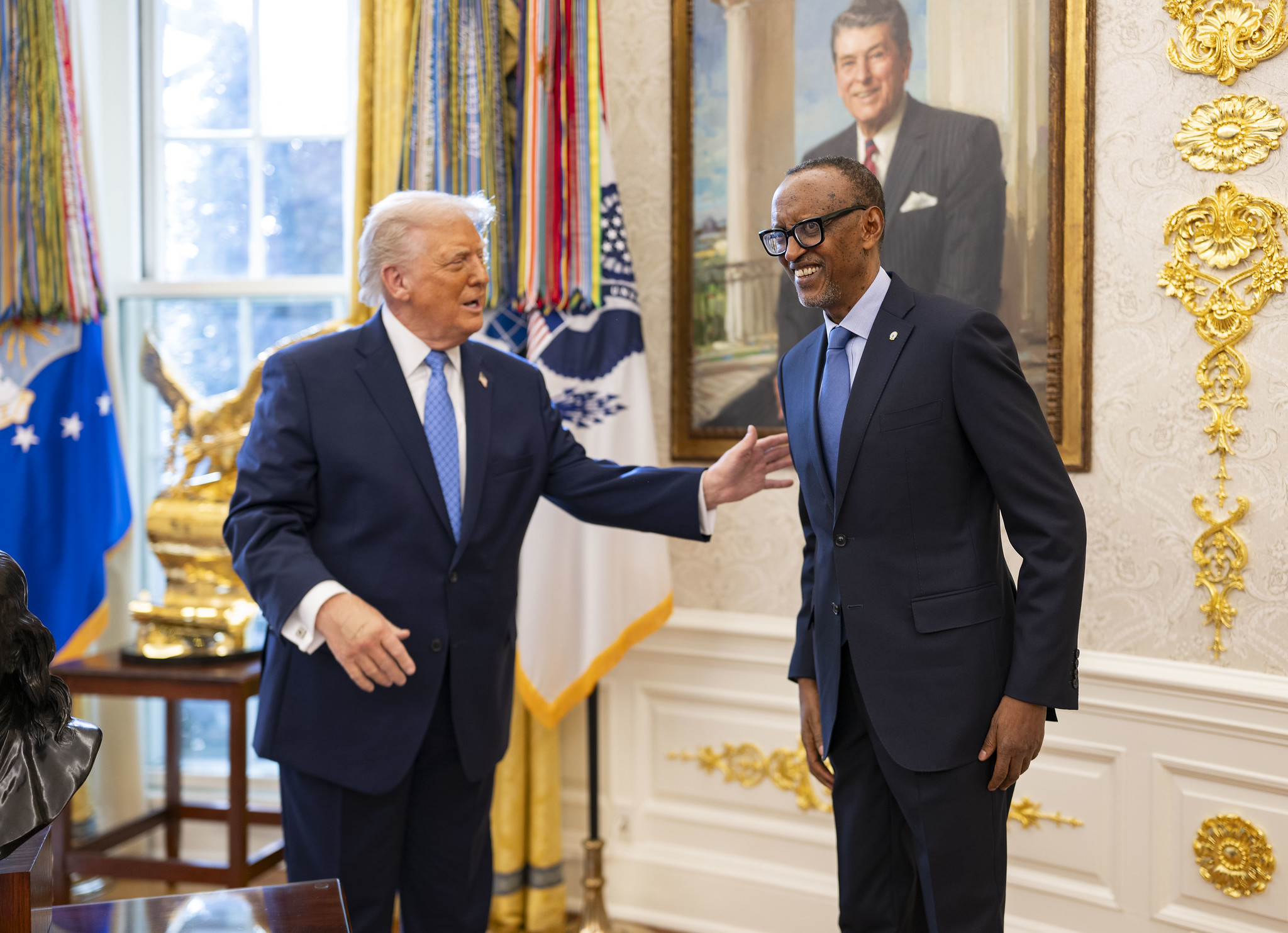
“President Trump never takes sides.”
Kagame, in the speech at the Institute of Peace offered what was arguably his most consequential line of the day:
“President Trump’s approach is even-handed — never taking sides,” he said. “He orients us toward the future, not the past.”
This comment drew attention in the room, touching directly on Rwanda’s long-standing complaint that previous mediations treated Kigali either as a villain or as the sole responsible actor, rather than addressing the multitude of armed groups, historical grievances, and cross-border operations.
Kagame said Trump’s neutrality created “space no one else had managed to create,” enabling trust and candid dialogue between Rwanda and Congo.
A pragmatic, not performative, peace process
Kagame drew a sharp contrast between Trump’s method and traditional international mediation:
“The process has not become an end in itself,” he said, referencing years of talks that produced communiqués but no change on the ground.
“President Trump’s approach is pragmatic.”
He credited this for accelerating negotiations and keeping discussions focused on outcomes rather than ceremony.
Kagame also emphasized that Trump’s focus on prosperity — not merely ceasefire mechanics — had been transformative.
“He emphasizes that the dividend of peace is prosperity and investment, including from the United States.”
This aligned strongly with Rwanda’s position that the region’s vast mineral wealth, fertile lands, and human potential must be used to uplift the people rather than fuel conflict.
Acknowledgment of Qatar and U.S. negotiators
Kagame delivered large praise to Qatar for facilitating discreet, high-pressure diplomacy:
“The role of Qatar has been absolutely central in getting us to this point.”
He then singled out two individuals: U.S. Secretary of State Marco Rubio, and Senior Advisor for Africa Mossad Boulos.
“I want to single out Secretary Rubio and Mossad Boulos for special appreciation. We would not be here today without their efforts.”
He described the U.S. team as disciplined, present, and committed throughout the negotiation — a subtle contrast with past peace efforts where African leaders often complained that foreign facilitators disengaged prematurely.
“If this agreement falters, the responsibility will not lie with President Trump.”
 In one of his most pointed lines, Kagame said the success or failure of the accord now rests squarely with African leaders:
“If this agreement falters and things do not work out as they are supposed to, the responsibility will not lie with President Trump — but with ourselves.”
This statement was a direct appeal to regional accountability, and a rejection of the pattern where peace collapses and blame is shifted to external mediators.
Rwanda’s commitment: security above all
Kagame reassured attendees that Rwanda’s position had remained consistent for decades:
“Our only objective is, and has always been, for our country to be safe and secure, after having endured so much tragedy.”
He said Rwanda’s past — referencing the 1994 Genocide against the Tutsi without naming it — had shaped the nation’s uncompromising security posture.
“We now only want to look forward in confident expectation of a prosperous and stable future.”
Acknowledging challenges ahead
Kagame warned that peace implementation is never linear: “There will be ups and downs on the road ahead — there is no doubt about it.”
He implied that armed groups, political spoilers, and mistrust would not vanish overnight, but the framework created by the Accord gave the region the strongest tool it had ever possessed.
Rwanda will not be ‘found wanting’
Closing his speech, Kagame reiterated Rwanda’s commitment to full implementation:
“Rwanda, I know, will not be found wanting. I can assure you of that.”
He addressed Trump, fellow African leaders, and U.S. congressional representatives:
“Excellencies, I thank you for your kind attention.”
Kagame then returned to his seat amid applause, with Trump tapping his arm in affirmation — a moment of visible rapport that commentators later described as unusually warm in U.S.–African diplomacy.
