




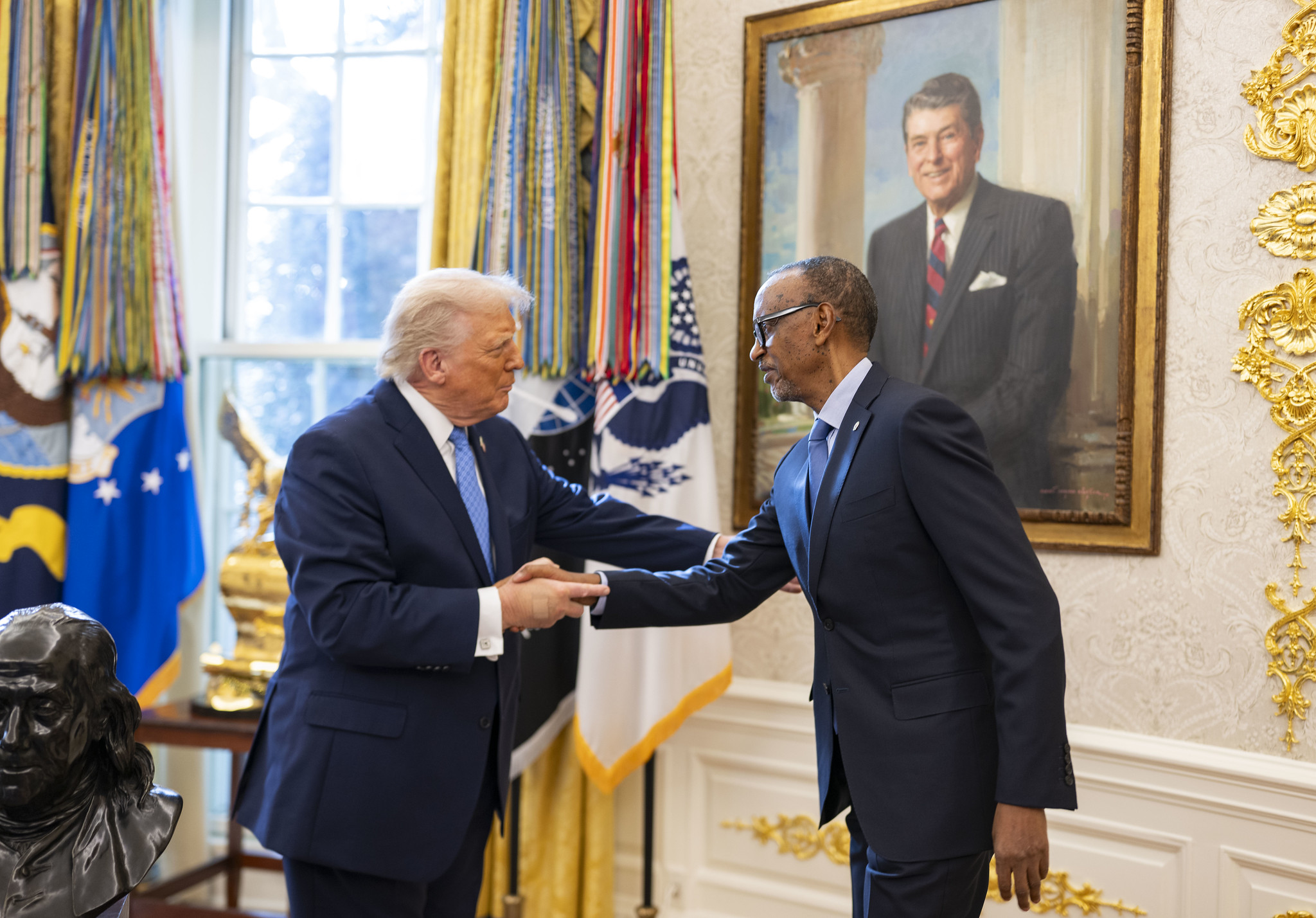
President Kagame is hosted to the White House by President Trump for the signing of the Washing Accords
President Paul Kagame has offered his most extensive public explanation yet of his working relationship with U.S. President Donald J. Trump, the ongoing regional crisis with the Democratic Republic of Congo (DRC), and the accusations surrounding the flow of Congolese minerals through Rwanda.
Kagame had in-depth interview with Al Jazeera’s Steve Clemons on the program The Bottom Line, recorded in Washington, D.C., where Rwanda and the DRC signed the Washingtin Accord, what has been described as a historic peace framework brokered by President Trump.
Kagame said the Trump-brokered deal represents a turning point in efforts to end decades of instability in eastern Congo, arguing that no previous U.S. administration had invested comparable direct attention, energy, or pressure in trying to resolve the conflict.
“We have never had anything like this,” Kagame said, noting that Trump personally convened both leaders and applied visibility and urgency that, according to him, had been absent for decades.
“President Trump found time, got interested, and invited us. One can give credit for that.”
The ‘Theories’ of Western Policy
Kagame drew a sharp contrast between what he called long-standing Western “theories” about democracy, freedom, and human rights, and Trump’s more transactional, results-driven style.
“People talk beautifully about human rights and democracy, yet nothing changes on the ground,” he said. “I prefer the approach of: what do we give, what do we gain, what are the results?”
Kagame argued that decades of rhetorical engagement from the West had failed to translate into improved livelihoods for Africans, whereas Trump’s interest lies in measurable outcomes and mutual benefit. This, he said, makes Trump’s involvement unusually promising.
The Head of State also openly acknowledged that African states share responsibility for their challenges.
“Maybe others carry blame, but this blame is invited by our absence in dealing with our affairs,” he said. “Still, if someone tries to help and we fail to find a solution, you cannot blame the one who tried.”
Tshisekedi Keeps Changing Positions
Kagame also revealed that it was DRC President Félix Tshisekedi—not Rwanda—who initiated both the Washington and Qatar negotiation tracks, despite African leaders accusing Kigali of “abandoning” African mechanisms.
“It was the very man—DRC—who initiated that,” Kagame stressed. “He requested the Doha meeting. He requested the Washington engagement.”
According to Kagame, Tshisekedi believed he could manipulate either process in his political favor—banking on the DRC’s size, global resource value, and paying people to get the results he wanted.
Kagame said this pattern has been consistent: “We have had experiences where the DRC reaches an agreement, and the next day they say the opposite. Not once, not twice, but many times.”
Despite this, Kagame said Rwanda would proceed step by step with the new agreement and expects both the United States and Qatar to keep monitoring the process.
DRC Minerals: ‘Rwanda’s Share Is the Smallest in the Region’
A significant portion of the interview focused on minerals—particularly tungsten, tin, tantalum, gold, and other strategic resources. Kagame pushed back strongly against the long-repeated allegation that Rwanda’s mineral exports originate illegally from the DRC.
He highlighted research and investment by a U.S.-based company, Trinity Metals, which confirmed high-quality Rwandan deposits: “Tungsten, tin, tantalum—these exist in Rwanda.”
“We are now number four in the world in tungsten. First in Africa.”
He noted – “The quality is much better than you find in many other places.”
Kagame said the narrative accusing Rwanda ignores the far larger flows through other countries: “If anything, the other neighboring countries of DRC export much, much bigger volumes than anything that goes through Rwanda.”
He added that international actors also play a role but often hide behind Rwanda as a convenient scapegoat.
Kagame said Rwanda’s stability and growth contradict the idea that it seeks to benefit from conflict.
“We have protected our country. We are not a source of instability. People drag us into this for their own reasons,” he said.
On Whether Trump Deserves a Nobel Peace Prize
Asked if Trump and Tshisekedi should be considered for the Nobel Peace Prize for their involvement in the regional process, Kagame declined to comment on himself but said Trump’s efforts deserve recognition: “Why not President Trump? Given what he has done in a short time… He shows good intention. He wants to try.”
Kagame described his relationship with Trump positively, saying his impressions from Trump’s previous term and the current engagement remained consistent.
“I like people who want results,” Kagame said. “In this case, we stand a much bigger chance than ever before to resolve the problems in our region.”
He contrasted this with long years of “too much talking, blame games, and ending up with nothing.”
Kagame: The Agreement Is Only the Beginning
Despite optimism, Kagame acknowledged that implementation will be the hardest part: “The devil is in the details… That is where complications always arise.”
Still, he added that the commitment of Washington and Doha gives the region its first real opening for progress in years.
“First things first—we are here, we are agreeing, we will sign. Then we move to the next steps.”
President Kagame’s interview reveals far more than routine diplomatic statements. It exposes deep frustrations with long-standing narratives about Rwanda, a clear endorsement of Trump’s hands-on approach, and a blunt critique of DRC President Tshisekedi’s inconsistent negotiating behavior.
Most notably, Kagame directly addressed one of the most politically charged accusations in the region—declaring that Rwanda’s export of DRC minerals is not only exaggerated but actually far smaller than that of other neighbors.
As Kigali and Kinshasa prepare to sign what may become a landmark U.S.-brokered deal, Kagame’s remarks underscore both the promise of the moment and the fragility of peace ahead.
