



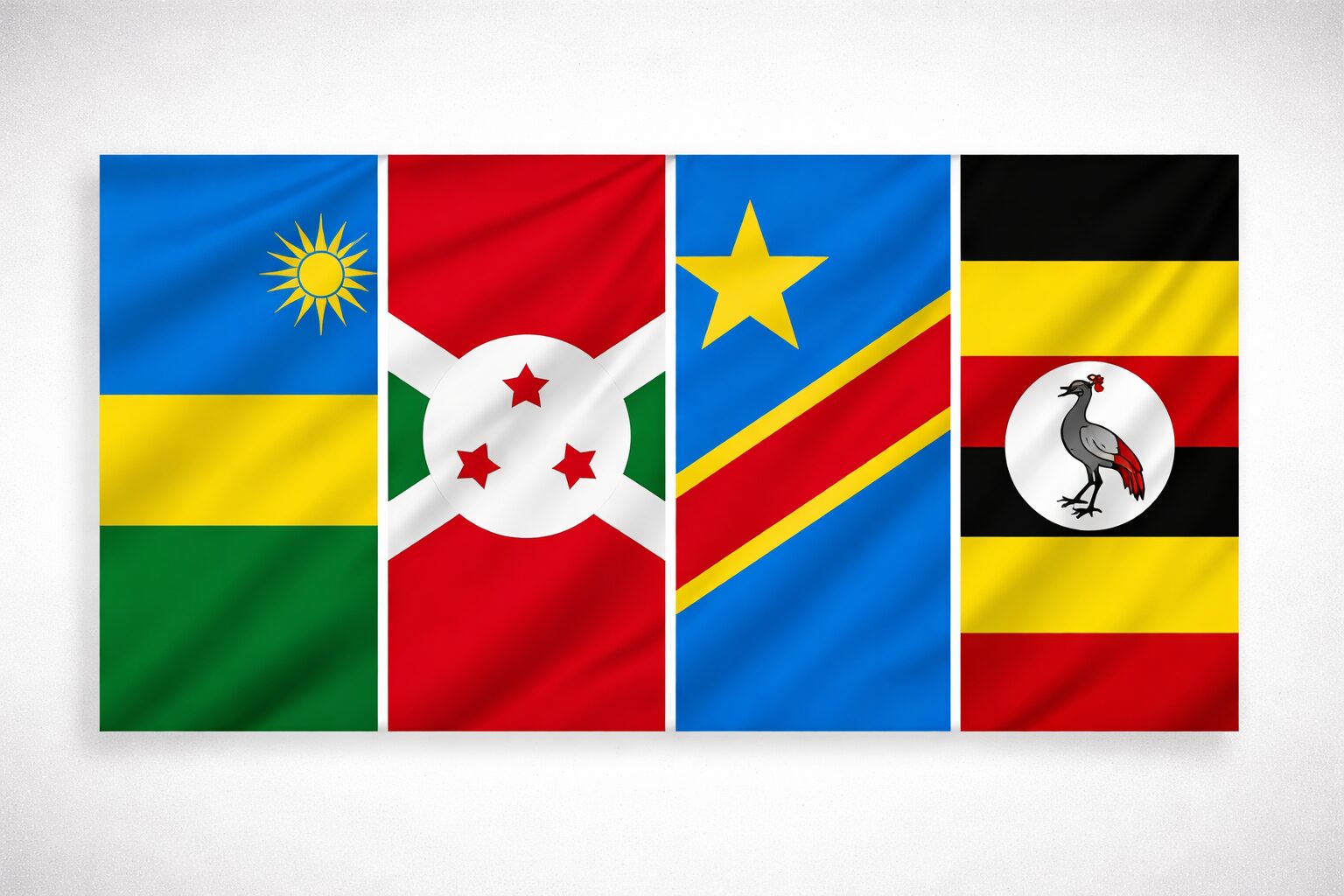
The flags of the countries that will hold the summit, whose dates have not been announced
BUJUMBURA, Burundi — Leaders from Rwanda, Uganda, Burundi and the Democratic Republic of Congo are preparing to meet in a new quadripartite summit aimed at addressing renewed insecurity in eastern Congo, it was announced on Monday.
The announcement came from the Burundi government, following a high-level visit by an African Union panel of facilitators that included former Botswana President Mokgweetsi Masisi.
The talks focused on how Burundi and its partners can contribute to restoring peace and security in the volatile eastern provinces of the Democratic Republic of Congo, where militias and armed groups have clashed with government forces for years.
The summit is expected to build on previous dialogues — including the Luanda and Nairobi processes — that have sought to bridge deep mistrust over responsibility for continued violence and the presence of foreign fighters.
But the summit’s timing intersects with a growing diplomatic flashpoint: the United States’ decision yesterday to impose sanctions on the Rwanda Defence Force (RDF) and several of its senior commanders, accusing Kigali of materially supporting the M23 rebellion — a charge Rwanda rejects.
The result is a complex diplomatic balancing act: Leaders are seeking renewed conversation and cooperation, even as one of the participating states is simultaneously the target of U.S. punitive measures.
Is Another Summit Necessary?
Summits on the Congo crisis have become almost routine fixtures of regional diplomacy. Yet for all the press briefings and joint communiqués, the hard question persists: when will words translate into results?
The agenda for Saturday’s summit of the eight member states of the East African Community — Rwanda, DR Congo, Kenya, Burundi, Somalia, South Sudan, Tanzania and Uganda — officially centers on economic integration measures, including a proposed joint cargo tracking system and other regional trade reforms.
Yet even if Congo’s security crisis is not formally listed on the program, it is unlikely to be absent from private deliberations. The conflict in eastern Congo continues to affect cross-border commerce, refugee flows and regional stability, making it the unspoken but unavoidable backdrop to any serious discussion about East Africa’s economic future.
Over the past several years, delegations have participated in multiple rounds of talks, but implementation remains elusive. Congolese authorities have been publicly accused of failing to take concrete steps toward disarmament of armed groups, including the FDLR — a militia with roots in Rwanda’s tragic 1994 genocide — and other local civila militias.
Critics of the summit cycle argue that declarations of intent mean little unless paired with verifiable action plans and accountability mechanisms. How many more meetings will be required before entrenched disputes over armed groups, borders and security guarantees are resolved with durable effect?
Parallel Tracks or Contradictions?
Sanctions are meant to apply pressure. Diplomacy is meant to build trust. Yet when they occur concurrently, their relationship can be fraught.
For Rwanda, it cannot be dismissed that sanctions will reinforce its legitimate security concerns, and concern that its issues are being sidelined in favor of punitive measures. Kigali has long argued that FDLR and many other civilian militias operating in eastern Congo pose direct threats to its territorial security and must be demobilized.
The challenge for the new summit will be whether it can transcend entrenched positions — and whether sanctions will be used as leverage toward genuine compromise or simply as point of contention.
Questions of Neutrality and Mediation
The summit’s potential key participant, Burundi’s President Évariste Ndayishimiye, adds another layer of complexity. As chair of the African Union this year, Ndayishimiye is positioned to play a lead role in steering regional diplomacy.
Yet Burundi itself has deployed troops to eastern Congo under bilateral arrangements with Kinshasa whereby Gitega has over 12,000 troops in South Kivu that have been accused of besieging the Minembwe region of the Banyamulenge community. Burundi forces are also accused of operating alongside Rwandan FDLR militia.
That raises an unavoidable question: Can a nation with boots on the ground be perceived as an impartial broker? Supporters argue that Burundi’s experience gives it a nuanced understanding of regional security dynamics. Skeptics suggest that neutrality requires distance from direct involvement in the conflict.
The Structural Challenge
Underlying the latest summits’ push is a structural crisis that no number of communiqués has fully addressed: insecurity in eastern Congo is not driven by a single factor, nor by one external influence.
A mosaic of armed factions, weak governance from Kinshasa, economic marginalization and competition over mineral resources has fueled violence for decades. Previous summits have produced cease-fire agreements, but less progress on durable disarmament, reintegration of combatants and institutional reform.
This structural deficit may explain why successive dialogues have felt repetitive: the underlying incentives for conflict remain unaltered.
In addition, the violations have become routine. For example, the AFC-M23, since the signing of th3 Washington Accords, releases near-daily alarms of Congolese forces attacking their positions. Besides, the Congolese government itself issues celebratory statements every day about this or that gain.
There has been no single international condemnation of this posture by the Kinshasa government.
Is Persistence Enough?
Some argue that persistence matters. Peace diplomacy, especially in protracted conflicts, can be slow and frustratingly incremental. Agreements that falter early sometimes re-emerge with greater traction later.
Yet if summits are to mean more than political theater, they must be anchored to measurable commitments: clear timetables for disarmament, cross-border security arrangements, independent monitoring mechanisms and accountability for violations.
The coming quadripartite summit offers a chance to revisit these fundamentals. But without a credible roadmap — and without reconciling the implications of concurrent sanctions — the region risks rehearsing familiar patterns of rhetoric without resolution.
In a diplomatic landscape marked by overlapping pressures — domestic, regional and international — the true test of this summit will not be its announcement, but whether it can marshal the political will needed to change the status quo.
