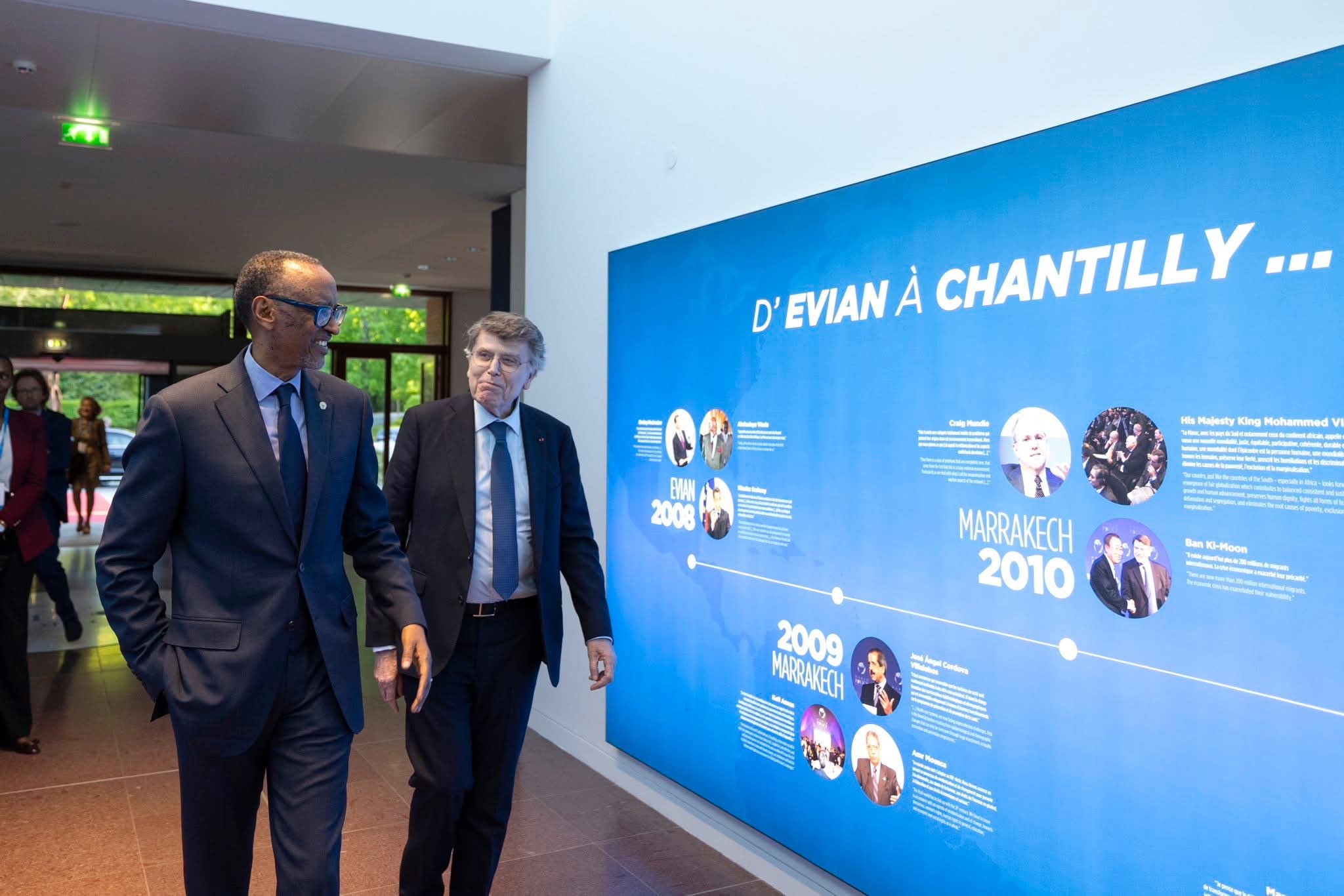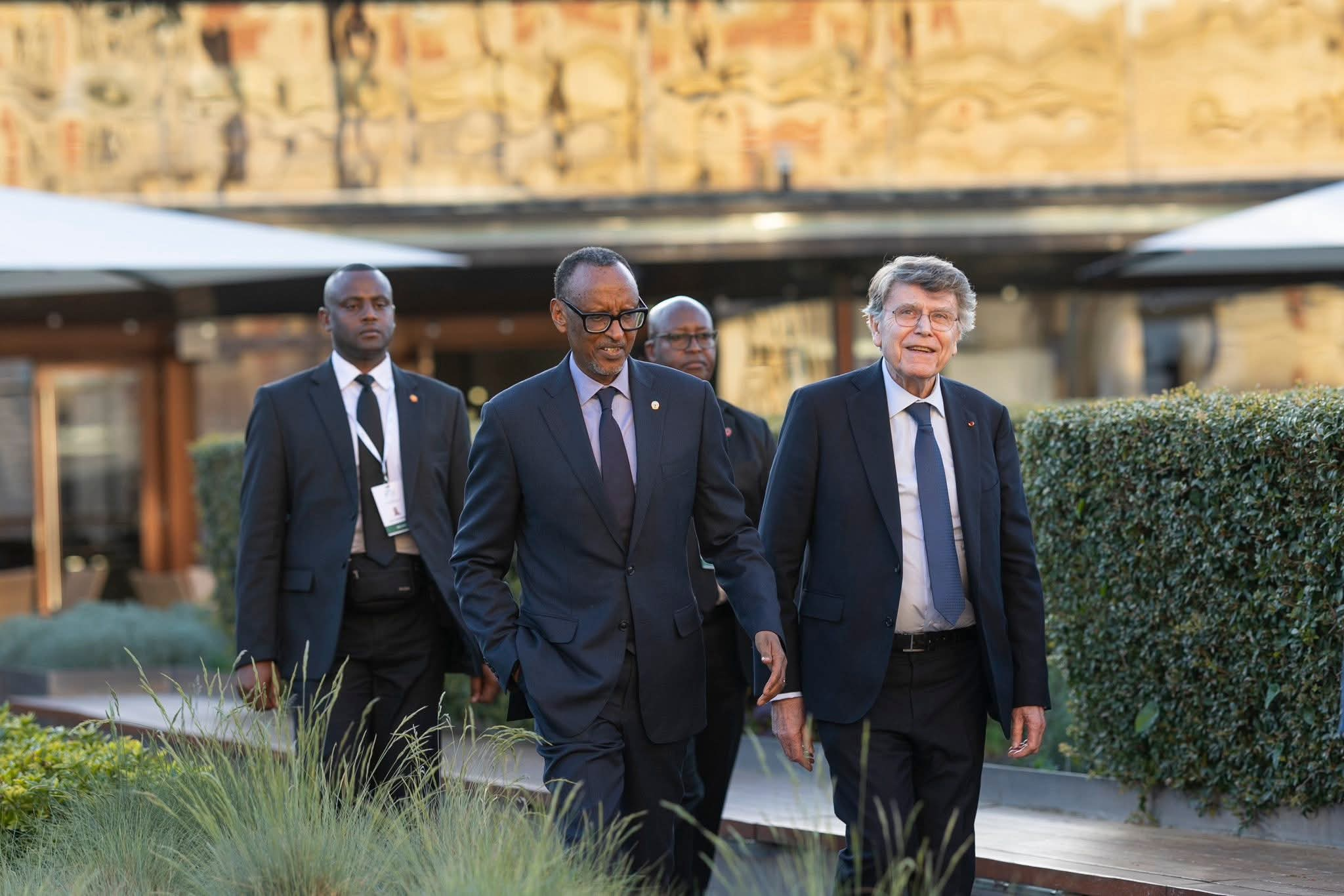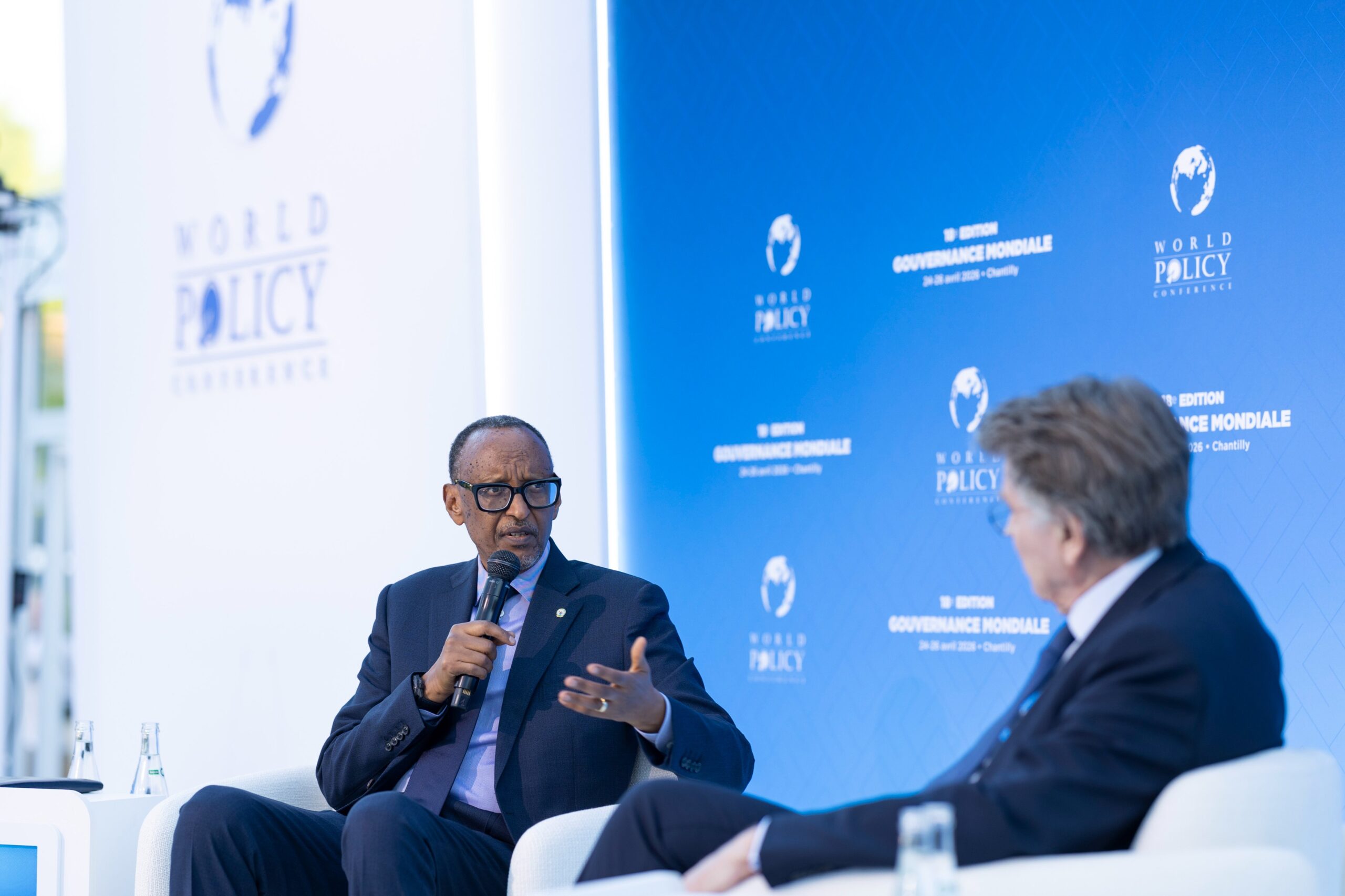
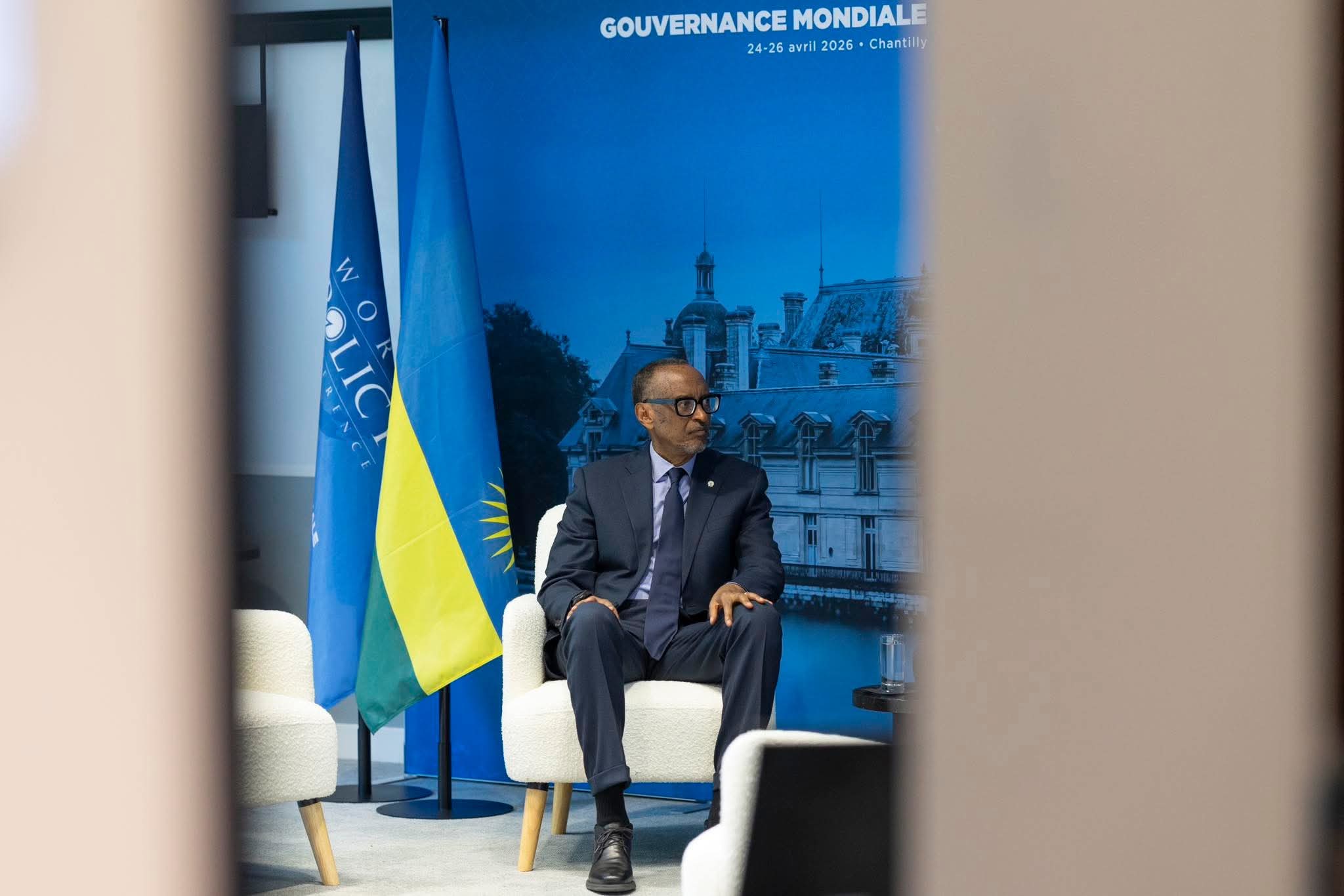
At the World Policy Conference in Chantilly, France, President Paul Kagame joined global leaders, policymakers and experts to discuss governance, development and international cooperation.
Organized by the French Institute of International Relations and led by Thierry de Montbrial, the forum convenes high-level dialogue on global challenges.
Kagame delivered a brief eight-minute keynote address before engaging in a Q&A session with de Montbrial, where he addressed global disorder, power imbalances, regional conflicts and Africa’s role in a shifting international system.
Below is the full question-and-answer session:
Thierry de Montbrial:
Mr. President, we have a few minutes to exchange ideas.
My first question: looking at the increasing chaos in the world today, what are the consequences of this global disorder on Africa—especially your region?
Do you expect increasing problems? I’m also thinking about attempts, including those by President Trump, to address the conflict between the Democratic Republic of Congo and Rwanda.
Paul Kagame:
Looking at the global order, one can only say there is a lot to be done to return to some form of stability.
Even when the world seemed stable over the past four or five decades, many things still needed to change to make that stability more inclusive. It was always a work in progress.
What we see today is not surprising. Inequalities have always existed. Conflicts have always existed. The global system has long assumed that what happens in the Global South is determined by the Global North.
When big powers feel threatened, they act however they want—without accountability. But when smaller countries respond to threats, they face blame, punishment, and criticism.
So the question is: who decides what is right or wrong? Is it simply those with power?
Africa has always been affected—not just now, but even during so-called stable times.
On our region, particularly eastern Congo:
These problems cannot be solved overnight. Crisis resolution requires addressing root causes and allowing time for dialogue that leads to win-win outcomes.
Efforts—whether from Washington or other processes—are ongoing. But sometimes they don’t address root causes and instead reflect competing interests rather than the realities affecting people.
Thierry de Montbrial:
Let me take another example—the current war involving Iran and its effects in the Gulf.
Do you see risks of escalation? Could this destabilize the Gulf region, threaten borders, or reshape the Middle East security structure?
Would that pose a major risk for East Africa?
Paul Kagame:
The situation is already very bad—and it can get worse.
If major powers do not act quickly, this could escalate into a global problem. You already see impacts: oil prices, fertilizer, food costs—affecting hundreds of millions.
These effects will spread across regions. It won’t remain confined.
Small countries like Rwanda—and Africa generally—have little influence over such conflicts, yet we pay a heavy price for them.
Thierry de Montbrial:
Let me end with two related questions about the West.
First, is the “Trump phenomenon” an accident, or does it represent a lasting shift in how the United States governs and views its global role?
Second, what does this mean for Europe? And what role should the European Union play in Africa?
Paul Kagame:
I would speak more about the West as a whole than about Trump specifically.
The West has produced the leaders it has today. It has taken many things for granted—believing it knows everything, decides everything, and that others must simply follow.
What is happening now reflects deeper internal contradictions within Western societies—issues that were ignored but are now surfacing.
For Africa, including Rwanda, we have a difficult history in terms of development and stability.
But we have learned that rebuilding must start from within. In Rwanda’s case, after total destruction, we began by relying on ourselves—even while partnering with others.
Africa has resources, people, and cultural strengths. But too often, we look outward and are told we cannot succeed without external support.
That mindset must be challenged.
We need more cooperation, more mutual respect, and a global system where one side does not decide everything.
People talk about a “rules-based international system”—but who makes these rules?
If the rules were truly respected, we wouldn’t see major powers violating them.
There is a lot of work to do—for everyone.
Even small countries can raise their voices and contribute to shaping a more balanced and stable global environment.
Thierry de Montbrial (Closing):
President, thank you very much.
I would like to thank you for your words—important points that need to be said and repeated.
And I encourage everyone who speaks about Rwanda to visit it. It is truly fascinating.
Paul Kagame:
You’re most welcome. Thank you.