



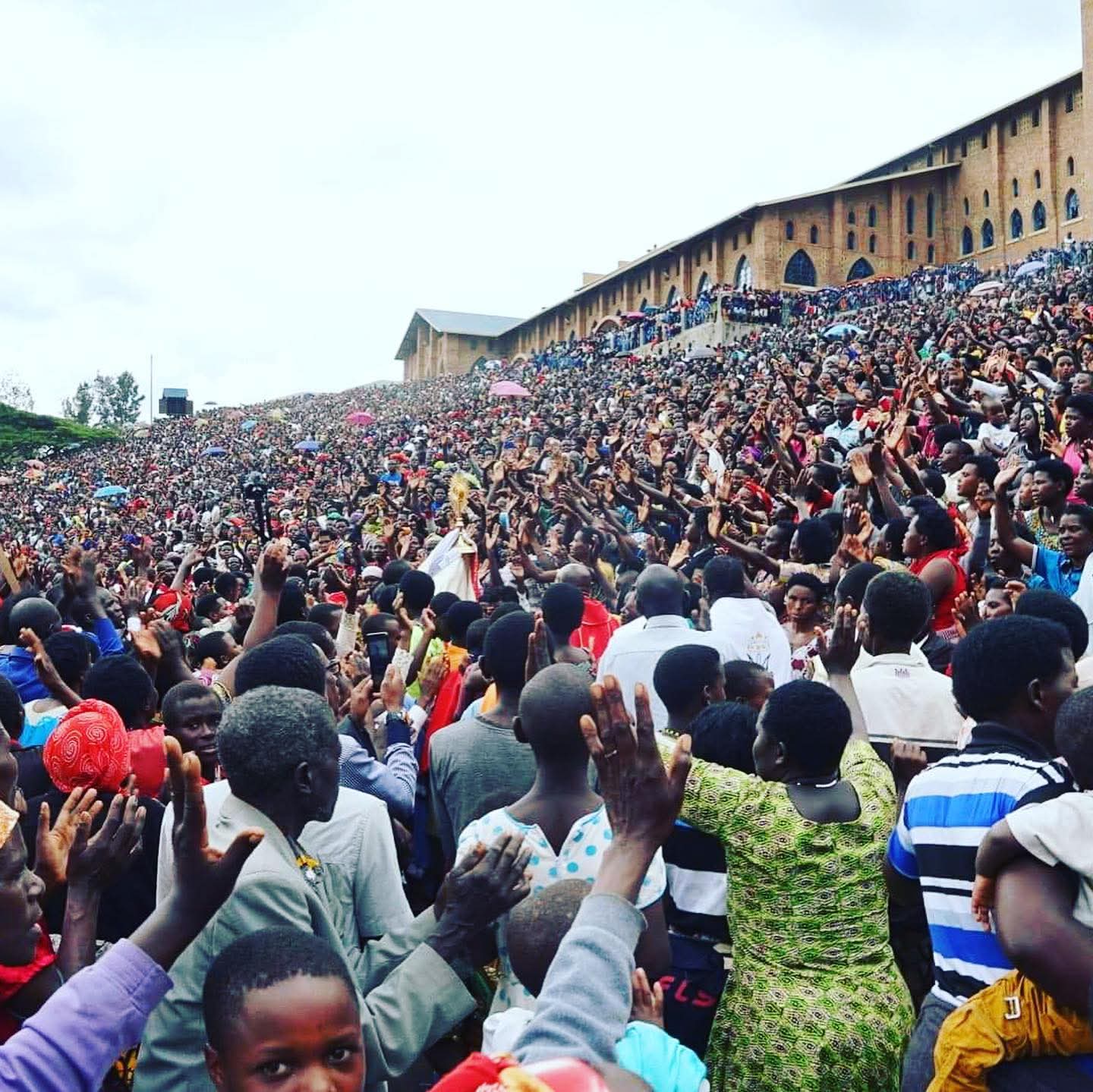
A gathering of Catholic faithfuls in Musanze District, northern Rwanda. The number appear countless as fara as the eye can see, but the state is slowly putting in place systems to know the health of each and everyone
Rwanda’s latest vital statistics report reads from the National Institute of Statistics (NISR), at first glance, like a technical document—dense with rates, ratios and administrative benchmarks.
But beneath the numbers lies a more revealing story: of a state steadily tightening its grip on the fundamentals of governance, even as it navigates the complex social transitions that come with growth.
Start with what might seem mundane: birth registration. In 2025, Rwanda recorded 356,838 births, pushing registration completeness to 92.9 percent, up from 90.3 percent the year before. At such high levels, gains are hard-won.
Reaching the last mile—rural households, delayed registrations, marginal populations—requires not just policy, but administrative precision. That Rwanda is still improving at this level suggests a system that is no longer merely functional, but maturing.
More striking is how quickly the country is building the infrastructure behind these gains. The expansion of its fully digital civil registration system has brought services closer to citizens—from hospitals to village-level administration—while linking birth, death and identity data into a single national architecture.
In effect, Rwanda is constructing a real-time map of its population, one that underpins everything from health planning to economic policy.
A System Under Expansion
Yet progress is uneven, and the report does not hide it. Death registration, long a weak point in many countries, remains incomplete. Though it improved to 50.5 percent in 2025, it still captures only about half of all deaths.
At the same time, the share of deaths registered within the legally required 30 days fell sharply—from 96.3 percent to 89.9 percent, the steepest decline in recent years.
This apparent contradiction—more deaths being recorded, but less quickly—points to a system under expansion.
As registration extends deeper into communities, especially rural ones where deaths often occur outside health facilities, speed becomes harder to maintain.
The trade-off suggests a deliberate shift: prioritizing coverage over timeliness. It is a familiar phase in state-building, where the reach of institutions expands before their efficiency fully catches up.
A Population in Transition
Beyond administration, the demographic signals are equally telling. Fertility continues its gradual decline.
The total fertility rate fell slightly from 3.6 to 3.5 children per woman, while both the crude birth rate and general fertility rate edged downward. These are not dramatic shifts, but they are consistent—and consistency matters.
Rwanda is moving through a controlled demographic transition, lowering fertility without the abrupt disruptions seen elsewhere.
At the same time, the country’s health profile is changing. Non-communicable diseases now account for the largest share of deaths, both in health facilities and in communities. This marks a transition from infectious diseases toward conditions associated with longer lifespans and changing lifestyles.
It is, in many ways, a sign of success.
From Assumptions to Evidence
The quality of health data is improving alongside these shifts. The proportion of deaths in health facilities with clearly defined causes rose sharply, from 64.7 percent to 82.3 percent in just one year.
In a region where cause-of-death data is often incomplete or unreliable, such gains are significant. They allow policymakers to move from assumptions to evidence, targeting resources where they are most needed.
Other indicators point to subtle but meaningful shifts in social behavior.
Registered marriages declined slightly, from 52,878 in 2024 to 50,256 in 2025, suggesting evolving patterns in family formation—whether through delayed marriage, urban pressures, or changing economic realities.
At the same time, 4,479 divorces were recorded, with 2,629 granted by courts during the year, a reminder that as societies modernize, family structures often become more fluid and legally mediated.
Meanwhile, a slight rise in low birth weight underscores the importance of continued vigilance in maternal and child health, even as overall systems improve.
Growth Meets Governance
All of this unfolds against a backdrop of strong economic growth. Rwanda’s economy expanded by 9.4 percent in 2025, continuing a long run of robust performance.
Its population remains young—nearly half under the age of 24—offering the potential for a demographic dividend if jobs and opportunities keep pace.
Taken together, the trends point to a country in transition, but not in turmoil. Rwanda is doing something difficult: expanding the reach of the state while improving the quality of its data, and navigating demographic change without losing stability.
The imperfections—gaps in death registration, delays in reporting—are real. But they are the kind that emerge when systems stretch to include more people, not fewer.
In the end, the report is less about statistics than about trajectory. It shows a government moving beyond basic service delivery toward something more ambitious: the ability to see, measure and respond to its population in near real time.
For a country that, not long ago, struggled with far more fundamental challenges, that alone is a notable shift—and one that may shape its next phase of development.

1 comment
We have a good working government and, more importantly, a visionary leader, who loves his country and his people. Nothing will stop us. Challenges will always be there but we’ll keep improving.
Comments are closed.