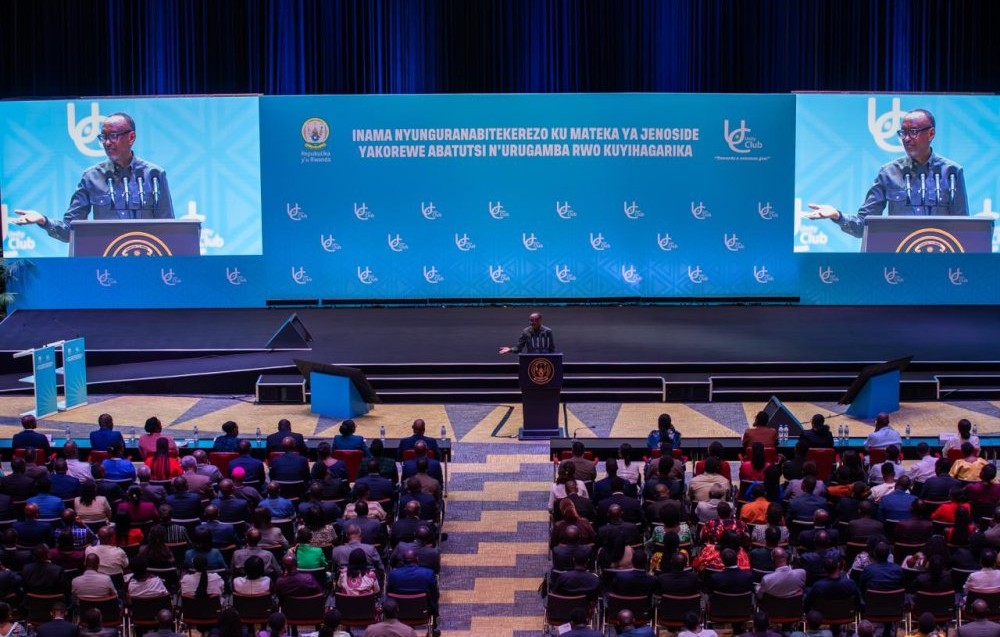
President Kagame speaking Saturday at Intare Conference Arena attended by Unity Club members, senior government officials and other leaders
KIGALI – There came a point during the Rwanda Patriotic Army liberation struggle to stop the 1994 Genocide against the Tutsi when President Paul Kagame told commanders who repeatedly encountered mass graves and scenes of unimaginable brutality, that he was not ready to see them again.
He made the decision after witnessing scenarios of fresh mass graves, entire families killed, and in some cases victims buried while still alive each time, they called him to come and see.
“I told them never to call me again to see. At one point I felt it was enough to tell me what had happened. As the leader, it would affect me, and I feared that my judgement would change,” Kagame said in a chilling revelation.
Speaking during a national forum at Intare conference arena attended by Unity Club members, senior government officials and other leaders, alongside First Lady Jeannette Kagame, the President concurred that even without witnessing the scenes directly, the reports stayed with him.
It was not, he says, an attempt to distance himself from the reality of the genocide but a deliberate choice shaped by a conviction that seeing too much of the horror would alter the judgement required of a commander leading a war meant to stop mass killings.
“I would put myself in the shoes of the victims and wonder how angry or how bad a person had to be to do that,” Kagame recalled.
Beyond Victims and Perpetrators
But amid the brutality, Kagame said another question of what kind of country could emerge after such destruction followed him throughout the struggle.
He thought not only about survivors, but also about those who had neither participated in the killings nor lost relatives.
“I thought those who were not victims should come and be part of us. But we also had to change in order to accommodate them,” he noted.
That thinking would later shape Rwanda’s post-genocide path, rebuilding a single society rather than a permanently divided one.
Former refugees were reintegrated. Children from families associated with the genocide were allowed to return, grow up, and in some cases later serve in leadership roles.
“We did this in the interest of the country so that future generations would never go through the same history,” the Head of State said.
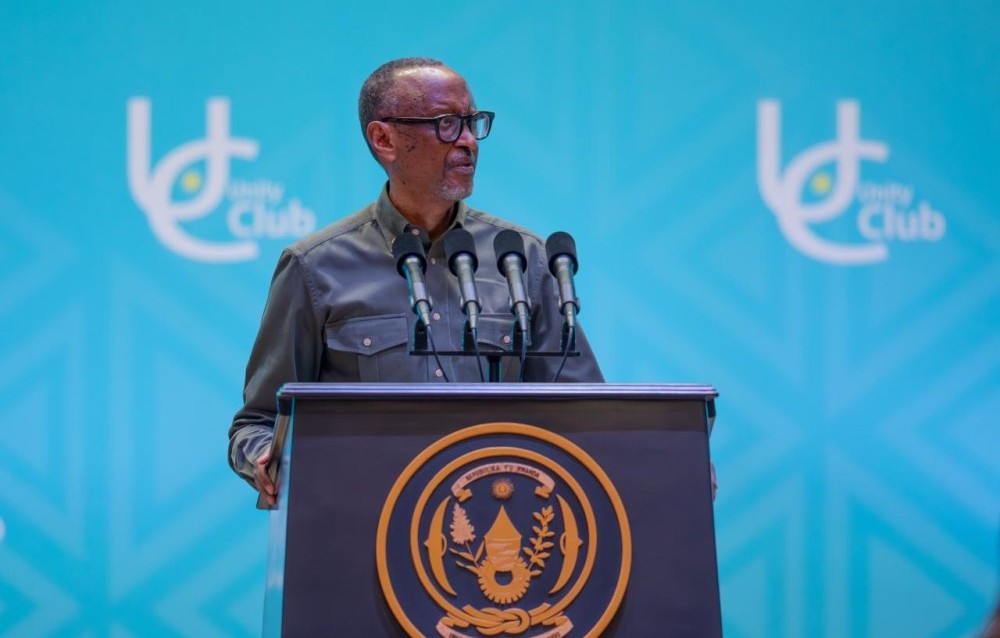
President Kagame addressing leaders at Intare Conference Arena attended by Unity Club members.
Silence is Not Innocence
Kagame also turned his attention to those who often describe themselves as innocent simply because they did not actively participate in the genocide. “If you did not participate, be thankful. But don’t brag about it.”
He warned against confusing silence with morality. “If you are at work and you see bad things happening and you keep quiet, it doesn’t mean you are good. It may mean that, given the opportunity, you could do the same.”
Excuses rooted in fear, he added, are not enough. “What did you fear? You should have feared keeping quiet instead.”
For Kagame, the lesson is simple but uncomfortable: societies do not collapse only through action, but also through the silence of those who watch wrongdoing unfold.
A Childhood Memory That Changed the Tone
After the weight of those reflections, Kagame shifted unpredictably. He recalled his childhood preparation for Catholic confirmation, when he was required to go to confession.
There was only one problem.
“I kept asking myself what I should confess because I hadn’t done anything.”
The room broke into laughter as he admitted that he eventually began inventing sins just to satisfy the requirement. But he quickly turned the humor into a lesson. “That is not confession,” he warned.
True confession, he said, is not a ritual. It is the courage to admit wrongdoing honestly and directly, without performance or pretense. It is also what makes healing possible for individuals and for societies, according to him. “It heals the soul,” he said.
He thanked those who have openly confessed their role in the genocide during reconciliation processes, saying such honesty strengthens national recovery rather than undermining it.
Looking back, Kagame described Rwanda as a country that has experienced both humanity’s worst destruction and an extraordinary effort at renewal.
Its recovery, he suggested, was not achieved by forgetting the past, but by making difficult choices of resisting anger, rejecting silence, and prioritizing reconciliation over revenge.