


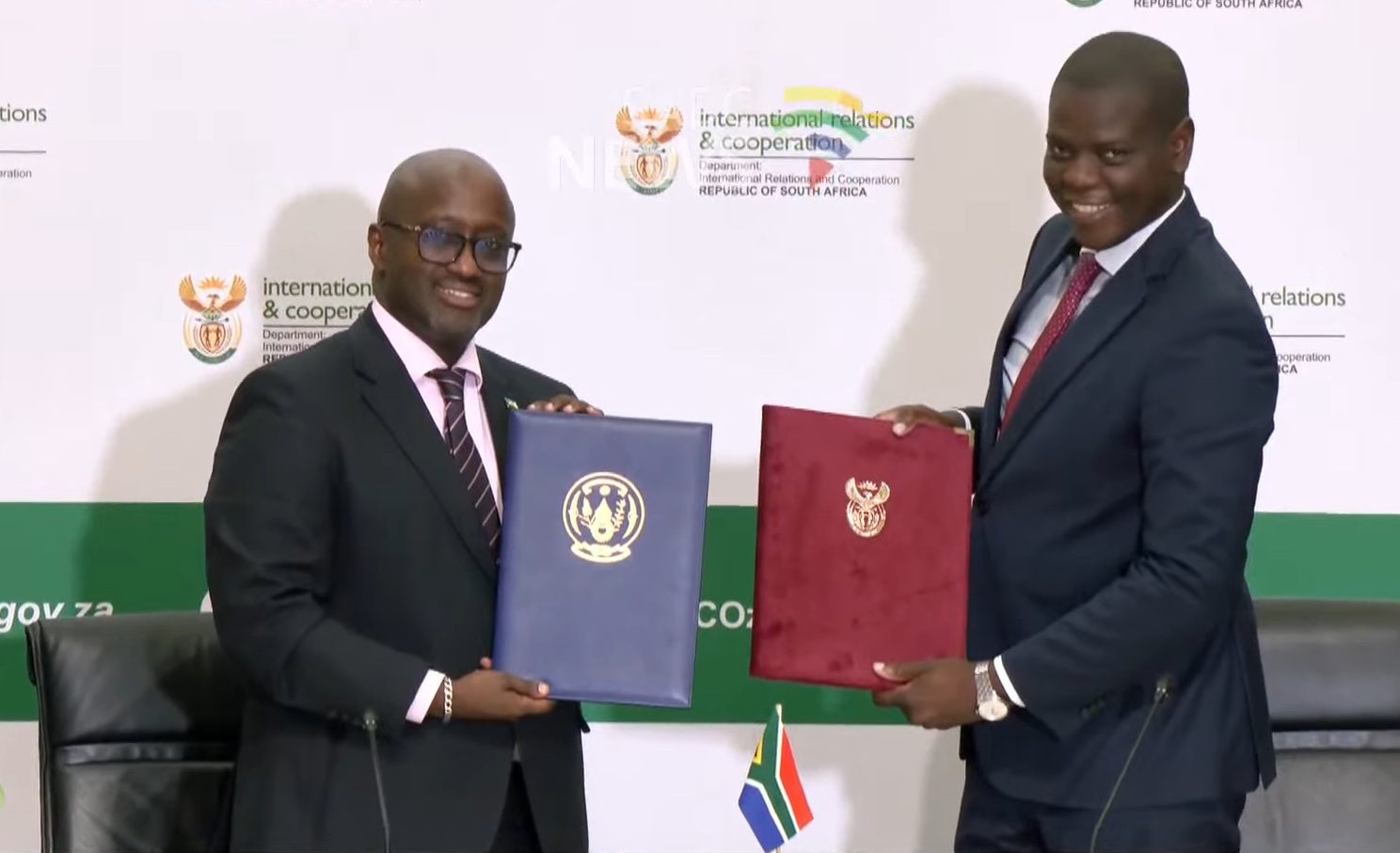
Rwanda’s Minister of Foreign Affairs and International Cooperation Olivier J.P. Nduhungirehe (Left) and South Africa’s Minister of International Relations and Cooperation, Ronald Lamola
PRETORIA, South Africa — Rwanda and South Africa have agreed to begin restoring visa access for ordinary Rwandan passport holders by mid-2027, marking a major step in the normalization of relations between the two countries after more than a decade of strained diplomatic ties.
The announcement followed high-level bilateral talks held in Pretoria on Wednesday, 17 June 2026, between South Africa’s Minister of International Relations and Cooperation, Ronald Lamola, and Rwanda’s Minister of Foreign Affairs and International Cooperation Olivier J.P. Nduhungirehe.
The meeting is part of an ongoing diplomatic effort to rebuild relations that deteriorated in 2014, when restrictions were imposed that effectively halted travel for Rwandans to South Africa amid worsening political tensions.
The 2026 engagement was described by both sides as a “reset” moment, with discussions focusing on rebuilding cooperation across trade, tourism, health, education, security, and broader regional engagement.
Following closed-door deliberations, the two ministers signed a joint communiqué outlining a roadmap for restoring bilateral cooperation and institutional engagement mechanisms.
The communiqué underscored political backing from both heads of state—President Cyril Ramaphosa and President Paul Kagame—in guiding the renewed diplomatic process and reaffirmed what it described as a shared historical trajectory shaped by liberation struggles and post-conflict rebuilding.
It referenced the parallel histories of apartheid in South Africa and the 1994 genocide against the Tutsi in Rwanda, framing the renewed relationship as grounded in shared resilience and a responsibility to contribute to peace, stability, and development on the continent.
The two governments agreed to revive and strengthen the Joint Commission for Cooperation (JCC), originally established as a structured platform for bilateral engagement across political, economic, social, cultural, educational, and scientific sectors. Rwanda is expected to host the next session of the revived JCC in the first quarter of 2027.
A key outcome of the talks was agreement on the phased resumption of visa issuance for holders of ordinary Rwandan passports travelling to South Africa, to be implemented within 12 months of the agreement’s operationalization, effectively pointing to mid-2027 as the expected timeline for full access.
President Cyril Ramaphosa and President Paul Kagame are also scheduled to meet at a later date to be agreed on via existing diplomatic communication channels.
The communiqué also highlighted plans to expand cooperation in investment and trade, including increased engagement between state-owned and private sector actors in both countries. Regular exchange visits, joint exhibitions, and participation in major continental forums were also encouraged.
Both sides commended existing collaboration in sectors such as tourism, wildlife conservation, hospitality, higher education, science and technology, and health research.
Events including Africa’s Travel Indaba, Meetings Africa, the Africa CEO Forum, and the International AIDS Society Conference were cited as examples of growing people-to-people and institutional exchange.
While acknowledging that relations had experienced “interruptions and setbacks” in recent years, the ministers said the Pretoria meeting marked meaningful progress toward full normalization.
They further committed to deepening cooperation in infrastructure development, regional integration corridors, justice systems, and economic partnerships, while also strengthening mechanisms for political consultations and technical coordination.
The ministers also exchanged views on regional and global security issues, including conflicts in eastern Democratic Republic of Congo, Sudan, South Sudan, Somalia, and instability in the Sahel region.
Both sides emphasized the need for peaceful resolution of disputes through dialogue and mediation, and called for stronger African-led security frameworks, including the operationalization of the African Standby Force.
They expressed concern over the worsening situation in South Sudan and reaffirmed support for ongoing peace processes under regional and continental mechanisms.
On global governance, the two countries noted the increasing instability of the international system and called for reforms to strengthen institutions such as the United Nations, arguing for broader representation and inclusivity.
The ministers concluded by reaffirming their commitment to regular consultations and confirmed that the next JCC session will be held in Rwanda in early 2027, with continued diplomatic engagement expected between the two heads of state to guide the process.
The implementation of visa resumption, however, remains subject to follow-up technical work and phased diplomatic coordination in the months ahead.
