



When Burundian President Evariste Ndayishimiye assumed the chairmanship of the African Union on February 14, he inherited a role designed to embody Africa’s commitment to unity, solidarity, and collective security. As AU chair, he is expected to champion peace and uphold the African Charter on Human and Peoples’ Rights.
Yet Burundi’s deepening military involvement in the Congolese civil war casts a long shadow over these noble objectives, raising fundamental questions about the credibility of its leadership at the helm of the continent’s premier political body.
The DRC government, with which Burundi is allied, stands accused by numerous Congolese voices, including civil society organizations and political actors, of conducting a genocidal campaign against Congolese Tutsi, particularly the Banyamulenge community in South Kivu, a province that shares a border with Burundi.
This raises a critical question: how does one reconcile the role of AU chairman with a controversial military intervention in one of Africa’s most complex and intractable crises?
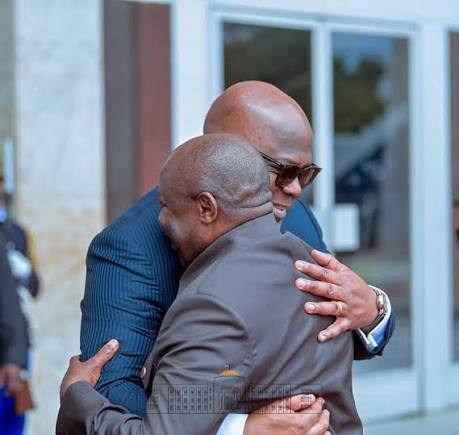
DR Congo President Félix Tshisekedi and Burundi counterpart Evariste Ndayishimiye hug at a previous meeting.
The AU chairman is expected to advance peace across the continent’s conflict zones, driving the AU’s “Silencing the Guns” agenda in Sudan, the Sahel, and the Great Lakes region.
Sadly, under Ndayishimiye’s watch, there has been no meaningful AU initiative to address the devastating war in Sudan, the escalating insurgencies in the Sahel and Mali, or the many other crises crying out for continental leadership.
Instead, for over two years, Burundian troops have been deployed in eastern Democratic Republic of Congo, fighting alongside the Congolese army against the AFC/M23 rebellion. UN reports estimate that as many as 10,000 Burundian soldiers have been operating in the conflict zone.
Banyamulenge civil society organizations in exile have accused these troops of committing war crimes, including the imposition of a blockade on the Banyamulenge community in Minembwe, South Kivu, cutting off access to food and medicine.
To complicate matters further, Kigali has repeatedly alleged that Burundian forces are fighting side by side with the FDLR, a United Nations and United States sanctioned terrorist group founded by perpetrators of the 1994 Genocide against the Tutsi.
Remarkably, these tensions between Rwanda and Burundi have provoked no official reaction from the AU or, for that matter, from the East African Community.
There is more. Whether wittingly or unwittingly, Ndayishimiye’s attempts to position himself as a mediator actively undermine the AU’s own mediation efforts. He recently invited Congolese opposition figures to Bujumbura, including Martin Fayulu, Delly Sesanga, and Jean-Marc Kabund, ostensibly to organize an “inter-Congolese dialogue.”
Meanwhile, the AU mandated mediation led by Togolese President Faure Gnassingbé continues, with Ndayishimiye effectively sidelining it. Many observers have questioned whether this is how the AU is supposed to function.
On a related note, this is not the first time Ndayishimiye has overstepped. In March, he attempted to bypass normal procedures and impose former Senegalese President Macky Sall as Africa’s candidate for UN Secretary General. The move was rejected by some 20 AU member states, with Rwanda condemning it as a “gross breach of procedure.”
Suffice it to say that Ndayishimiye’s position is untenable. He must choose: either resign as AU chair or step away from the conflict. He cannot have it both ways. He cannot enjoy the privilege of being both referee and player.
The AU’s professed values of unity, solidarity, and “silencing the guns” ring hollow when its chairman is actively participating in the Congolese civil war while simultaneously using his position to assist his ally Tshisekedi in placating the opposition.
In practical terms, it is time for the official mediators, including Americans, Qataris, and AU designated facilitators, to impose order on the peace processes currently underway. The fragmentation of mediation efforts only serves the interests of those who benefit from the status quo.
As recent fighting in Minembwe, where Burundian troops were directly involved, makes clear, the risk of this war spilling into Burundi is real and growing.
The question for the continental body is whether it can afford such a development.
