



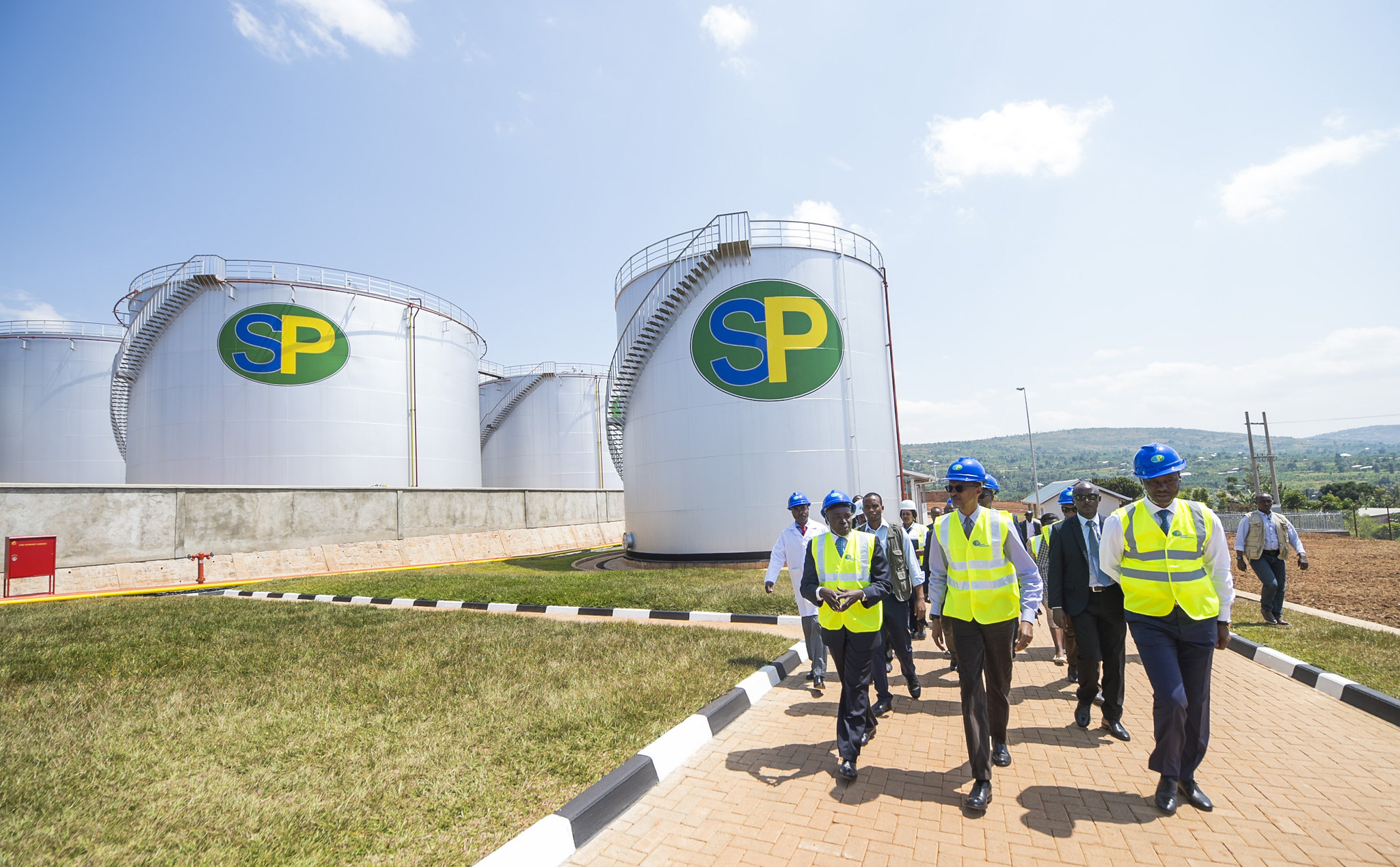
Inauguration by President Paul Kagame of the SP Rusororo Fuel Depot | Gasabo District, 11 June 2016. It is one of the country’s strategic storage facilities
KIGALI – For a small, landlocked country that imports every litre of fuel it consumes, few issues are more critical than how quickly fuel can reach the country and how much can be stored once it arrives.
Rwanda is seeking to strengthen both by opening two new government-backed fuel import corridors—one through Tanzania and another through Kenya—in a bid to reduce supply risks after months of volatility in global oil markets.
The two arrangements represent one of the most significant changes to Rwanda’s fuel import strategy in years, giving the government greater control over procurement, transport and storage while diversifying the country’s supply routes.
Two Deals, Two Corridors
The first arrangement, disclosed by Prime Minister Dr. Justin Nsengiyumva during an address to Parliament on July 9, routes bulk fuel imports through the Tanzanian port of Tanga.
An initial shipment of 40,000 tonnes—equivalent to roughly 47 million to 54 million litres, depending on the fuel mix—is expected to arrive by the end of July, with additional monthly shipments planned thereafter.
Rwanda separately signed an agreement with Tanzania on July 3 to import petrol and diesel through the Port of Tanga. The agreement, between the Rwanda National Energy Company (RNEC) and Gulf Bulk Petroleum Tanzania Limited, provides the framework for the new supply route.
The second, larger arrangement was signed on June 29, when Rwanda and Kenya established a government-to-government framework allowing Rwanda to import refined petroleum products through the Port of Mombasa, using Kenya’s pipeline network and fuel storage infrastructure.
The framework replaces previous commercial procurement arrangements with direct government purchasing, enabling Rwanda to import fuel in bulk while relying on Kenyan infrastructure for transport and storage.
Under the agreement, fuel volumes moving through the Northern Corridor are projected to increase from about 42,000 to 50,000 cubic metres in 2025 to more than 500,000 cubic metres—about 500 million litres—annually.
The first cargo under the new framework, designated RNEC 001/2026, is expected to dock at Mombasa between September 4 and 6.
Kenya has also agreed to extend the amount of time Rwandan government fuel cargoes can remain in Kenya Pipeline Company storage facilities from the standard 35 days available to commercial oil marketers to as long as 90 days.
The longer storage period gives Rwanda greater flexibility to build strategic reserves and manage fuel stocks during periods of market volatility or supply disruption.
Expanding Import Capacity
Rwanda consumes an estimated 730 million litres of refined petroleum products each year.
The Kenya agreement alone is expected to provide more than 500 million litres annually once fully implemented.
Combined with the Tanzania arrangement—which, if sustained at one 40,000-tonne shipment each month, could deliver between 560 million and 650 million litres annually—the two corridors would eventually exceed Rwanda’s current annual fuel consumption.
Government says the import volumes will increase gradually over time as demand continues to grow.
Despite the new routes, the Dar es Salaam corridor is expected to remain Rwanda’s principal gateway for general cargo, with more than 70 percent of imports continuing to pass through Tanzania.
The Kenya and Tanga arrangements therefore complement rather than replace existing logistics networks, providing dedicated government-controlled channels specifically for petroleum imports.
Reducing Exposure to Global Shocks
The new agreements follow months of turbulence in global energy markets.
Earlier this year, crude oil prices rose from about US$70 to more than US$126 a barrel amid conflict involving the United States and Iran and renewed disruption around the Strait of Hormuz, pushing international petrol and diesel prices up by nearly half.
The surge forced Rwanda’s government to spend nearly Rwf48 billion between March and June to subsidise diesel prices and shield consumers and businesses from the full impact of rising fuel costs.
The episode highlighted Rwanda’s vulnerability as a landlocked country that depends entirely on imported petroleum products. Disruptions affecting ports, shipping routes, pipelines or suppliers can quickly translate into higher transport costs, food prices and inflation.
Diversifying supply routes, suppliers and storage facilities cannot shield Rwanda from global crude oil prices, but it can reduce logistical risks by ensuring the country has alternative import channels if one route experiences disruption.
Rwanda’s recent investment in the Kenya Pipeline Company, acquired after the company listed on the stock exchange in March 2026, further strengthens cooperation between the two countries, while the extended 90-day storage period provides additional flexibility to build strategic fuel reserves.
Strengthening Energy Security
The new agreements do not insulate Rwanda from international oil prices, which remain determined by global markets.
Bulk government procurement can help smooth price volatility and secure more favourable purchasing terms, but it cannot eliminate the effects of sustained increases in crude oil prices.
Both arrangements are also new and will depend on effective coordination between governments, infrastructure operators and suppliers as they move from planning to implementation.
The agreements nevertheless represent a significant step in Rwanda’s broader effort to strengthen energy security through diversified supply routes, expanded storage capacity and direct government procurement.
While they cannot prevent future increases in global oil prices, they are expected to improve the country’s ability to manage supply disruptions and respond more effectively to external shocks.
