



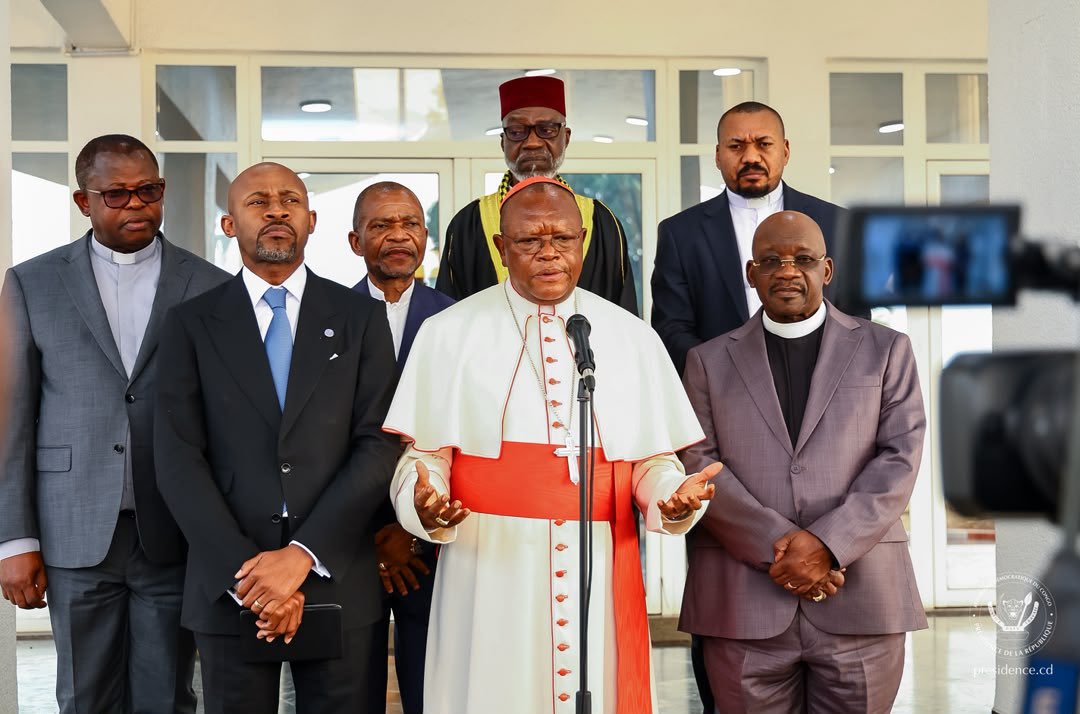
Cardinal Ambongo and other clergy issued a statement after meeting Tshisekedi.
KINSHASA, Democratic Republic of Congo — After months of resisting calls for broad political talks, President Félix Tshisekedi on Friday embraced the idea of an inclusive national dialogue, a move that comes as his government faces mounting political pressure in the capital and an increasingly precarious security situation in the country’s east.
The decision followed a meeting at the Cité de l’Union Africaine with leaders of the Democratic Republic of Congo’s main religious denominations, among them Cardinal Fridolin Ambongo of the Catholic Church, who has emerged as one of the country’s most influential voices for dialogue.
Government said a roadmap outlining the process would be released in the coming days.
Speaking on behalf of a delegation that included Catholic, Protestant, Evangelical and Muslim leaders, Cardinal Ambongo welcomed the announcement.
“We rejoice in this announcement and express our gratitude to the Head of State,” he said, describing the initiative as an opportunity to foster peace and unity among “all the sons and daughters of the Congo.”
The announcement represents a significant shift for Tshisekedi, whose administration had repeatedly resisted appeals by the National Episcopal Conference of Congo (CENCO) and other religious leaders for an inclusive political process.
The dispute had intensified over the government’s proposal to amend the Constitution, a plan critics argued could deepen divisions in a country already strained by armed conflict and political polarization.
In a June 19 statement titled The Nation Is in Peril, CENCO argued that constitutional revision lacked “necessity, urgency or opportunity” and warned that pursuing it while large parts of eastern Congo remained beyond government control carried serious risks.
“In a context where political rivalries take on ethnic and tribal connotations, the outbreak of another civil war is to be feared,” the bishops wrote.
The statement prompted a sharp response from supporters of the ruling Union for Democracy and Social Progress (UDPS). Members of the party’s youth movement, Force du Progrès, demonstrated outside CENCO headquarters, burning tires and displaying messages in support of the president and constitutional reform.
Some government allies also accused church leaders of advancing positions that indirectly benefited Rwanda, which Kinshasa accuses of supporting the AFC/M23 rebellion.
Government spokesman Patrick Muyaya said the proposed dialogue should help build what he described as a “united home front” against “Rwandan aggression,” adding that those taking part should share a common commitment to defending the country.
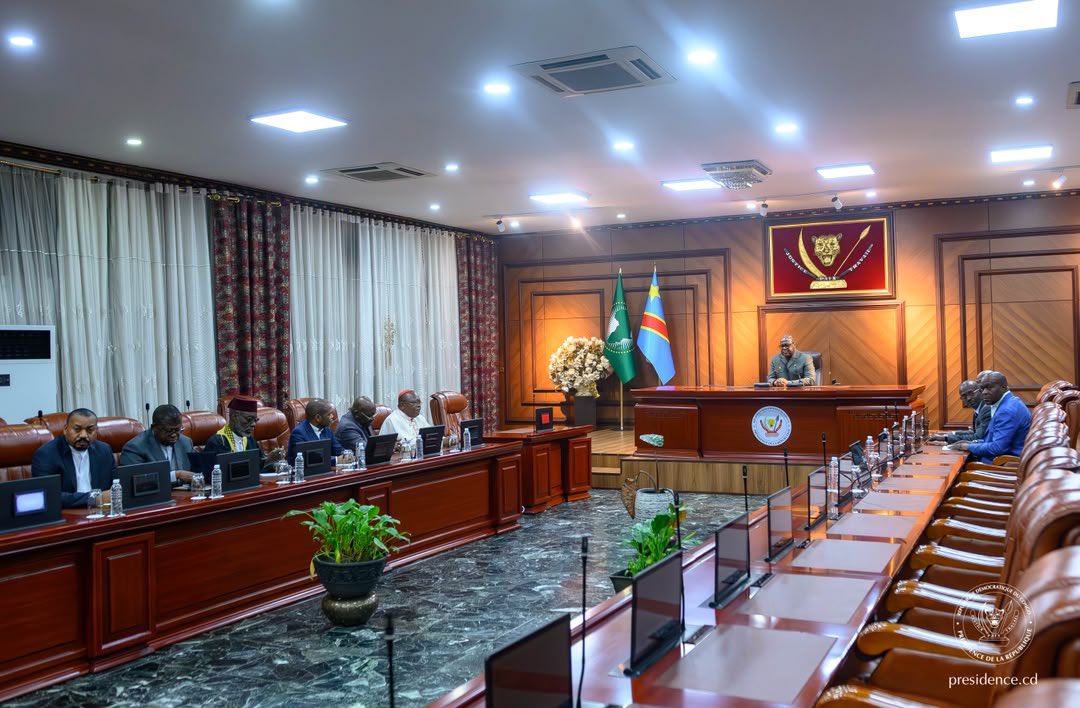
Tshisekedi is expected to formalize the initiative through a presidential ordinance.
The announcement also comes as opposition parties prepare demonstrations scheduled for July 22.
The C64 coalition, which includes Martin Fayulu and Moïse Katumbi, has said it will only participate in dialogue if the government abandons plans for constitutional reform, releases political prisoners and guarantees political freedoms.
The political uncertainty unfolds against the backdrop of a worsening conflict in eastern Congo, where the AFC/M23 coalition controls significant territory in North and South Kivu despite regional mediation efforts.
Fighting has continued in recent weeks, displacing civilians and complicating diplomatic initiatives aimed at ending the conflict.
Whether the proposed dialogue can narrow Congo’s widening political divisions may depend not only on who takes part, but also on whether it convinces deeply skeptical opponents that it is intended to produce compromise rather than political advantage. For a country confronting both war and domestic tensions, the stakes are considerable.
