



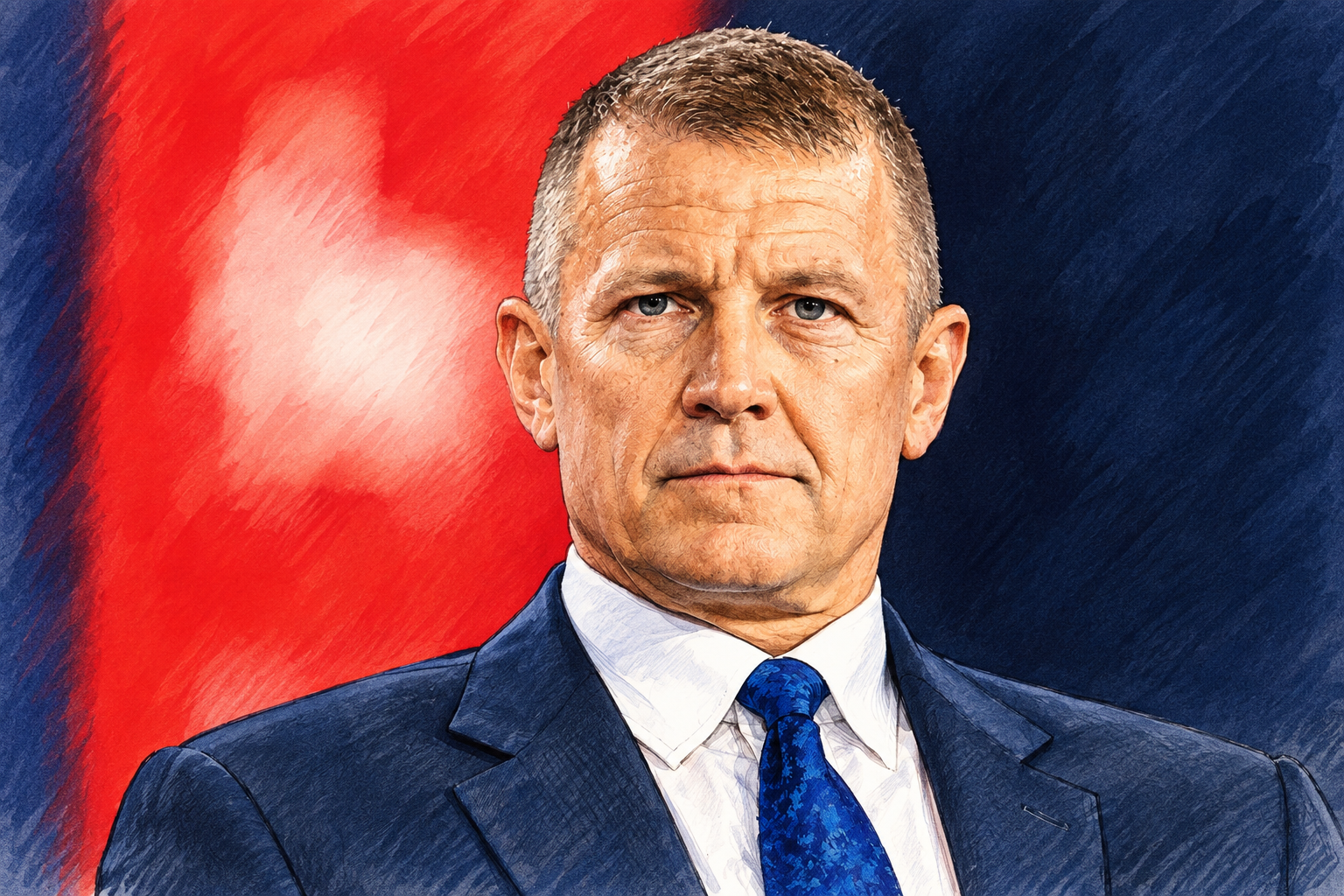
KIGALI — Erik Prince, the American private military contractor who has called for the United States to resume colonial rule over African countries, is expanding his role in the Democratic Republic of Congo (DRC), where a deadly ambush has exposed the risks facing his latest mercenary operations.
Prince, founder of the controversial private security company Blackwater, has secured a major contract with the government of Congolese President Félix Tshisekedi to provide security and mining services. His operations now include deploying drones and foreign military contractors to support the Congolese army against the AFC-M23 rebel movement in the country’s east.
But the latest deployment has suffered casualties, including the death of a former New Zealand special operations soldier and the serious injury of Tim Kennedy, an American former Green Beret known for his mixed martial arts career and television appearances.
The developments, reported by The New York Times on October 9, 2026, have drawn fresh attention to Prince’s growing influence in a conflict that has attracted competing military, political and commercial interests.
They also revive questions about the views of a man who has openly advocated a return to colonial rule in Africa.
‘Absolutely, yes’
In a 2024 podcast interview, Prince argued that the United States should take direct control of countries whose governments he considers incapable of governing themselves.
“If so many of these countries around the world are incapable of governing themselves, it’s time for us to just put the imperial hat back on, to say, we’re going to govern those countries,” he said.
He extended that argument to the African continent, declaring that “pretty much all of Africa” was incapable of governing itself.
When his podcast co-host raised the possibility that listeners would interpret his position as support for colonialism, Prince responded: “Absolutely, yes.”
The remarks amounted to an explicit endorsement of a colonial approach to governance, rather than simply a call for stronger American engagement with African countries.
Prince has also argued that African governments are failing their populations through corruption and the mismanagement of national resources. His proposed response, however, is for the United States to assume governing authority in countries he considers unable to manage their own affairs.
The comments are particularly significant given his business interests in countries where foreign security operations intersect with valuable natural resources.
A major role in Congo’s war

Prince’s growing involvement in Congo follows a contract signed in late 2024 to provide security and mining services to Tshisekedi’s government.
According to the New York Times, the five-year agreement was worth hundreds of millions of dollars, although the amount paid under the contract was unclear.
Through Vectus Global, the company leading his operations in Congo, Prince has supplied drones and foreign contractors to support the Congolese government’s military campaign against AFC-M23, which has captured significant territory in eastern Congo.
The operations have included drone strikes carried out by Colombian and Ukrainian pilots contracted by Prince. His forces also helped Congolese troops recapture the strategic city of Uvira in January, according to the newspaper’s report.
The arrangement comes as Kinshasa struggles to contain the conflict in the east and seeks additional military capabilities beyond those available through its own armed forces.
It also coincides with Washington’s efforts to expand American companies’ access to Congo’s mineral wealth, particularly critical minerals such as cobalt, in a sector where Chinese businesses have established a strong presence.
In December 2025, the United States and Congo signed an agreement intended to give American mining interests preferential access to opportunities in the country. Some Congolese officials privately described the arrangement as a “peace for minerals” deal, according to the New York Times.
Prince’s contract therefore places him at the intersection of Congo’s security needs and the broader competition over its natural resources.
Deadly setbacks in eastern Congo
Prince’s operations have faced serious difficulties in the country’s eastern highlands, where fighting between Congolese government forces and armed groups has intensified.
The New York Times reported that several Colombian contractors were killed in a battle in the Minembwe Highlands early in September 2026.
On September 17, another group of mercenaries accompanying Congolese soldiers was caught in an ambush. Kennedy was shot several times, while Justin Conaglen, a former member of New Zealand’s special operations forces, was killed alongside other personnel.
The circumstances of the ambush remained unclear in the newspaper’s account. A person briefed on the incident described it as a “long ordeal” that was made worse by a lack of support from Congolese forces.
Kennedy was evacuated through Burundi to South Africa, where he received treatment at a private hospital in Johannesburg. He was subsequently flown to the United States to continue his recovery at Walter Reed National Military Medical Center.
New Zealand’s foreign ministry confirmed that it was providing support in connection with Conaglen’s death but declined to disclose further details.
Prince and a spokesman for Vectus Global declined to comment to the New York Times on the operations described in its report.
The casualties have raised further questions about the effectiveness of the foreign military contractors employed by Congo, as well as the risks involved in relying on private forces to conduct operations in difficult and volatile terrain.
Sean McFate, a former private military contractor and fellow at the Atlantic Council, criticised Prince’s record, saying that among mercenaries operating in Africa, “Prince is derided because he has zero successful missions.”
Zobel Behalal, who has written about mercenaries in Congo, warned that the government’s reliance on Prince could create more problems than it solves.
“It’s a sign that the army is very weak. And while others are making money, in the end it’s the population that suffers,” Behalal said.
From military operations to mineral revenues
Prince’s work in Congo extends beyond the battlefield.
His company employs about 100 people in an effort to help the government recover some of the estimated $3 billion in annual tax revenue that Congo loses through fraud in its mining sector, according to the New York Times.
The initiative includes plans to digitise mining records, identify widespread fraud and improve the collection of taxes owed to the state.
An employee of Prince described the effort as a campaign against what he called the “blatant looting” of Congolese resources by criminal networks, including some Chinese mining companies.
The initiative is led by a former French Foreign Legion soldier operating from a financial centre in Kinshasa.
Prince has also been negotiating with Congolese officials over a possible $200 million contract to protect the country’s air force assets, according to an adviser to Tshisekedi cited by the newspaper.
Separately, he has been promoting Vectus Air Defense Systems, a company selling anti-drone technology intended to protect sensitive infrastructure, including oil fields and data centres.
These activities illustrate the breadth of his interests in Congo, spanning military contracting, security technology and the administration of mineral-related revenues.
A controversial record
Prince’s role in Congo builds on a long history of private military ventures that have attracted controversy.
Blackwater became internationally notorious following the killing of Iraqi civilians by its personnel in Baghdad in 2007. Prince has also faced scrutiny over other overseas operations, including activities in Libya and Somalia.
In Libya, his mercenaries had to flee by speedboat in 2019 following a dispute with the warlord who had hired them. In Somalia, United Nations investigators accused his forces of violating an international arms embargo in 2012.
His views on colonialism have added another dimension to the controversy surrounding his activities.
In the 2024 podcast interview, Prince argued that the United States should abandon its reluctance to exercise direct control over foreign countries and instead resume an imperial role.
His response to the suggestion that such a policy amounted to colonialism was unequivocal: “Absolutely, yes.”
For critics, the combination of those views and his expanding role in Congo raises questions about the relationship between private military power, foreign access to natural resources and the sovereignty of African states.
American officials have said Prince’s business ventures in countries such as Congo are private operations and do not receive support from the US government.
Prince is a prominent supporter of US President Donald Trump and has used his political connections to advance his business interests. His sister, Betsy DeVos, served as education secretary during Trump’s first administration.
The New York Times reported that Prince met Belgium’s top Africa diplomat, Marc Pecsteen de Buytswerve, at the residence of the US ambassador in Belgium in January 2026. During the meeting, Prince sought assistance in retrieving drones impounded by Dutch customs and requested Belgian authorisation for the export of firearms and ammunition to Congo. Both requests were rejected, according to European officials cited by the newspaper.
Prince’s ambitions in Congo are unfolding amid a conflict with devastating consequences for civilians and a wider contest over the country’s security and mineral resources.
His operations may offer the Congolese government additional military and revenue-collection capabilities. But the casualties among his contractors, the questions surrounding his effectiveness and his explicit support for colonial rule place his expanding role under intense scrutiny.
