


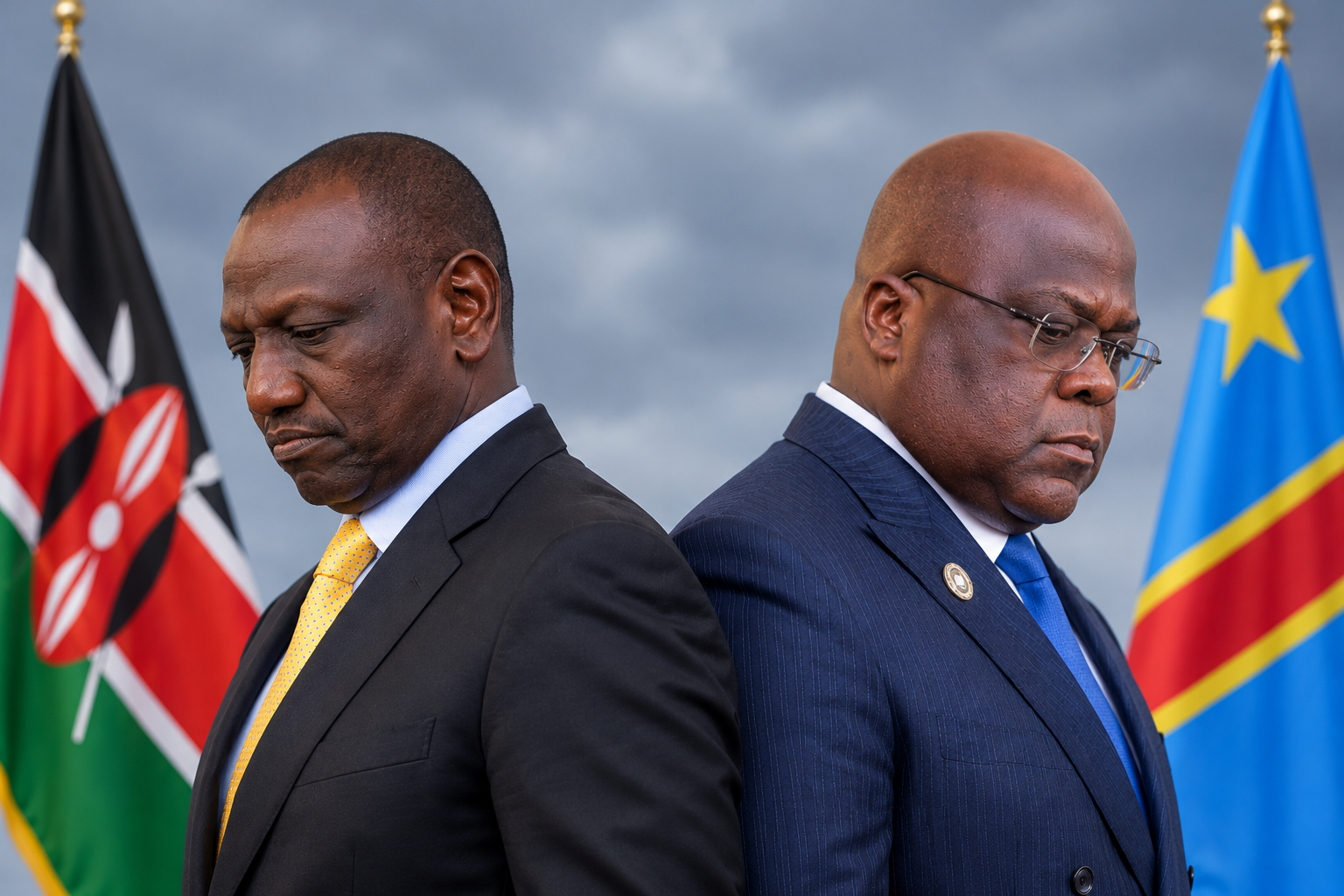
Kenyan President William Ruto and DR Congo counterpart Felix Tshisekedi
When President William Ruto and his Congolese counterpart, Félix Tshisekedi, sat down in Oyo on Sunday, 22 November, under the mediation of Republic of Congo President Denis Sassou-Nguesso, the cameras captured warm handshakes and talk of African solidarity.
But behind closed doors lay a stubborn reality that had poisoned relations between Nairobi and Kinshasa for nearly five years: in Tshisekedi’s diplomatic playbook, disagreement is treated as betrayal, neutrality as taking sides, and an independent foreign policy as outright hostility.
For Nairobi and many other governments, working with Kinshasa remains an exhausting exercise in walking a tightrope, where anything short of total submission invites backlash.
When in November 2022, Kenya stepped up, deploying the Kenya Defence Forces (KDF) to lead the East African Community Regional Force (EACRF) under Major General Jeff Nyagah, it expected gratitude. Instead, Kenyan troops faced hostility. Kinshasa demanded an offensive war against M23, directly contradicting the regional force’s mandate to oversee political and ceasefire arrangements.
At the February 2023 EAC summit in Bujumbura, Tshisekedi publicly humiliated Maj-Gen Nyagah in front of President Ruto, accusing the Kenyan commander of favouring M23. Following intimidation and covert surveillance of his residence, Nyagah resigned in April 2023.
By December, the EACRF had been forced to withdraw early after Kinshasa refused to renew its mandate. This made it clear that Tshisekedi rejected Ruto’s suggestion that, having secured a six-month ceasefire, the regional force should now help move the conflict towards a political settlement.
This was not the only time Kenya’s neutrality and respect for the rule of law caused tensions with the DRC. In December 2023, when former DRC electoral chief Corneille Nangaa launched the Congo River Alliance (AFC), which includes M23, at a Nairobi hotel, Kinshasa recalled its ambassador and demanded immediate arrests, seemingly unable to grasp how a constitutional democracy works.
President Ruto rightly stood firm on the rule of law. “We only arrest criminals and deal with them, not issuing statements,” he told Kenyans on 17 December, adding: “Statements are issued almost every day against me, but I never arrested anyone.” Holding a press conference in a free society does not amount to endorsing rebellion, but Kinshasa refused to recognise the distinction.
Today, even as talks of reconciliation between Kinshasa and Nairobi continue, it remains uncertain whether the underlying cause of the crisis has been resolved. That cause lies within Kinshasa’s political culture, in which an obsession with Rwanda has hardened into the main dividing line in Congolese politics. Every politician, particularly those in the opposition, is expected to toe Tshisekedi’s line or risk being branded “pro-Rwanda” and accused of treason. To survive politically or appease Kinshasa, public figures are effectively expected to condemn Rwanda every day as proof of their patriotism.
Having normalised this zero-sum mentality at home, Kinshasa expected the same alignment abroad. But Ruto repeatedly refused to play along.
At the Africa CEO Forum in Kigali in May 2024, for instance, Ruto challenged the narrative promoted by Kinshasa and its Western allies.
“How is the M23 Kagame’s problem? It’s a Congolese problem,” he told interviewers, recalling an East African Community heads of state meeting at which Kinshasa was asked whether M23 fighters were Rwandan or Congolese. “And the DRC told us: ‘They’re Congolese.’ End of question. If they are Congolese, how does this become a Rwandan problem?”
Ruto’s point was that an insurgency involving Congolese citizens requires an internal Congolese political solution. Kinshasa, however, immediately cast his reasoning as pro-Rwandan bias.
Worse still, Kinshasa’s frustration spilled into dangerous ethnic rhetoric. Tshisekedi’s ally and MP Justin Bitakwira framed the conflict in eastern DRC as an existential war between Bantu and Nilotic peoples. Invoking the conspiracy theory of a “Hima Empire”, he urged viewers to scrutinise President Ruto’s physical features in an attempt to link Kenya’s head of state to Tutsi power.
As documented by the UN Group of Experts, this toxic narrative fuelled ethnic profiling across the DRC and put ordinary Kenyans directly at risk. And Kenyans have paid the price.
In June 2024, Kenyan marathoner Kennedy Kiptoo Lilan was detained in Kinshasa after Congolese soldiers mistook him for an M23 fighter based solely on his physical appearance. In January 2025, mobs protesting M23’s advance attacked Kenya’s embassy in Kinshasa, alongside other diplomatic missions accused of backing Rwanda.
By September 2025, the rhetoric had turned deadly. Sarinke Isaya, a Kenyan Maasai shoe vendor, was lynched and burned alive in Mambasa, Ituri, after locals treated his “Nilotic” features as evidence of Tutsi espionage. His killing came amid a wider wave of arbitrary arrests targeting Kenyan and Tanzanian Maasai traders, as well as Somali truck drivers.
After the meeting in Oyo, it is unclear whether two things are now clear to Congolese leaders. First, that Kinshasa cannot dictate the foreign policy of other countries. Kenya does not need to become Rwanda’s enemy to prove its friendship with the DRC. Second, that nothing can justify violence against ordinary Kenyan citizens in the DRC.
Genuine regional partnership requires mutual respect and a commitment to protecting each other’s citizens.
