



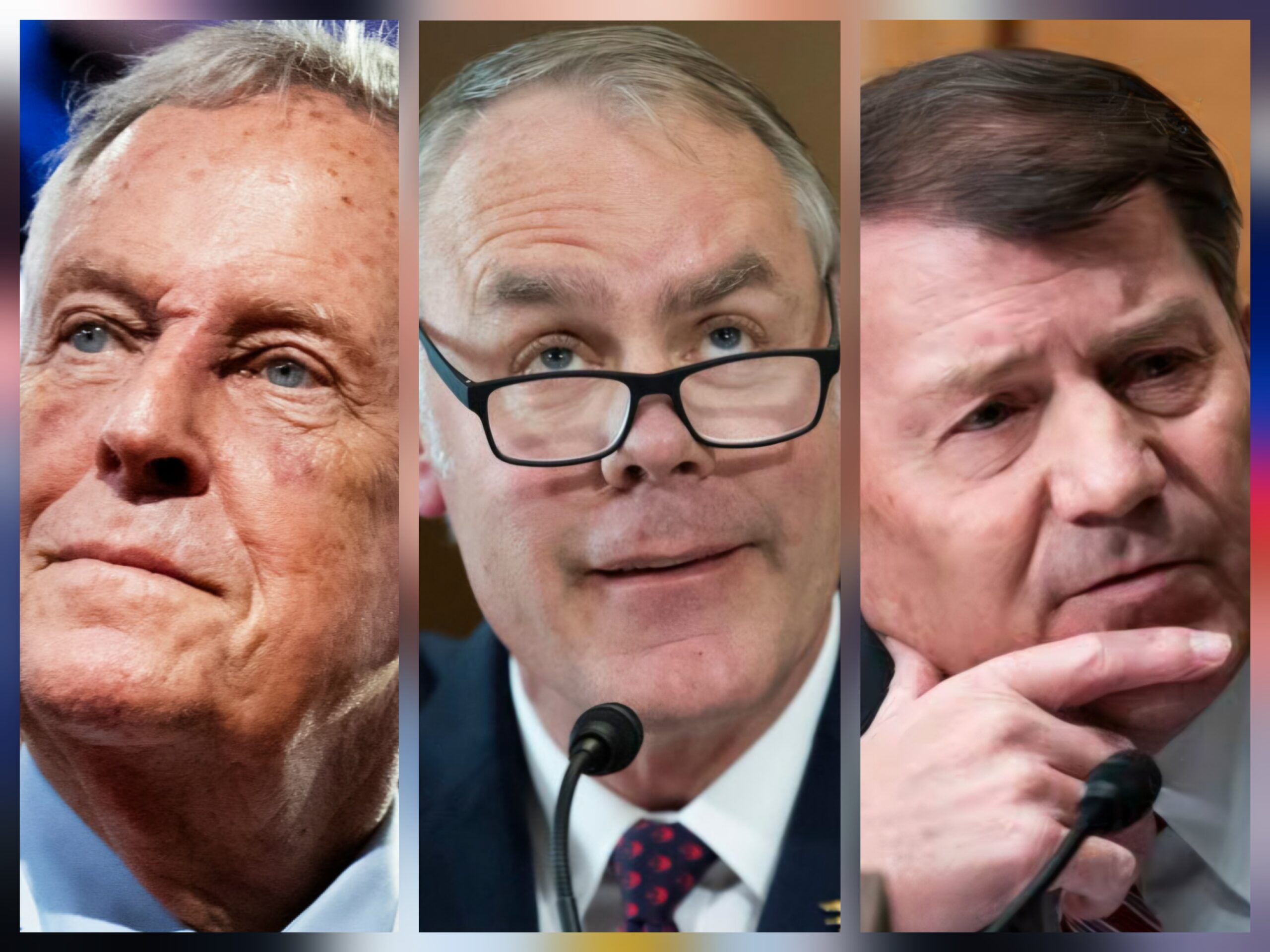
Congressmen Joe Wilson and Ryan Zinke, and Senator Mike Rounds
Three American lawmakers have called on President Donald Trump’s administration to reconsider sanctions against Rwanda. They say the measures risk undermining the peace agreement between Rwanda and the Democratic Republic of Congo (DRC).
The intervention is politically significant. All three lawmakers are Republicans, the party to which Trump belongs. Their position adds a voice from within the President’s own party to criticism of the administration’s approach, which has also come from Democrats.
The Democrats have just secured control of both chambers of Congress in the November 3 midterm elections. Their growing influence is expected to bring closer scrutiny of Trump’s foreign policy.
In a letter dated November 16, the lawmakers wrote to US Treasury Secretary Scott Bessent. They criticised sanctions targeting the Rwanda Defence Force (RDF) and Rwanda’s Ministry of Defence.
They argued that the measures were putting pressure on one party while leaving the other with little incentive to honour the agreement.
The letter was signed by Congressmen Joe Wilson and Ryan Zinke, and Senator Mike Rounds.
The lawmakers praised Trump’s efforts to secure peace between Rwanda and the DRC. They described the December 4, 2025 signing of the Washington Accords for Peace and Prosperity as a major diplomatic achievement.
They said the agreement created an opportunity to improve regional security, expand economic cooperation and protect American strategic interests in Central Africa.
But they warned that lasting peace would depend on both governments fulfilling their commitments.
“Recent measures, including Treasury Department sanctions targeting the Rwanda Defense Force and Rwanda’s Ministry of Defense, are handicapping one party, while leaving the other party to the agreement emboldened to pursue a military solution rather than implement the peace agreement,” they wrote.
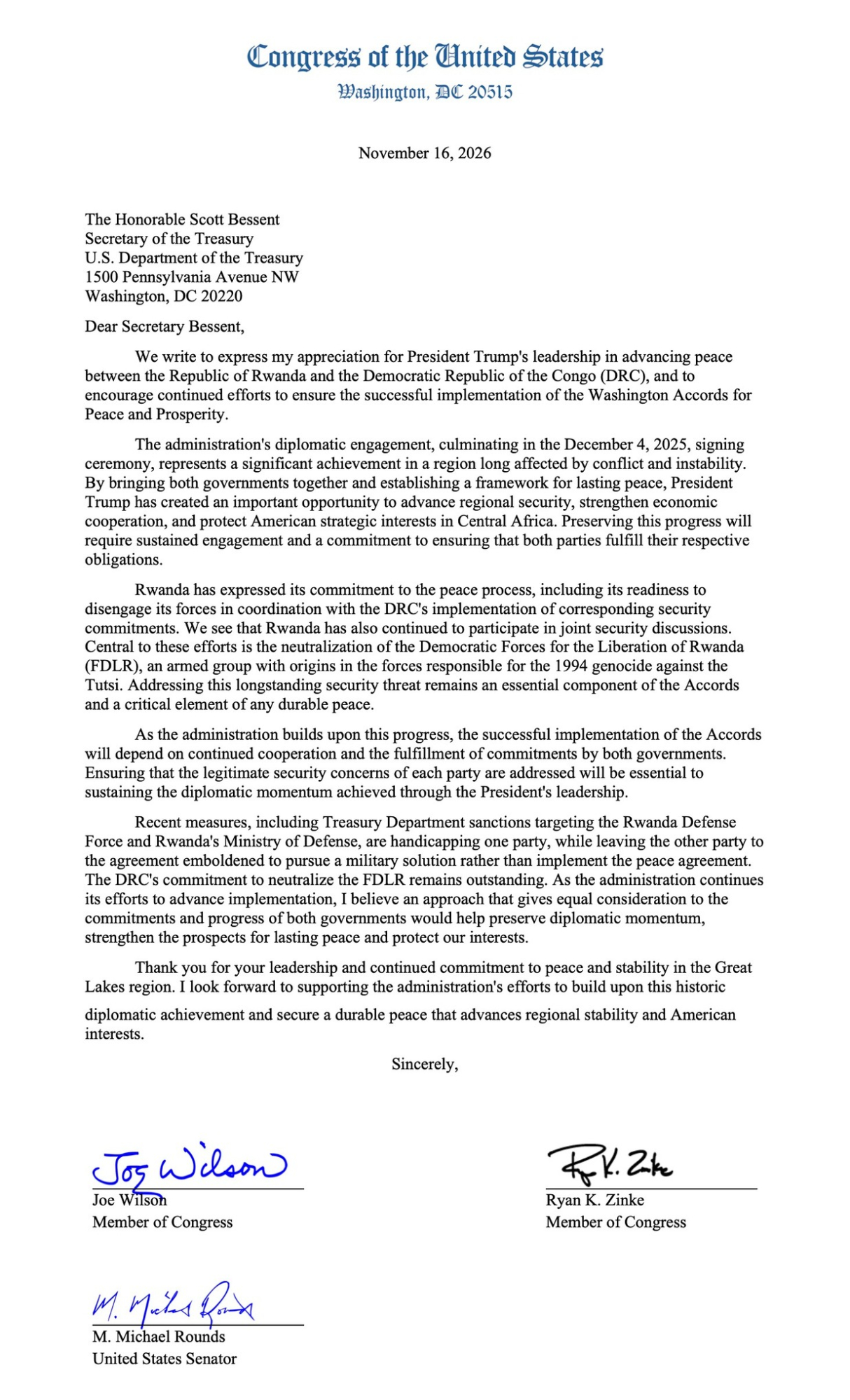
The lawmakers singled out the need for the DRC to neutralise the Democratic Forces for the Liberation of Rwanda (FDLR).
They described the group as an armed organisation with origins in forces responsible for the 1994 Genocide against the Tutsi.
Addressing the FDLR threat, they said, remains essential to implementing the Washington Accords and achieving lasting peace.
The letter also acknowledged Rwanda’s stated commitment to the peace process. This includes its readiness to disengage its forces in coordination with the DRC’s implementation of corresponding security commitments.
The lawmakers said Rwanda had continued taking part in joint security discussions. They stressed that both countries’ legitimate security concerns must be addressed.
Their intervention comes amid growing criticism from former American officials over what they see as an uneven approach by the Trump administration.
Tibor Nagy, a former US Assistant Secretary of State for African Affairs, has questioned why Washington is sanctioning Rwanda while giving less attention to armed groups he says threaten Rwanda and are supported by the Congolese government. He has argued that targeting only one side will not end the conflict.
Cameron Hudson, a former senior State Department and National Security Council official on Africa, has raised concerns about the administration’s growing focus on Congo’s mineral wealth.
In comments to French newspaper Le Monde, Hudson argued that access to minerals had become the central strategic interest driving US policy in the DRC. His remarks reflect wider concerns that Washington’s pursuit of economic and mineral interests could overshadow the political and security issues behind the conflict.
The three lawmakers called for an approach that gives equal consideration to the commitments and progress of both governments. They said this would preserve diplomatic momentum, strengthen prospects for peace and protect American interests.
The letter comes amid continuing tensions over the implementation of the Washington Accords. Security commitments and the FDLR threat remain major points of disagreement between Kigali and Kinshasa.
The lawmakers thanked Trump for his leadership and pledged support for his administration’s efforts to secure lasting peace in the Great Lakes region.
