



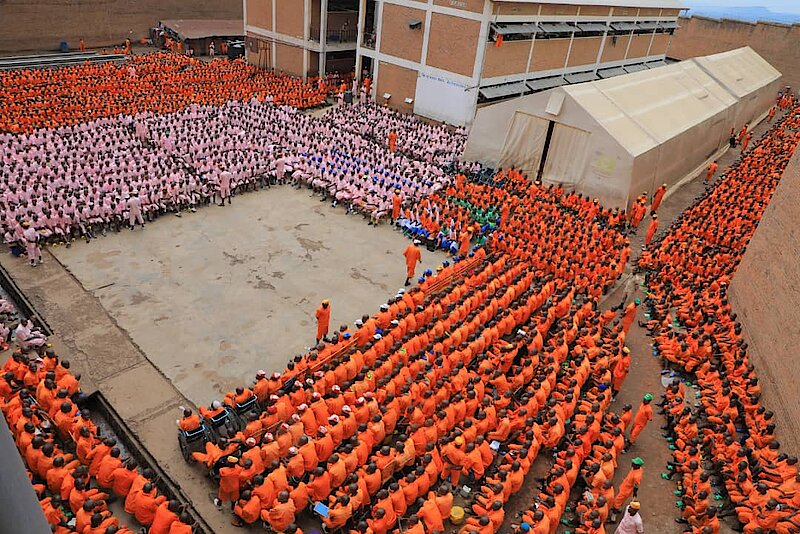
MOVING TOWARD CAPACITY: While Rwanda’s prison occupancy has dropped from 140% to 103% over the last two years, Senators are now pushing for electronic monitoring to further ease the strain on correctional facilities.
KIGALI — Rwanda is eyeing a digital shift in its judicial system as Senators push for the introduction of electronic monitoring to permanently dismantle the long-standing challenge of prison overcrowding. While new data from the National Commission for Human Rights (NCHR) shows the occupancy rate has dropped significantly—from a staggering 140% in 2022/23 to 103% today—lawmakers argue that “high-tech” surveillance is the missing piece to bringing the system back under capacity.
The call followed the presentation of the NCHR’s 2024–2025 annual report to the Senate, where the Committee on Social Affairs and Human Rights reviewed the Commission’s recent findings and its upcoming 2025-2026 action plan.
For more than three decades, prison congestion has been a persistent concern in Rwanda. However, the latest report suggests the tide is finally turning. The national prison occupancy rate now stands at 103 per cent, a marked improvement from the crisis levels recorded just two years ago. To bridge that final gap, Senators believe electronic tags for selected offenders could provide the necessary relief without compromising public safety.
Digital Solutions for Modern Justice
Senators questioned why congestion remains above capacity despite ongoing efforts to release eligible inmates. Senator Pelagie Uwera urged the government to accelerate plans for electronic monitoring technology, allowing certain offenders to be supervised outside correctional facilities.
“When we look at the country’s progress in infrastructure and technology, electronic monitoring could complement measures already in place, so that not every offender must necessarily serve time in prison,” she said. “If given proper attention, this could become another important milestone for our country.”
Senator Emmanuel Havugimana also welcomed the downward trend, noting the drop from 140.7 per cent in 2022/23 to 103 per cent today. However, he cautioned that the figure remains high across Rwanda’s 14 correctional facilities, some of which still face severe localized congestion.
Havugimana argued that low-risk inmates could be fitted with electronic ankle bracelets, allowing them to remain productive. “Rwanda has made impressive progress in technology. Some individuals could support themselves outside prison instead of being a burden on the state. They could farm or work while wearing the device, and if they violate restrictions, they could be brought back.”
The legislative framework for this shift is not new. Rwanda’s updated criminal procedure laws in 2019 officially recognized electronic monitoring as an alternative to incarceration. While the Ministry of Justice indicated in 2020 that the technology was ready for deployment, the practical rollout has yet to match the pace of the country’s broader digital transformation.
Concerns Over Transit Centers
Beyond the prison walls, Lawmakers raised alarms regarding “transit centers,” where some detainees are reportedly being held beyond legally permitted limits.
The NCHR report revealed that 8,784 individuals were found to have overstayed their authorized duration in these basic detention facilities. This has pushed occupancy levels in transit centers to 110.6 per cent.
Senators called for stronger measures to ensure prompt releases, warning that prolonged detention takes a toll on mental health, family welfare, and the national budget. While the report did not specify the exact length of the overstays, Adrie Umuhire, Chairperson of the Senate Committee on Social Affairs and Human Rights, clarified the legal boundary.
“No one is legally allowed to spend more than 72 hours in a transit center,” Umuhire stated. She noted, however, that some individuals find themselves repeatedly detained due to recurring socially disruptive behavior.
Umuhire emphasized that those in transit centers are not convicted criminals. Instead, they are held for rehabilitation with the goal of correcting behavior before reintegration into society—a process she argues should not be hindered by administrative delays.
