
An architectural visualization of a large infrastructure project, like a new school campus in Rwanda, highlights the complex administrative process the government faces in acquiring thousands of small, family-owned land plots for national development.
KIGALI — In Rwanda, building a simple school or extending a power line can become a massive administrative task. With approximately 12 million land plots across the country, Rwanda faces a unique geographic and legal challenge. Most plots are tiny—often less than half a hectare—and are frequently owned by multiple family members simultaneously due to generational inheritance.
This fragmentation creates a logistical bottleneck for the government. To clear just two hectares of space for a new road or classroom, officials may need to track down and compensate upwards of 1,000 different individuals.
The 120-Day Rule
By law, the government must compensate citizens for their land within 120 days before relocating them. This mandate is designed to protect property rights and provide families with the liquidity needed to move. If payment is delayed, the government is legally required to pay an additional 5% penalty.
Despite these protections, the process is often stalled. Philippe Kwitonda, Director General at the Ministry of Environment, notes that when hundreds of people claim interest in the same small area, determining the rightful recipient of funds is incredibly difficult. If a family dispute arises over ownership, the payment is frozen until the matter is settled.
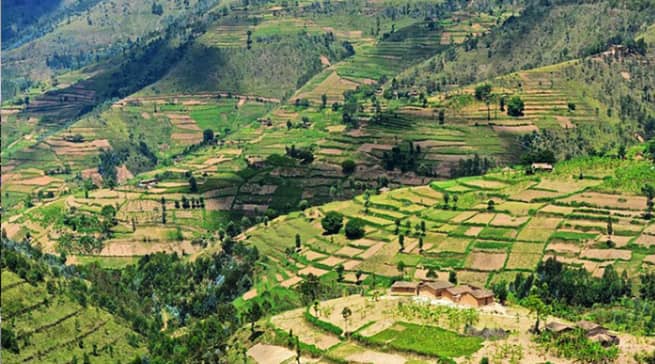
The patchwork of small, terraced plots across Rwanda’s hillsides illustrates the country’s unique land ownership challenge, where a single hectare can be divided among hundreds of individual owners.
The Cost of Waiting
While officials maintain that the system is functional, several citizens describe being trapped in a state of “limbo” for years. Jean Bosco Niyomugabo from Nyagatare District claims the Rwanda Energy Group (REG) took his land in 2022. He was forbidden from building, and his crops were cleared for power lines. Four years later, he is still waiting for payment.
Ndagijimana Aimable from Nyabihu District reports that his crops were destroyed for an electricity project three years ago. He says officials asked for his documents five months later but then claimed they had lost them. In Rulindo District, a resident named Elias questions why payments aren’t finalized before work begins, noting that while house demolitions receive immediate attention, those losing agricultural land often feel overlooked. KT Press has not independently verified the specific compensation claims made by the residents in this story.
A Digital Solution: The LDMS
To combat these delays and the “paperwork shuffle” described by residents, the government has introduced the Land Disputes Management System (LDMS). Developed by the National Land Authority, the LDMS is a digital platform designed to modernize how land conflicts are handled and improve transparency.
The system aims to eliminate the uncertainty residents feel during the compensation process through real-time case tracking. This allows users to monitor the exact progress of their case online, ensuring that documents aren’t lost in an office. Additionally, automated notifications send proactive updates on case status, keeping citizens informed without requiring them to travel long distances to government offices.
By moving these disputes into a transparent digital environment, the government hopes to ensure that economic development does not come at the cost of individual livelihoods.
The Official Outlook
In response to recent complaints, Kwitonda stated his office is working with REG and local authorities to investigate specific cases. He confirmed that a nationwide report on these delays has already been compiled to identify where the system is failing.
Kwitonda emphasized the need to look at the truth of these claims and promised to work with REG to speed up the process. He characterized these as urgent issues that must be handled quickly to maintain public trust.
The Road Ahead
As Rwanda continues its rapid development, the tension between national progress and individual property rights remains a significant hurdle. The introduction of the LDMS marks a major step toward modernization and efficiency in land management.
However, for the farmers who have spent years waiting for their compensation, the true measure of success will not be the launch of a new platform, but the moment the digital system finally translates into a long-awaited bank deposit.