
The Annual General Meeting of ZEP-RE (PTA Reinsurance Company) is underway in Kigali.
KIGALI – Rwanda is at the centre of a critical continental conversation as it hosts the Annual General Meeting of ZEP-RE (PTA Reinsurance Company), bringing together policymakers, insurers and financial leaders to explore how insurance can evolve from a niche service into a driver of resilience, inclusion and sustainable growth.
The role of insurance in Africa’s economic future featured prominently in remarks by the Minister of Finance and Economic Planning, Yusuf Murangwa, who acknowledged both the progress made and the scale of the challenge ahead.
Insurance penetration across Africa remains low, at about 3 percent in Sub-Saharan Africa—well below global averages. This gap leaves millions of households, small businesses and governments exposed to shocks.
“The informal worker, the farmer, the small trader—these are not uninsurable. They are simply underserved, and that is where the real opportunity lies,” Murangwa said.
Insurance as a Strategic Tool for Resilience
Across the continent, climate shocks are intensifying, with floods, droughts and extreme weather events becoming more frequent and costly. The Governor of the National Bank of Rwanda (BNR), Soraya Hakuziyaremye, noted that over 80 percent of catastrophe-related losses in Africa remain uninsured.
Between 2019 and 2023, the continent recorded an estimated $32 billion in economic losses, most of which was borne by governments, households and businesses.
“This is no longer about isolated risks. These shocks are part of our new normal, and insurance must be treated as a strategic tool for economic resilience, fiscal stability and inclusive growth,” she said.
Rwanda’s trajectory reflects both vulnerability and ambition. Disaster resilience is currently estimated at 47 percent, below the national target of 60 percent, prompting accelerated reforms to strengthen risk financing systems.
A newly launched National Insurance Strategy aims to expand coverage through digital innovation, improved product design and stronger public-private collaboration.
Progress is already evident. Microinsurance uptake has grown by 70 percent over the past three years, signalling rising awareness and demand among underserved populations. However, scaling these gains remains a key challenge.

Soraya Hakuziyaremye, the Governor of the National Bank of Rwanda (BNR) says that climate shocks are intensifying and insurance must be treated as a strategic tool for economic resilience.
ZEP-RE’s Expanding Role in Inclusive Growth
Hope Murera, Managing Director of ZEP-RE, says the company’s evolving role reflects a deliberate shift toward inclusion and impact. Established more than three decades ago with a pan-African mandate, the institution now operates in 55 countries, serving over 700 companies while anchoring its strategy in resilience.
“ZEP-RE is not just a commercial institution; we are a development partner. Our mandate is to operate profitably while strengthening climate resilience, supporting livelihoods and enabling economic stability across the markets we serve,” she said.
Murera pointed to the company’s 2026–2028 strategy, which prioritises financial inclusion, climate risk solutions and targeted interventions in agriculture, trade and small enterprises. Through its subsidiary, ECA Africa, ZEP-RE is also investing in agri-tech innovations aimed at protecting farmers and stabilising food systems.
“Our focus is on unlocking opportunity where traditional insurance has not reached. That means designing solutions that respond to real risks—whether a farmer facing drought, a trader navigating supply chain shocks, or a government managing disaster exposure,” she added.
Among the flagship initiatives is the DRIVE programme, which provides index-based livestock insurance to pastoralist communities in East Africa. The model illustrates how tailored insurance products can protect livelihoods while strengthening resilience at the grassroots level.
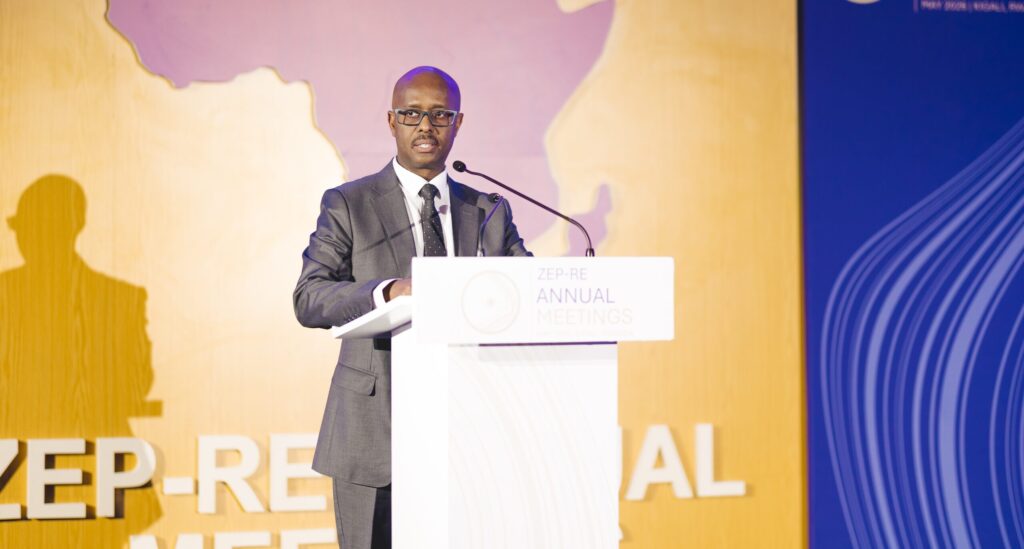
Yusuf Murangwa, Rwanda’s Minister of Finance & Economic Planning, says that Insurance penetration across Africa remains critically low.
From Pilots to Systemic Impact
Despite recent gains, experts stressed that Africa’s insurance sector must move beyond pilot programmes to scalable, system-wide solutions. Fragmented regulation, low financial literacy and affordability constraints continue to limit uptake, particularly in the informal sector where risk exposure is highest.
Participants agreed that progress will depend on stronger alignment among governments, regulators, insurers and development partners. “There is no room for incremental progress without tangible impact. We must match the scale and speed of the risks we face,” Murangwa cautioned.
Digital platforms, mobile money ecosystems and embedded insurance models are expanding access to underserved populations. Meanwhile, innovations such as sovereign risk pools and parametric insurance are enabling faster, more predictable disaster responses.
Insurance, they noted, must evolve into a core pillar of economic policy rather than an afterthought. Closing the protection gap would help safeguard lives, stabilise economies and unlock investment otherwise lost to unmanaged risk.

Hope Murera, the Managing Director at ZEP-RE explained that there is a deliberate shift toward inclusion and impact.