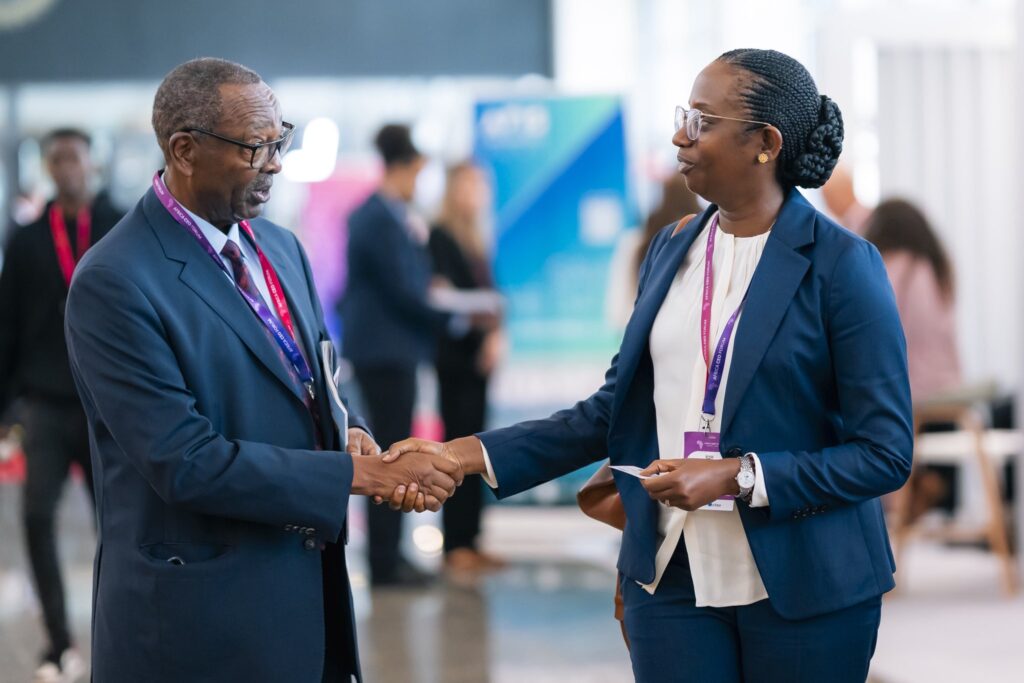
BK CEO Diane Karusisi exchanges pleasantries with a guest at the Africa CEO Forum in Kigali.
KIGALI– African business leaders, financiers and logistics experts have called for urgent investment in integrated transport systems and regional trade corridors, warning that the continent cannot achieve large-scale economic growth without improving the movement of goods across borders.
The call was made during a high-level panel on unlocking Africa’s hidden logistics advantage at the Africa CEO Forum in Kigali.
Discussions focused on how Africa can better use waterways, railways, roads and digital systems to reduce trade costs, improve connectivity and deepen regional integration.
Speakers said fragmented infrastructure, poor coordination and inconsistent regulations continue to hinder trade, despite growing demand for faster and more efficient supply chains.
From “Landlocked” to “Land-Linked”
Diane Karusisi, Chief Executive Officer of Bank of Kigali, said African countries must rethink how they view geography and trade. She noted that Rwanda has deliberately shifted from seeing itself as landlocked to positioning itself as a regional connector.
“For landlocked countries like ours, we actually say that we are land-linked, not landlocked, because we connect West to East and vice versa,” Karusisi said.
She said Rwanda has invested heavily in trade facilitation measures, including digital systems and one-stop border posts, to reduce delays and improve cargo movement from ports in Tanzania and Kenya.
“We built one-stop border posts where customs, banks, standards agencies and other institutions work together,” she said. “It is proof that geography is not destiny.”
According to Karusisi, Rwanda has reduced cargo transit times from 14 days to just three days through improved coordination and logistics reforms.
She added that Kigali’s dry port is increasingly serving the wider region by handling cargo destined for eastern Democratic Republic of Congo, while creating jobs and supporting cross-border trade.
Karusisi stressed that Africa must stop financing isolated infrastructure projects and instead invest in complete trade ecosystems linking roads, railways, ports and logistics hubs.
“There is no point financing one road from point A to point B if you are not looking at the entire ecosystem,” she said. “We need to build corridors for trade, not just isolated infrastructure.”
Corridors as Integrated Economic Ecosystems
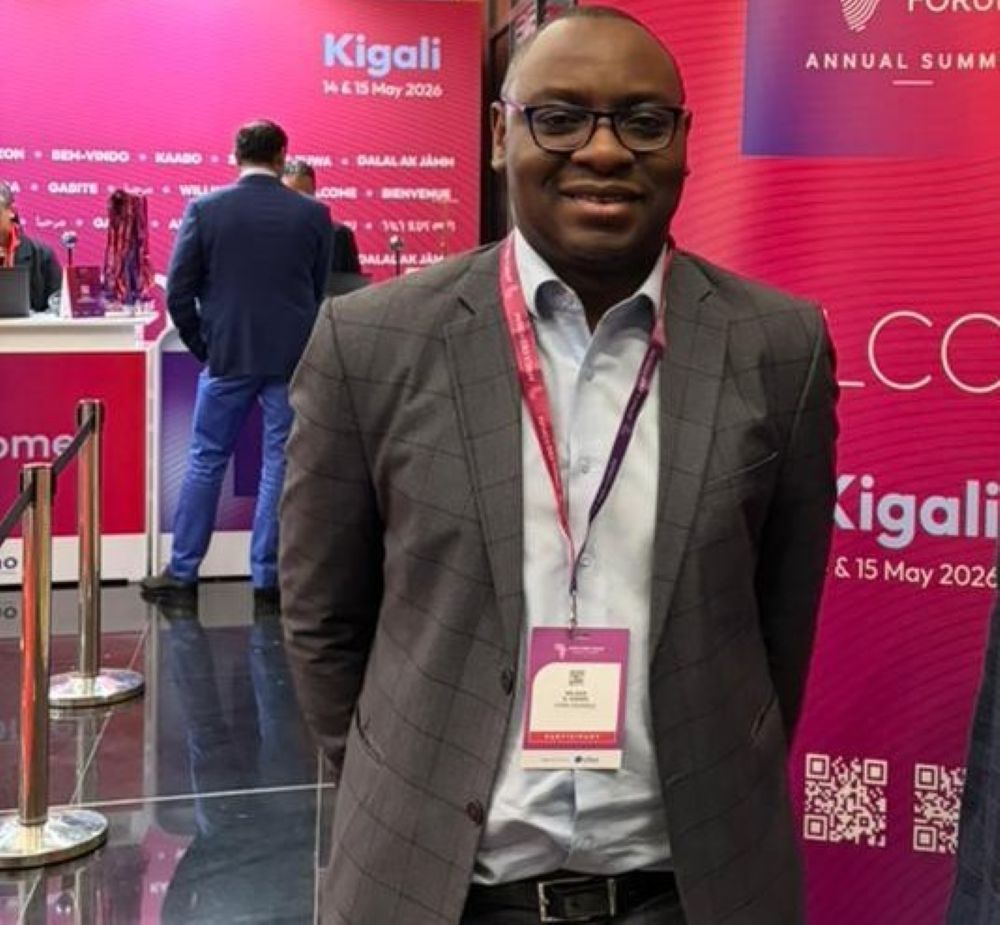
Wilson Kaindi, Country Director of KPMG, says that Africa is at a pivotal moment as global supply chains are being reshaped and geopolitical uncertainty increases.
Ousmane Dione, the World Bank’s Regional Vice President for the Middle East and North Africa, said Africa must move beyond treating infrastructure as stand-alone projects and focus on fully integrated economic corridors.
“We need to think in a much more integrated way,” Dione said. “Corridors are not just about transportation. They must connect industries, logistics, agriculture and energy systems.”
He cited the Niger River as a major but underused asset that could transform regional trade if backed by stronger institutions, better coordination and long-term investment.
Dione said inland waterways remain largely overlooked in national development plans, despite their potential to reduce transport costs and stimulate economic activity.
Adeline Gabillaud, Regional Director for Africa at CMA CGM Group, said private sector investors are ready to commit capital, but regulatory fragmentation remains a major obstacle.
“If there is a common regional will, companies like ours are ready to invest,” she said.
Gabillaud said governments must create predictable legal and financial frameworks to unlock large-scale investment in alternative logistics systems.
She also announced that CMA CGM plans to deploy Africa’s first electric barge in Lagos, marking a move toward cleaner and more efficient inland transport.
Africa’s Opportunity to Scale
Wilson Kaindi, Country Director of KPMG, said Africa is at a pivotal moment as global supply chains are being reshaped and geopolitical uncertainty increases.
“Our time is now, and we need to embrace it and take it,” Kaindi said.
He said Africa’s young population, natural resources and growing markets give the continent a strong foundation for global competitiveness, but only if governments and businesses improve coordination and scale up their operations.
Kaindi added that firms such as KPMG are supporting this transformation through advisory, tax and audit services that help governments and investors structure infrastructure financing, strengthen compliance and boost investor confidence.