



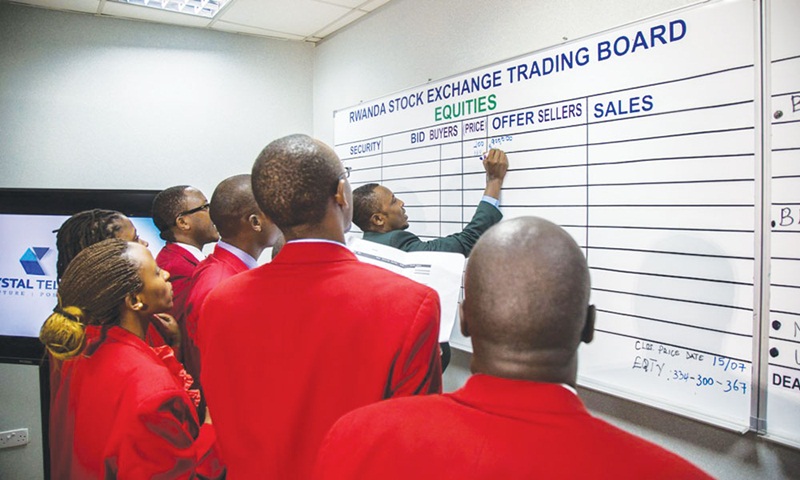
Traders on the Rwanda Stock Market floor
KIGALI — Rwanda’s latest Treasury bill auction attracted more than four times the amount of money the government wanted to borrow, highlighting strong demand from banks and investors looking for a safe place to put their money.
According to the National Bank of Rwanda, investors submitted bids worth Rwf54.96 billion during the June 4 auction, while the government was seeking to raise only Rwf12.5 billion.
This means demand reached 440 percent of the amount on offer, says the Central Bank’s Weekly Bulletin released Monday June 8.
Treasury bills are short-term loans that investors make to the government in exchange for interest payments.
The strong demand suggests that banks and other investors currently have plenty of cash available and are willing to lend it to the government, even at slightly lower interest rates.
The auction covered four types of Treasury bills ranging from 28 days to one year.
Demand was high across all categories.
The 28-day bills attracted nearly Rwf11 billion in bids for only Rwf3 billion on offer. The 91-day bills received Rwf12 billion in bids against Rwf3 billion offered, while the 182-day and 364-day bills were also heavily oversubscribed.
As demand increased, interest rates fell slightly.
The average interest rate on the 28-day bill dropped to 8.10 percent, while the 91-day bill fell to 8.23 percent. The 182-day bill declined to 8.37 percent, while the one-year bill remained steady at 8.96 percent.
For the government, lower interest rates mean it can borrow money more cheaply.
Meanwhile, the latest Treasury bond was issued on May 14, 2026, with a 20-years maturity and a face value of FRW 10.0 billion.
The auction attracted 65 applications worth FRW 26.0 billion, representing a subscription rate of 260.4 percent. The bond was issued at par with yields of 13.0 percent
The wider results also suggest that many investors currently prefer the safety of government securities rather than taking greater risks elsewhere.
This comes at a time when Rwanda’s banking sector is holding significant liquidity. Commercial banks currently have reserves well above the minimum levels required by the central bank.
Globally, financial markets remain uncertain due to rising oil prices, tensions in the Middle East, and expectations of higher interest rates in the United States.
Despite these pressures, demand for Rwanda’s government debt remains strong.
This is not only for rich people or bankers. The government wants everyone to participate.
Yes it is a regular process. Auctions happen almost every week or every two weeks. The bulletin mentions auctions on April 30, May 7, May 14, May 21, May 28, and then June 4.
That’s roughly every Thursday. You don’t have to wait for a special event.
Last week’s performance clearly reflects confidence in government securities, although it also shows that there are limited investment alternatives attracting large amounts of money in the local market.
For now, the government is benefiting from strong investor appetite, allowing it to raise funds at relatively low borrowing costs while banks and investors earn stable returns.
