


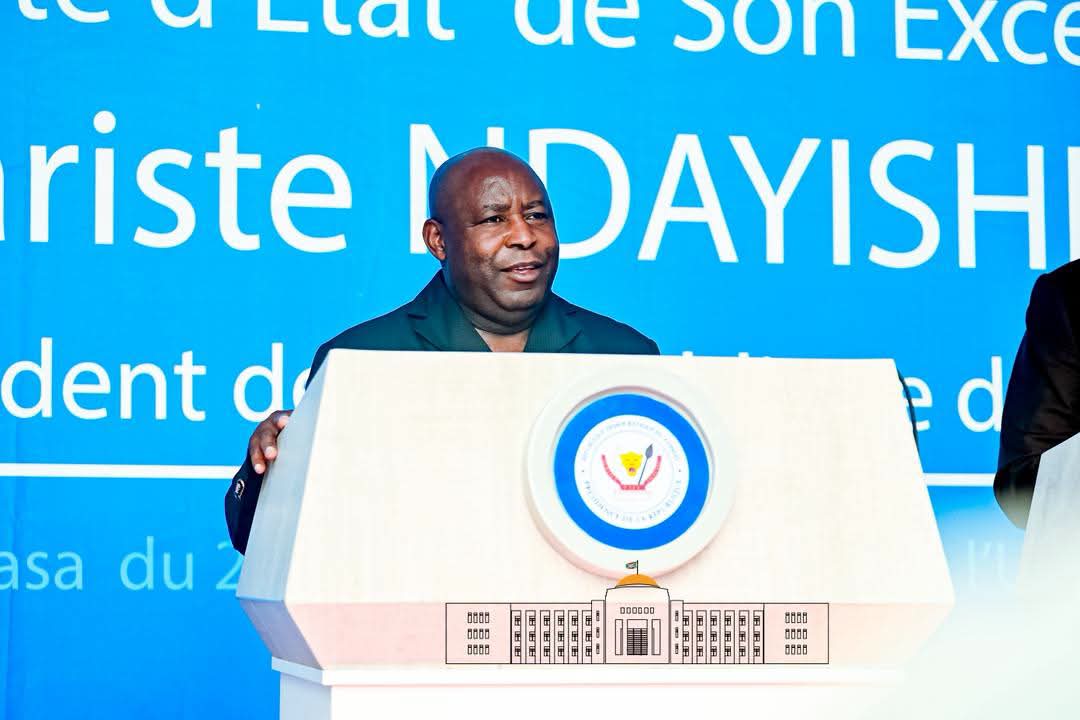
Burundi President Evariste Ndayishimiye was on a visit in Kinshasa these past days as his country suffers economic struggles
In Burundi, a critical shortage of foreign currency remains one of the biggest threats to the country’s future growth, according to the International Monetary Fund.
In a June 23 assessment of Burundi’s economy, the IMF projects growth of 3.9 percent this year and an average of 4.3 percent annually through 2031, citing progress in fiscal reforms, mining, agriculture and electricity expansion.
Public debt has fallen sharply, inflation has eased from recent highs, and exports are expected to increase.
Yet beneath those encouraging indicators lies a persistent vulnerability: the country does not have enough foreign currency reserves.
At the end of 2025, Burundi held just $214 million in international reserves, equivalent to only 1.6 months of imports.
The gap matters because foreign reserves are the dollars and other hard currencies that countries use to pay for imports, service external debt and cushion economic shocks.
For Burundi, the consequences are felt most visibly at petrol stations.
The country imports virtually all of its fuel, but importers require foreign currency to pay suppliers abroad. When dollars become scarce, fuel imports can slow, contributing to shortages that have periodically disrupted transport, commerce and daily life across the country.
It is the reason social media in Burundi is always trending with videos of long lines at petrol stations, or vehicle sprints as drivers rush on rumour of a station with fuel.
The IMF’s assessment suggests that Burundi’s recurring fuel crisis is not simply a supply-chain problem. At its core, it is a foreign-exchange problem.
For context as to how important international reserves are, by comparison, neighboring Rwanda held as of end 2024 reserves estimated at more than $2.5 billion, enough to cover 3.6 months of imports.
Despite being an agricultural economy, IMF also says Burundi continues to import significant amounts of food, fuel, fertilizer, medicines and industrial goods.
At the same time, its export base remains narrow, relying heavily on coffee, gold and tea. The result is constant pressure on the country’s foreign-currency position.
The Fund expects reserves to gradually rise over the coming years, potentially reaching more than $500 million by 2031.
However, even then, reserve coverage would remain below the level the IMF considers adequate for a country facing Burundi’s vulnerabilities.
The challenge is particularly important because the country’s broader economic ambitions depend on imports.
Expanding electricity access, modernizing agriculture, developing mining and improving infrastructure all require equipment, machinery and fuel purchased from abroad.
Without a stronger reserve buffer, Burundi will remain exposed to swings in global commodity prices, disruptions in regional trade and increases in fuel costs.
For one of Africa’s poorest nations, the next stage of recovery may depend less on how fast the economy grows and more on how many dollars it can earn and keep.
