


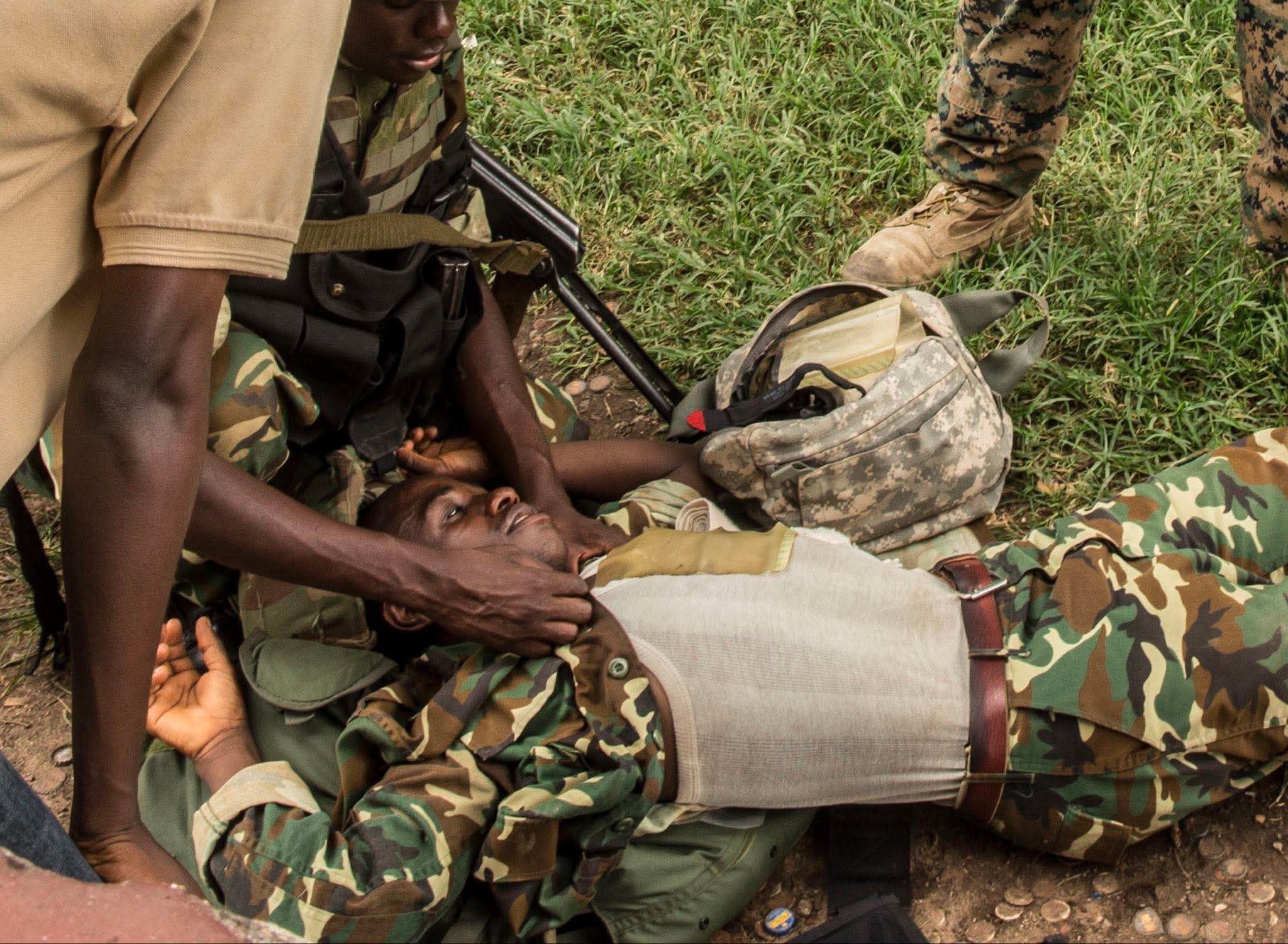
One of many images widely circulating is this Burundian soldiersl being helped by colleagues. It appears the soldiers sent the images to their commanders but somehow they found their way on social media
MINEMBWE, DR Congo — High in the mountains of South Kivu, a major offensive launched this week by a coalition of Congolese, Burundian and allied forces appears to have encountered a familiar obstacle: the difficulty of translating overwhelming military power into control of territory.
The latest battle for Minembwe began on Wednesday when a coalition composed of the Congolese army (FARDC), Burundi’s military (FDNB), Wazalendo militias, Rwandan FDLR militias and other allied forces intensified operations aimed at seizing the strategic highland town from Twirwaneho, a Banyamulenge armed movement aligned with the broader AFC/M23 coalition.
The assault was accompanied by heavy artillery fire, drone strikes and aerial bombardments, marking one of the most significant military operations in South Kivu in recent months.
Yet by the weekend, the story was less about military victory than about competing claims of what had actually happened on the battlefield.
Minembwe occupies a unique place in eastern Congo’s conflict landscape. Perched in the Banyamulenge highlands, it provides commanding views over surrounding valleys and key access routes across South Kivu.
For Twirwaneho, it serves as both a military stronghold and a symbol of community security. For Kinshasa and its allies, capturing it would represent a significant strategic and political achievement.
The coalition entered the offensive with substantial advantages. Burundi alone is estimated to have deployed more than 20,000 troops in eastern Congo, making it one of the largest foreign military contributors supporting the Congolese government.
Combined with FARDC units, local militias and allied armed groups, the coalition possessed overwhelming numerical superiority as well as access to artillery, drones and aircraft.
As fighting intensified, a second battle quickly unfolded online.
Kinshasa government-aligned social media accounts began reporting major gains, claiming rebel defenses had collapsed, large numbers of fighters had been killed and coalition forces had effectively taken control of Minembwe.
But the evidence presented publicly failed to match the scale of those claims.
Notably absent were images showing significant rebel casualties, captured positions inside Minembwe, or proof that Twirwaneho forces had been routed.
No photographs emerged supporting repeated claims that large numbers of rebels had been killed or that foreign forces allegedly fighting alongside them had suffered major losses.
Instead, much of the imagery circulated appeared to show troops positioned in surrounding highlands and adjacent areas rather than inside Minembwe itself.
Meanwhile, what was widely visible and verifiable were videos appearing to show Twirwaneho fighters moving openly within the town.
Perhaps the most striking footage showed Brigadier General Charles Sematama, Twirwaneho top commander, walking through the dusty streets of Minembwe and greeting residents. Supporters of the movement presented the images as proof that the town remained under their control despite days of bombardment and repeated reports of its capture.
At the same time, some of the most widely circulated battlefield videos showed wounded Burundian soldiers being evacuated, Congolese troops withdrawing from contested areas and Wazalendo militia fighters carrying injured commanders from the front lines.
A notable one was video of several dozen civilian armed men carrying what appeared to a heavy injured commander as they ran up the mountains.
By Friday and Saturday, some coalition supporters appeared to adjust their messaging. Rather than insisting that Minembwe itself had fallen, they increasingly argued that government forces controlled strategic ridges, approaches and surrounding areas.
The shift reflected a recurring reality of modern conflict: declarations of victory often move faster than developments on the ground.
The battle also highlights a lesson military planners have learned repeatedly throughout history: mountains favor defenders.
Difficult terrain can neutralize many of the advantages enjoyed by larger armies. Superior manpower, artillery and air power do not automatically translate into battlefield success when defenders know the terrain, enjoy local support and operate from fortified positions.
That dynamic appears increasingly evident in South Kivu.
Despite overwhelming numerical superiority and significant firepower, the coalition has so far struggled to demonstrate a decisive breakthrough.
For Burundi, whose military commitment to eastern Congo has expanded dramatically in recent years, the campaign raises difficult questions about the cost of prolonged involvement in one of Africa’s most complex conflicts.
Officially, Burundi’s presence in eastern Congo is based on security cooperation agreements with Kinshasa and is publicly presented as part of efforts to combat armed groups operating in the region.
But Kigali increasingly views the conflict through a broader strategic lens.
Rwandan government has repeatedly told the world that the coalition assembled in eastern Congo — including FARDC, Burundian forces, FDLR militia and Wazalendo militias — represents a growing security threat to Rwanda itself.
President Paul Kagame and other senior officials have provided evidence of the Congolese government of collaborating with the FDLR, the militia formed by remnants of forces responsible for the 1994 Genocide against the Tutsi.
Rwanda has also repeatedly warned about increased military deployments along its borders and what it describes as efforts to destabilize the country through alliances involving forces hostile to Kigali.
Public statements by Congolese President Félix Tshisekedi and Burundian President Évariste Ndayishimiye have frequently heightened tensions, while Kigali has responded with warnings that regional security risks are growing rather than diminishing.
The result is that every battle in places like Minembwe now carries significance far beyond the territory being contested.
What unfolds in these mountains is increasingly viewed by regional capitals not simply as a local military engagement but as part of a wider struggle over security, influence and the future balance of power in the Great Lakes region.
For now, Minembwe remains contested.
And in the mountains of South Kivu, where geography has humbled armies for generations, the latest offensive appears to have produced not a clear victory but another reminder that overwhelming force is often easier to assemble than it is to convert into lasting control.
