 KIGALI – President Paul Kagame has recounted a little-known incident 1991, when he was briefly detained in Paris while representing the Rwanda Patriotic Front (RPF) at peace discussions, saying the experience shaped his understanding of international politics and reinforced Rwanda’s determination to rely on facts rather than external narratives.
Speaking during an extended RPF Bureau Politique meeting at Intare Arena, Kagame used the three-decade-old incident to explain why Rwanda continues to question how regional conflicts are interpreted on the global stage.
The President said he had travelled to Paris in September 1991 despite concerns from fellow RPF leaders, who feared for his safety as fighting continued in Rwanda. He insisted on attending because he believed failing to show up would reinforce the perception that the RPF was unwilling to pursue peace.
“I told our people, if we don’t go, if we don’t show up, we’ll never be understood. They will think we are just there fighting and we don’t want peace,” Kagame recalled.
He remembers taht the visit quickly took an unexpected turn during a meeting with French officials, where one official repeatedly urged the RPF to stop fighting. As he attempted to explain the historical context of the conflict, Kagame said the discussion became increasingly tense.
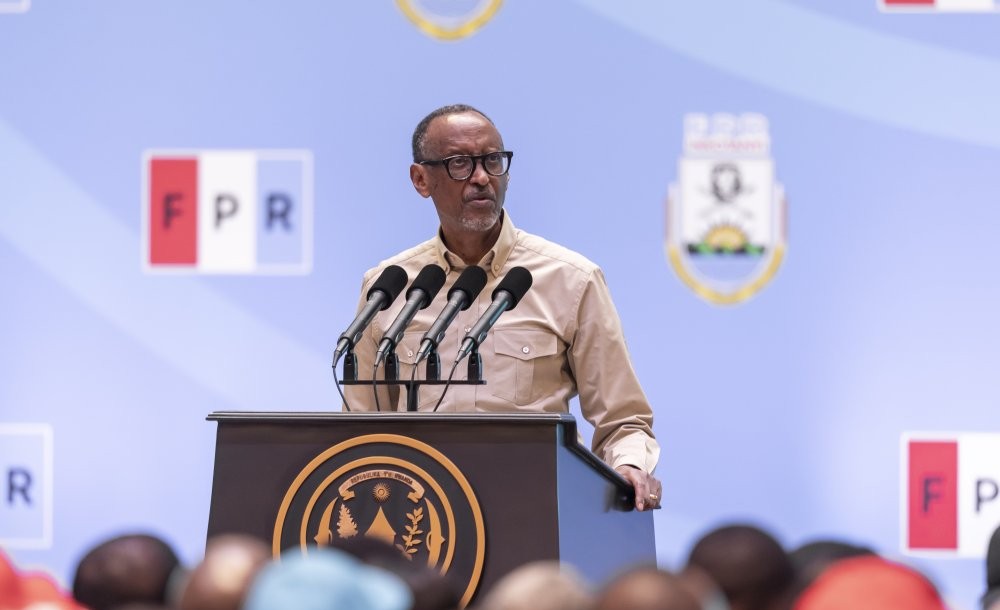
President Kagame addressing guests.
He particularly recalled one remark that stayed with him. “He told me, ‘Even if you overthrow the Kigali administration, you will not find your people.'”
At the time, Kagame said he did not fully grasp the meaning of those words but looking back after the 1994 Genocide against the Tutsi, he believes the statement reflected an awareness of what was being planned against Rwanda’s Tutsi population.
“I could not but conclude that was the meaning. They were privy to what was going on,” he said.
Hours after the meeting, Kagame said armed men entered his hotel room before dawn, detained him and two colleagues, confiscated their documents and took them to a detention facility in Paris, where they remained until later that evening.
Although he was eventually released and travelled to Brussels before returning to Rwanda, Kagame said the experience remains one of the moments that shaped his understanding of international diplomacy.
More than three decades later, he said similar patterns continue to emerge in discussions surrounding the conflict in eastern Democratic Republic of Congo.
Rwanda has repeatedly found itself blamed for a crisis whose origins predate the country’s involvement and whose root causes, particularly the continued presence of the FDLR and the persecution of Congolese Tutsi communities, have not been adequately addressed.
“This conflict did not start from and was not started by Rwanda at all,” he said, adding that international discussions often seek to portray Rwanda as the source of instability while overlooking the broader historical and security context.
The Head of State said Rwanda has consistently urged regional leaders and international partners to address the threat posed by the FDLR, warning that failure to confront the group has prolonged insecurity in the region.
He also questioned what he described as selective interpretations of events, saying evidence presented by Rwanda is often ignored while pressure, including sanctions, is applied without equal attention to the underlying issues.
Reflecting on recent diplomatic engagements held in cities including Nairobi, Doha, Dar es Salaam and Washington, Kagame said Rwanda has participated in every major effort aimed at finding a peaceful solution but lasting peace cannot be achieved by ignoring the factors that fuel the conflict.
“The complication of this world politics and geopolitics is that there are people who think they just dictate what the truth should be,” he said.
He also expressed concern over recent violence targeting Congolese Tutsi communities in areas such as Minembwe, arguing that the suffering of those communities should not be dismissed or treated as irrelevant simply because it falls outside prevailing international narratives.
Concluding his remarks, Kagame said Rwanda would continue defending its security interests and speaking out on issues it considers fundamental, regardless of external pressure.
“Making people shut up is probably more difficult than people think. I will only shut up when I’m dead,” he said.
For Kagame, the events of 1991 an early lesson that international narratives do not always reflect realities on the ground, a conviction that continues to shape Rwanda’s approach to regional security and diplomacy more than three decades later.