



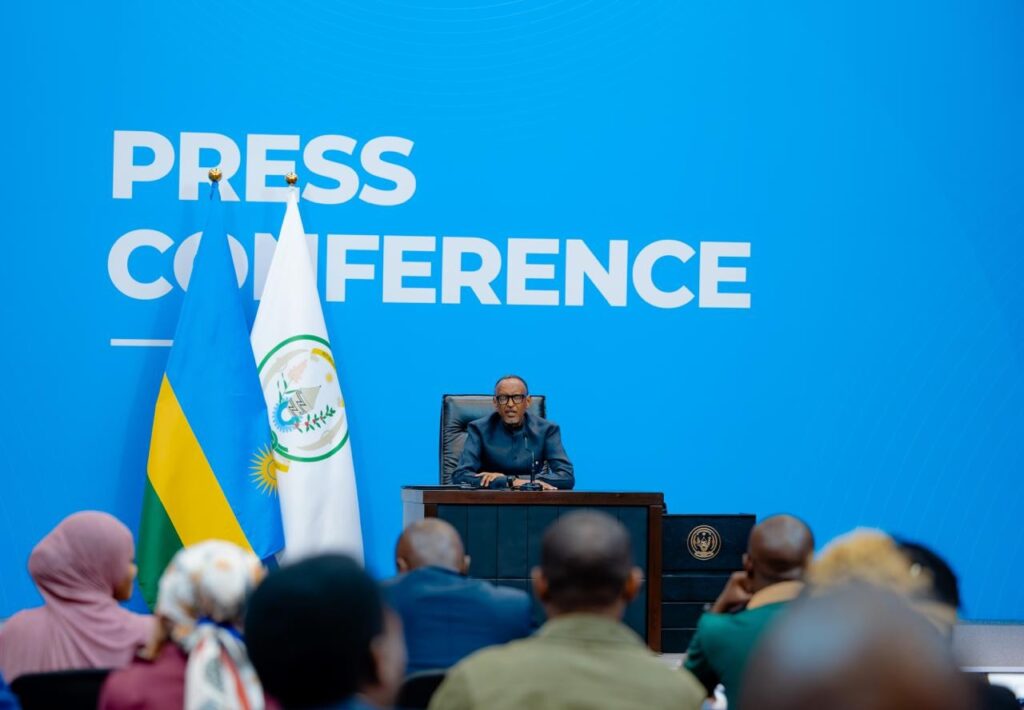
President Kagame held a press conference on August 24, 2026.
KIGALI – President Paul Kagame has warned that Rwanda cannot afford to place its survival in the hands of international peace efforts whose interventions have failed to address the underlying causes of the conflict in eastern Democratic Republic of Congo three decades later.
According to him Rwanda will remain involved in the conflict for as long as the threat posed by the FDLR remains unresolved.
“Our problem in Congo has always been FDLR. I can say this 100 times, and if this problem is not resolved, Rwanda will always remain involved,” Kagame said during a 3-hour press conference on August 24, 2026.
The unusually blunt formulation captures Rwanda’s position in advancing against security threats rooted in the continued presence of the FDLR and its ideology.
His remarks come against the backdrop of successive attempts to negotiate an end to the conflict, including the Washington peace agreement, which was expected to provide a framework for addressing the security and political issues driving the crisis.
But the head of State questioned why a problem that has been discussed for years continues to return to negotiations without being resolved.
“The origin of the problem is known. The handling and the mishandling of this problem over many years is known. The actors are known. The issue has effectively been discussed yet the same questions continue to resurface,” he said.
Kagame said he remains pleased that efforts have been made to create frameworks for resolving the crisis, but agreements and negotiations only matter if they lead to action. That is where he believes the region has repeatedly fallen short.
Security Before Pressure
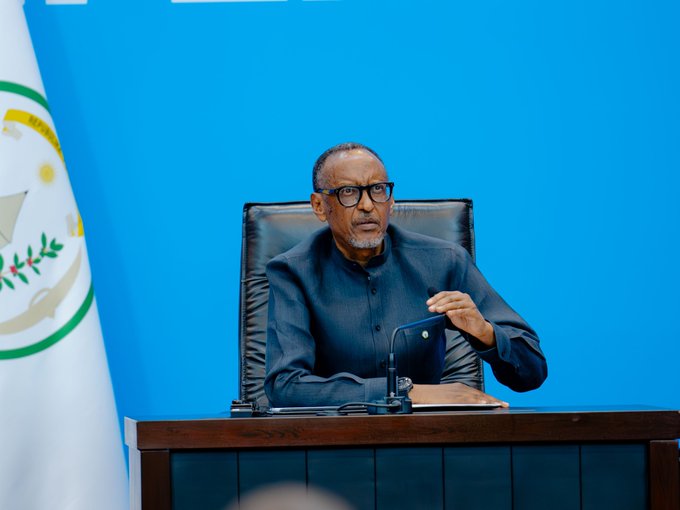
The President rejected the idea that sanctions and international pressure, on their own, can resolve the crisis.
“Sanctions, yes, they really create problems. They do. But that is all. These are problems added to the problems that were originally there,” he said.
His argument is that adding pressure without dealing with the security problem leaves the original crisis intact while creating new tensions around it. That calculation, he said, leaves Rwanda with little choice but to remain responsible for its own protection.
“We behave in a manner that protects us at any cost and will do anything that contributes to that protection, day or night. There are no two ways about it,” Kagame said.
He acknowledged that Rwanda operates in a difficult international environment, where its actions have attracted criticism, pressure and sanctions. But Rwanda cannot allow concern about how its decisions are viewed externally to override its responsibility to protect its nationals.
“You know we are a country that can’t afford to mess up. If you give so many enemies we have an excuse, a chance to bring it to us, I think it will be largely our mistake. We do what is right to protect ourselves and we will do it without fear, favour, day or night, any time,” he said.
Kagame pointed to the country’s continued participation in peace efforts as evidence that it remains willing to work with others but drew a distinction between pursuing peace and depending on others to guarantee Rwanda’s security.
A Problem That Keeps Returning
Kagame’s remarks suggest that Rwanda’s frustration is now as much about the failure to implement solutions as it is about the conflict itself.
He said Africans should be able to recognize the value of working together to resolve problems rather than repeatedly searching for explanations for why commitments have not been fulfilled.
The same principle, in his view, applies to the Congo crisis where identifying the actors and origins of the problem is not enough if the measures needed to address it are continually delayed.
Beyond Kagame’s expression of frustration, his message underpins the numerous promises and participation in repeated efforts to find a solution, while the security issue it considers fundamental remains unresolved.