



KIGALI, Rwanda — Africa has no shortage of universities, leadership programmes or highly trained professionals. Yet across the continent, governments and institutions continue to struggle with weak accountability, poor policy implementation and corruption.
Francis Gatare believes the problem lies deeper.
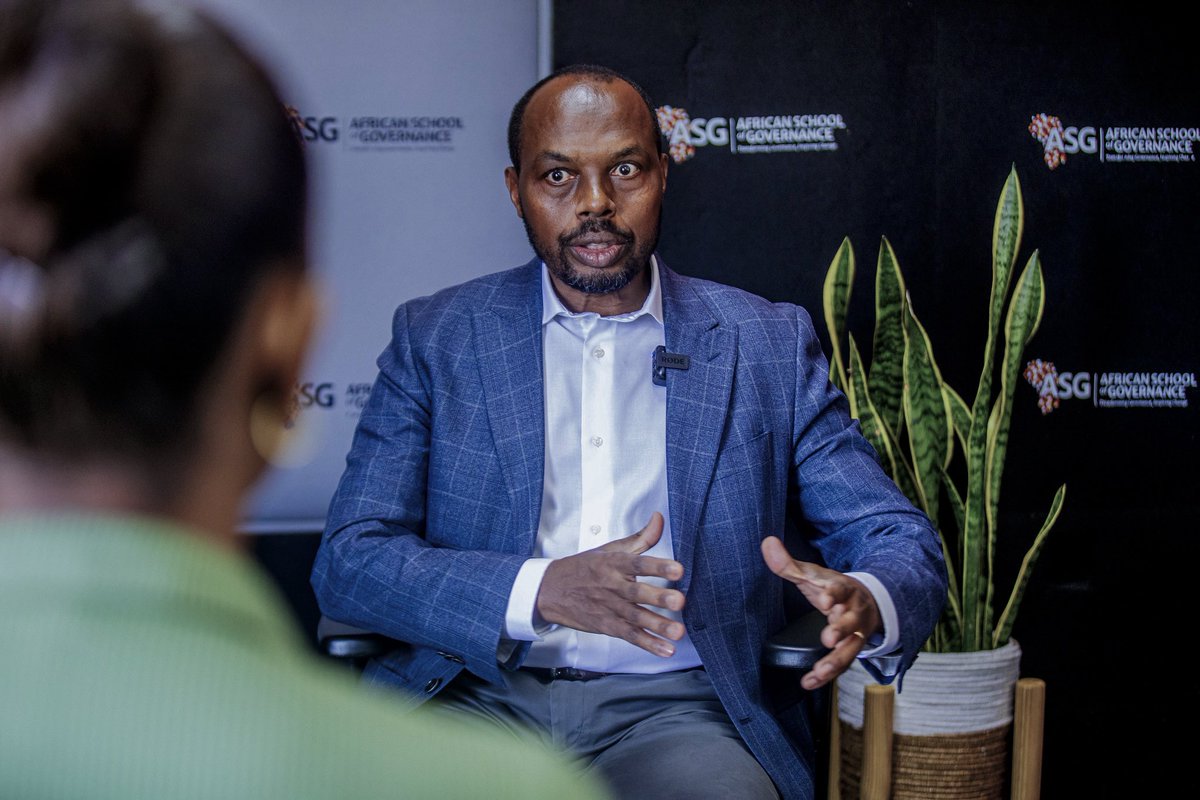
The president of the African School of Governance (ASG) argues that Africa’s governance crisis cannot be solved simply by building stronger institutions or producing more experts. It must begin with changing the character, values and mindset of the people who lead them.
“Many challenges that you see magnified as institutional challenges or as societal challenges, the origin is at the individual level,” Gatare said in an interview with Kigali Today Ltd.
His argument is the foundation of the African School of Governance, an initiative established by President Paul Kagame of Rwanda and former Ethiopian Prime Minister Hailemariam Desalegn.
The school was created around a question that Gatare says emerged from the founders’ experience: Why do highly educated and technically capable Africans sometimes fail to deliver results once placed in positions of responsibility?
The answer, he says, is that expertise alone does not make a leader.
Beyond the Expert
Gatare divides effective leadership into three layers.
The first is technical competence. An economist should understand economics. An engineer should understand engineering. A doctor should understand medicine.
But technical knowledge, he argues, is only the starting point.
The second is management — the ability to manage organisations, people and, importantly, oneself.
The third is leadership, which requires something deeper: character, ethics and values.
“You can be a good manager, but it doesn’t make you a leader,” Gatare said.
The school therefore targets people who are already professionals rather than trying to replace conventional universities.
Its purpose is to add another layer to their education.
For a journalist, for example, that means learning not only how to report a story but how to use journalism responsibly and ethically in the public interest.
The same principle applies to professionals in government, business, medicine, engineering and other fields.
The Three Questions Leaders Must Answer
At the centre of ASG’s approach are three ideas: identity, privilege and purpose.
The first is identity.
Gatare argues that many Africans continue to define themselves primarily through narrow ethnic, tribal or national identities rather than seeing themselves as part of a larger African community.
That matters, he says, because identity influences loyalty — and loyalty influences how a person uses their position.
“A lot of people don’t see themselves as real Africans,” he said.
For ASG, developing an African identity is not about abandoning national identities. It is about understanding that the prosperity of one African country is connected to that of its neighbours and the wider continent.
The second issue is privilege.
Some people have access to education, authority, money, information or platforms that others do not.
Gatare says the question is what they do with that advantage.
Too often, he argues, people use privilege to acquire even more privilege rather than to serve the communities that enabled them to rise.
That leads to the third question: What is your purpose?
Gatare says ASG asks participants to confront a simple reality — everyone eventually dies.
The question, therefore, is what a person does with the knowledge, resources and authority they possess while they are alive.
“When you have resources that can take care of yourself and your family, you have a responsibility for the service of others,” he said.
For Gatare, leadership is ultimately about legacy.
Fixing Institutions by Changing People
This philosophy also shapes how ASG approaches Africa’s familiar governance problems.
Weak institutions, corruption and poor policy implementation are often discussed as structural problems. Gatare sees them partly as consequences of individual behaviour.
A leader’s beliefs and values influence his or her behaviour. Repeated behaviour becomes habit, and habits can eventually become institutional culture.
The reverse can also happen.
A leader committed to fairness, integrity and results can build institutions around those principles and influence the people working within them.
“Everybody can make a plan. Anybody can buy or write a strategy,” Gatare said. “But the discipline that is required to get a strategy off the ground to see results is what makes a difference.”
That emphasis on execution is particularly important for a continent where ambitious policies and development plans frequently encounter problems during implementation.
Changing the African Mindset
ASG is now trying to take the conversation beyond its classrooms through the inaugural Africa Mindset Reset Forum, held in Kigali this week August 25-26.
Gatare describes the forum as an attempt to start a broader continental conversation about the attitudes that hold societies back.
He contrasts two possible mindsets.
One sees scarcity and asks what can be done with limited resources.
The other looks for possibilities even in difficult circumstances.
One accepts mediocre standards.
The other demands excellence.
For Gatare, Africa needs more of the second.
The ambition is not simply to organise a conference, but to create a network of people and institutions across Africa that share the same commitment to leadership, values and service.
“One school cannot teach the whole continent,” he said.
ASG therefore wants to build partnerships with institutions and individuals across the continent, eventually reaching all 54 African countries.
The challenge is turning an idea about mindset into measurable change.
Gatare’s answer is to begin where leadership itself begins: with the individual.
The continent may need better institutions, stronger policies and more resources. But, in his view, none of those will be enough if the people entrusted with them lack the character and sense of purpose to use them well.
“What will be the purpose of your existence?” he asks.
For ASG, that may be the more fundamental question behind Africa’s governance crisis.

1 comment
Highly ambitious project that might redefine Africa and her peoples destiny if it is holistically implemented but it requires ASG to encapsulate the rock of Gibraltar mindset. Congrats on the successful hosting of the forum.
Comments are closed.