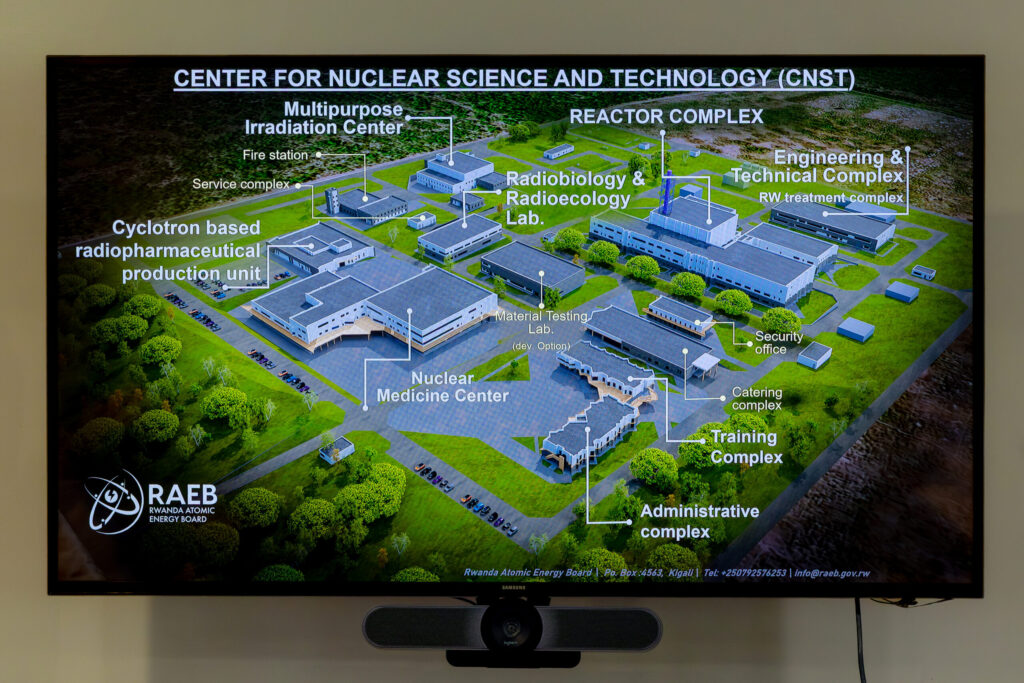
A model of a nuclear plant with Small Modular Reactors (SMRs) that Rwanda intends to establish.
KIGALI — Nuclear science and technology extend far beyond electricity generation. Today, it drives modern medicine through cancer diagnosis and treatment, supports agricultural innovation, enhances industrial quality control, aids water resource management, and enables advanced scientific research. This multi-purpose technology strengthens national development across multiple sectors simultaneously.
In Rwanda, this broader potential intersects with a pressing structural challenge: a limited domestic energy footprint. Combined, Rwanda’s existing electricity sources—hydropower, methane gas, solar, peat, and diesel—generate roughly 1,000 megawatts (MW). This figure has become a critical benchmark as economic activity expands.
Government projections estimate that Rwanda’s electricity demand could surge to between 2.5 and 4.5 gigawatts (GW) by 2050. This widening gap cannot be closed by incrementally expanding existing systems alone, prompting policymakers to explore long-term alternatives, including nuclear energy.
To address these regional energy dynamics, Kigali is hosting the second edition of the Nuclear Energy Innovation Summit on Africa (NEISA 2026). The three-day continental gathering brings together experts, policymakers, scientists, and energy stakeholders to discuss the future of nuclear science on the continent.
While nuclear conversations remain distant or politically sensitive for many nations, Kigali’s approach is increasingly technical and development-focused. Hosted by President Paul Kagame, the summit has drawn high-level participation, including Dr. Samia Suluhu Hassan, President of the United Republic of Tanzania, and Faure Essozimna Gnassingbé, President of Togo.
A Baseload Option for National Development
A defining advantage of nuclear energy is its ability to provide continuous baseload electricity. Unlike weather-dependent solar or wind power, nuclear plants operate consistently day and night, providing a stable, predictable output.
This stability is achieved through nuclear fission—the process of splitting uranium atoms inside a controlled reactor. The reaction generates intense heat to produce steam, which drives turbines to generate large-scale, steady electricity. Notably, a single conventional nuclear reactor can produce between 1,000 and 1,200 MW, effectively matching Rwanda’s entire current installed capacity.
According to Dr. Fidele Ndahayo, Chief Executive Officer of the Rwanda Atomic Energy Board, nuclear energy is being prioritized for both its scale and its reliability.
“The specificity of nuclear power is that it is available 24 hours a day, seven days a week for several years,” Ndahayo said. “You need to avoid any disruption in generation because disruption may lead to bad consequences.”
For Rwanda, this reliability is central to supporting industrial growth, expanding digital infrastructure, and driving long-term economic transformation.
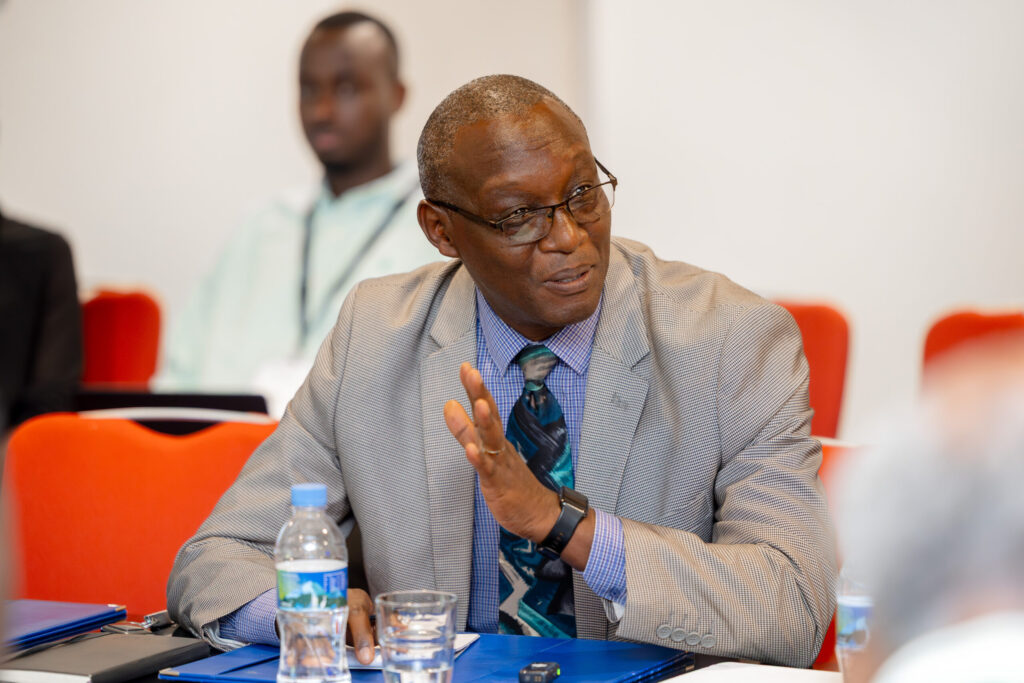
Dr. Fidele Ndahayo, the Chief Executive Officer of the Rwanda Atomic Energy Board, speaking during a press briefing on May 18, 2026.
Why Small Modular Reactors Fit Rwanda’s Strategy
Rather than pursuing massive, conventional nuclear plants, Rwanda is focusing on Small Modular Reactors (SMRs)—a newer generation of nuclear technology designed for flexibility and phased deployment.
Traditional nuclear plants require vast land areas and extensive safety exclusion zones, making them impractical for densely populated or geographically smaller nations.
“In Rwanda, which is almost 26,000 square kilometers, large nuclear power plants are not really an option,” Ndahayo explained.
SMRs, by contrast, are built in smaller units and can be scaled gradually to match demand. This allows countries to introduce nuclear capacity incrementally while managing costs and infrastructure requirements more effectively.
“Luckily, the market now has small modular reactor technologies under development. You can scale the production depending on demand,” Ndahayo added.
Rwanda aims to deploy its first SMR in the early 2030s, with long-term projections targeting approximately 1.5 GW of nuclear capacity by 2050.
Financing, Safety, and the Energy Transition
Despite its promise, nuclear energy remains one of the world’s most complex and capital-intensive infrastructure undertakings. Development costs run into the billions of dollars, and implementation timelines typically stretch between seven and ten years before a plant becomes operational.
This lengthy preparation requires establishing rigorous regulatory frameworks, environmental safeguards, a skilled workforce, cybersecurity systems, emergency preparedness mechanisms, and a national grid capable of handling uninterrupted, high-load electricity.
Safety remains a paramount consideration. While nuclear accidents are statistically rare, Rwanda is emphasizing preparedness for low-probability, high-impact scenarios. Earlier this year, the International Atomic Energy Agency (IAEA) conducted an Integrated Nuclear Infrastructure Review (INIR) mission in Rwanda, confirming that the country has made substantial progress in its early-stage nuclear readiness.
Ultimately, Rwanda views nuclear science not as a replacement for its current grid, but as a foundational layer for a more stable, scalable, and diversified energy future, alongside its continued applications in healthcare, agriculture, and scientific research.