


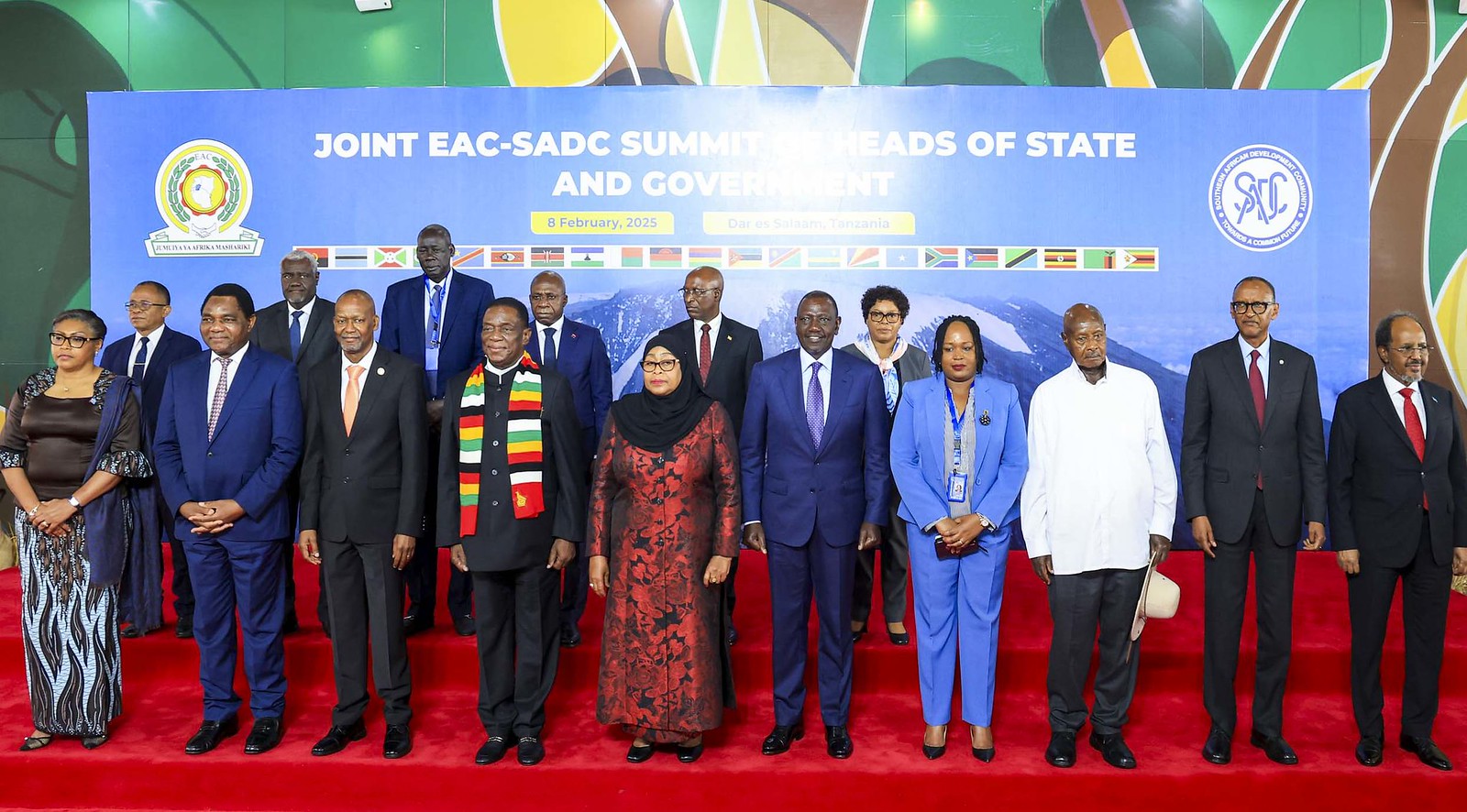
East African Community (EAC) and Southern African Development Community (SADC) Joint Summit on eastern DRC | Dar es Salaam, 8 February 2025
Kigali – The government of Rwanda has warned that military operations could be launched against the Democratic Forces for the Liberation of Rwanda (FDLR) if its fighters refuse to voluntarily return home, with regional forces from the East African Community (EAC) and Southern African Development Community (SADC) likely to be involved.
Foreign Affairs and International Cooperation Minister, Ambassador Jean Patrick Olivier Nduhungirehe, made the remarks on Tuesday while briefing the Chamber of Deputies on the peace agreement signed between Rwanda and the Democratic Republic of Congo (DRC) in Washington on June 27, 2025.
The agreement outlines a series of commitments, including the dismantling of the FDLR, which is made up of remnants of the perpetrators of the 1994 Genocide against the Tutsi. It also requires the Congolese government to terminate all forms of support to the group.
“This agreement is a major step toward restoring peace, security, and trust between Rwanda and the DRC,” Minister Nduhungirehe told lawmakers.
He noted that the deal includes provisions for joint security coordination and the creation of a monitoring committee with representatives from both countries, the United States, Qatar, and Togo.
Rwanda, the minister said, has a long-standing system in place to reintegrate former FDLR fighters who voluntarily repatriate.
“We continue to receive returnees at Mutobo Demobilisation and Reintegration Centre, and we are prepared to do the same now. But for those who refuse to return voluntarily, the alternative will be military force,” he said.
Members of Parliament asked who would be authorized to use such force in the event of noncompliance. Minister Nduhungirehe responded that any military engagement would be coordinated through the regional mediation frameworks.
“The EAC and SADC, who are already discussing security interventions in the region, are expected to lead such operations if FDLR fighters defy repatriation efforts,” he explained. He added that the African Union also has a stake in ensuring the peace agreement is enforced.
The minister emphasized that dismantling the FDLR will not be easy, pointing to the visible collaboration between FDLR and the Congolese army (FARDC). He cited the recent case of former rebel commander Brig Gen Gakwerere, who returned from Congo dressed in FARDC military uniform.
Since its formation after the 1994 genocide against the Tutsi, the FDLR has been responsible for deadly cross-border attacks into Rwanda. In 2019, it launched an attack in Kinigi, Musanze District, ahead of Rwanda’s preparations to host the Commonwealth Heads of Government Meeting (CHOGM).
In April 2025, following the fall of Goma to M23 rebels, FARDC and FDLR forces—alongside SADC troops—were accused of shelling Rwandan territory, killing 16 civilians, injuring many others, and causing widespread property damage.
Rwanda has repeatedly demanded that the DRC cease support for the FDLR and has maintained that failure to do so forces it to reinforce its national defense posture.
“The presence and support of FDLR within the DRC threatens our security,” Nduhungirehe said. “If peaceful reintegration is rejected, then firm military action—through regional collaboration—will be the only remaining option.
