



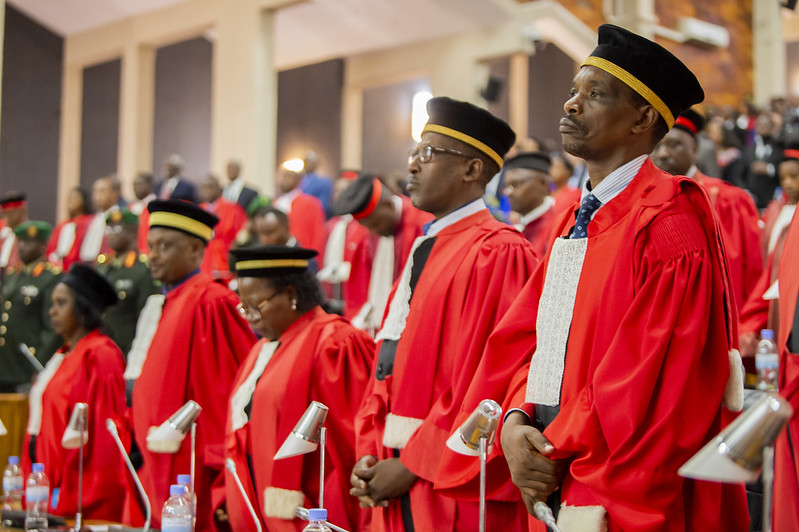
Supreme Court bench at previous state function
In a groundbreaking ruling, the Supreme Court of Rwanda has quashed its own conviction of businessman Mironko François Xavier, overturning a decision made earlier this year in which he was sentenced for contempt of court.
The Court declared part of Article 81 of Law No. 22/2018 unconstitutional, specifically addressing provisions related to immediate sentencing for contempt of court during hearings.
The case began on February 22, 2023, when Mironko, a prominent businessman, was convicted of contempt of court during a hearing for his case RS/INJUST/RCOM00001/2019/SC.
The charge stemmed from remarks he made during proceedings, in which he accused the court of bias and unfair rulings. The Court acted swiftly, sentencing him to two years in prison, with one year and nine months suspended. Mironko was immediately taken to prison.
However, in a surprise development, Mironko was released after serving three months in prison from February 22, 2023. There has not been an explanation as to what changed.
In its ruling, delivered on July 26, 2025, the Supreme Court examined Mironko’s claims and the application of Article 81, which grants courts the power to immediately sentence individuals who commit offenses during hearings—whether or not the court has jurisdiction to hear such offenses initially.
The actual article from Law No 22/2018 governing civil, commercial, labour, and administrative procedures, reads:
Article 81: Trying offences of contempt of court
A person who, during the hearing, commits an offence punishable by a maximum sentence of imprisonment for five (5) years, the court may immediately sentence the perpetrator even if in practice the court has not jurisdiction to hear such an offence in the first instance.
In such a case, the judge adjourns the hearing and orders security personnel to take the perpetrator out of the courtroom and calls the public in the hearing to order. The court registrar takes minutes of what has happened. The judge immediately writes a judgement based on the facts and violated legal provisions, then gets the person having been expelled back to the courtroom and reads to him/her the judgement rendered against him/her in all its provisions, and re-opens the hearing. No other formalities take place and the parties are not allowed to take the floor with regard to the offence committed.
If the offence committed in the hearing is punishable by a sentence of imprisonment for more than five (5) years, the court orders security personnel to arrest the perpetrator and makes a statement detailing the facts, and the perpetrator together with his/her file are taken to the competent public prosecutor in order to prepare the file and submits it to the court.
Decisions taken according to the provisions of this Article are enforced with immediate effect.
Under the article, a person found guilty of contempt of court can be sentenced immediately, without the opportunity to defend themselves or present legal arguments.
The Court found that while the first paragraph of Article 81 was constitutional, the second paragraph, which allows for immediate sentencing without due process or the right to appeal, was in violation of the Rwandan Constitution.
The Court ruled that this provision contravened Article 29 of the Constitution, which guarantees the right to be informed of the charges, the right to legal defense, and the right to appeal.
Court’s Findings and Reasons
The Supreme Court highlighted several points in its judgment:
- Violation of Fair Trial Rights: The Court noted that the second paragraph of Article 81 violates the right to a fair trial by denying the accused the opportunity to be informed of the charges or to have legal representation.
- Infringement on the Presumption of Innocence: The Court emphasized that a person should be presumed innocent until proven guilty in a court of law. Immediate sentencing, without due process, effectively bypasses this principle.
- Unconstitutionality of Immediate Sentencing: The Court found that while courts have the authority to maintain order during proceedings, immediate punishment for contempt of court could not override the rights guaranteed under the Constitution. In particular, the right to a fair trial and the right to appeal must be respected.
- Corrective Action: The Supreme Court ordered paragraph two of Article 81 to be rewritten to reflect due process, ensuring that those accused of contempt are given the chance to defend themselves before being sentenced. The Court also emphasized that the accused must be provided with the opportunity to appeal the judgment.
The Decision’s Immediate Impact
The Court’s decision to quash its own conviction of Mironko is unprecedented and carries significant legal implications.
By overturning the conviction and declaring part of Article 81 unconstitutional, the Court reinforced the importance of constitutional rights in the judicial process, ensuring that fair trial guarantees are upheld in all legal proceedings.
Mironko’s legal team expressed satisfaction with the ruling, noting that this case sets an important precedent for future cases involving contempt of court.
They also highlighted the need for judicial reforms to ensure that laws do not infringe upon the rights of individuals, particularly in cases involving freedom of speech and the right to a defense.
The ruling also casts a spotlight on the broader application of Article 81 and its implications for Rwanda’s judicial system. The provision, which was designed to maintain order in the courtroom, has now been deemed unconstitutional in part, paving the way for further review and potentially more changes in how contempt of court offenses are handled.
This ruling will automatically lead to future reforms, as courts and lawmakers seek to balance the need for maintaining decorum in judicial proceedings with the necessity of upholding constitutional principles.

1 comment
My insights have been understood as analysed in my LL.M thesis here https://dr.ur.ac.rw/handle/123456789/1403
Comments are closed.