


Mushimiyimana Claude is not your ordinary rural young man
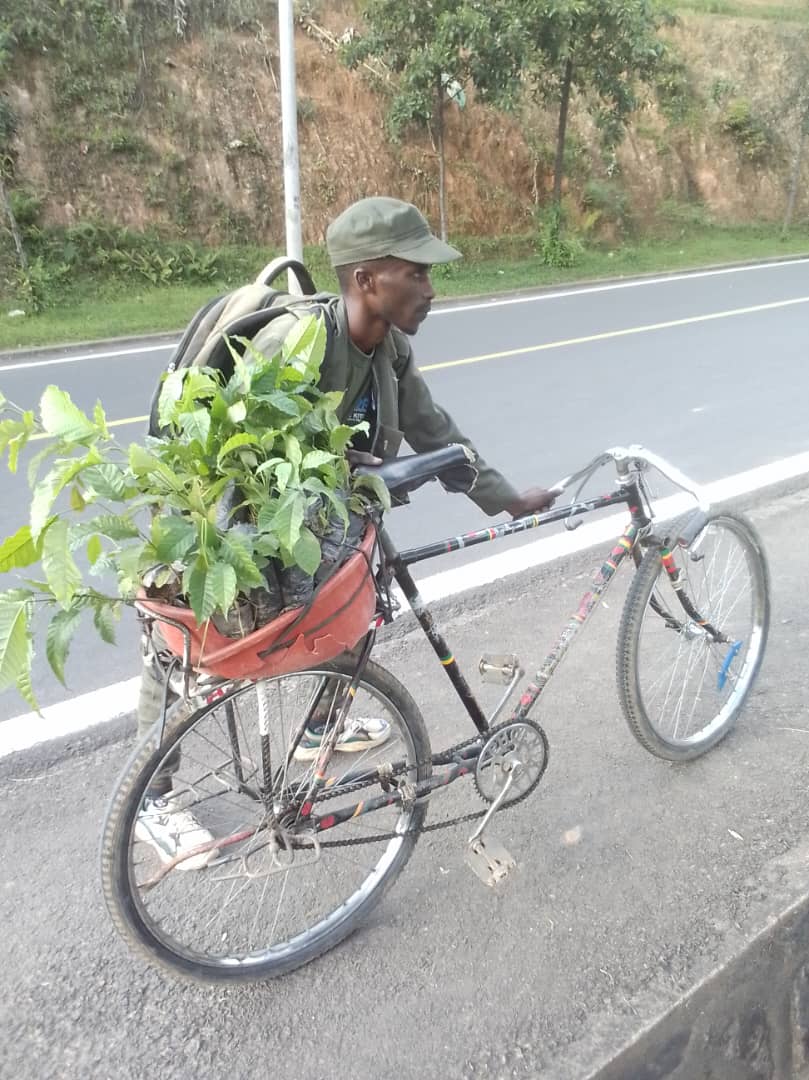
At sunrise, while most of his peers are still in bed or preparing for class, Mushimiyimana Claude is already on the move—his bicycle loaded with tree seedlings, a hoe strapped to the frame, and purpose in his stride.
The 25-year-old student from Mubuga Cell, Gihombo Sector, in Nyamasheke District, has made it his personal mission to protect the environment, one tree at a time.
Along a 5-kilometer stretch of the scenic Kivu Belt Road in Kirimbi Sector, Claude has quietly planted 2,470 trees—mostly by himself, with no big sponsorships or media fanfare.
His journey began not with a tree, but with a clearing.
“On November 3, 2024, I started by weeding the trees that had already been planted, just to help them grow better,” he recalls. “But then I realized that wasn’t enough. So I started planting new trees.”
What followed was months of determined effort. He planted 1,035 trees near drainage areas and another 1,435 along the roadside.
He did it using his own hands and his own means—digging the holes, planting, and transporting the seedlings by bicycle.
Mushimiyimana would begin each day at 7:00 a.m. and keep going until 6:00 p.m., working through heat and dust, driven by a deep love for biodiversity and a desire to give back to his country.
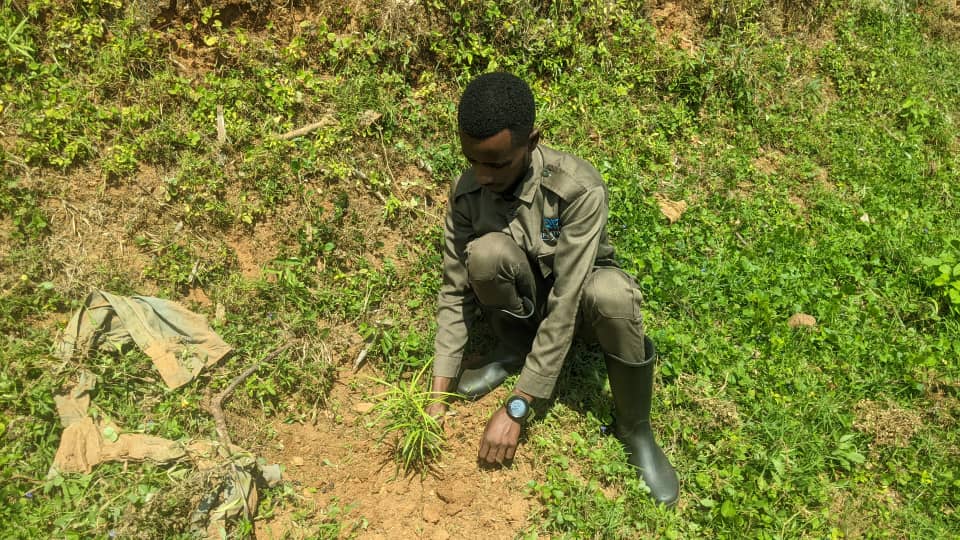
Mushimiyimana is currently studying Biodiversity Conservation at RP Kitabi College – Rusizi Campus, and says his work is a way of putting theory into practice.
“I want people to understand that it’s not just about what we learn in class,” he says, “It’s also about what we do with it.”
In an interview with Umuseke, Mushimiyimana shared that his actions initially drew skepticism.
“Many people tried to discourage me when I started. But now, they’re beginning to understand the importance of tree planting. Some even ask me for seedlings so they can plant in their own fields.”
Unfortunately, he doesn’t yet have the resources to run a nursery of his own.
The seedlings he plants come mostly from the Red Cross, and he admits that meeting the growing demand from neighbors is a challenge.
Still, that hasn’t stopped him.
What’s perhaps most striking about Mushimiyimana’s story is that he hasn’t spent a lot of money to make a big impact. What he lacks in funds, he has made up for with time, energy, and determination.
“It didn’t cost me much at all. I used my physical strength. I would dig the holes, plant the trees, and transport them myself by bicycle,” he says. “I did this to show people that you don’t need to be rich to serve your country. You don’t need to have solved all your personal problems either. Sometimes, all it takes is sacrifice.”
His message to Rwandan youth is as clear as the path he’s carved along the Kivu Belt Road.
“Planting a tree is a small act, but it has a big impact. It protects the Earth, gives us clean air to breathe, reduces the effects of climate change, and contributes to our economy and well-being.”
Many of the trees he planted months ago are already thriving. The road looks greener now, more alive—and for those who used to scoff, it’s now a living testament to what one person can do with no money, but a lot of heart.
Mushimiyimana continues to work toward his vision, unshaken by sun or doubt. His bicycle remains his faithful partner, ferrying seedlings to the earth one trip at a time.
He may be a student, but in many ways, Mushimiyimana is already teaching Rwanda a lesson—about environmental responsibility, quiet leadership, and how to build a greener future with nothing but willpower and a hoe.

