




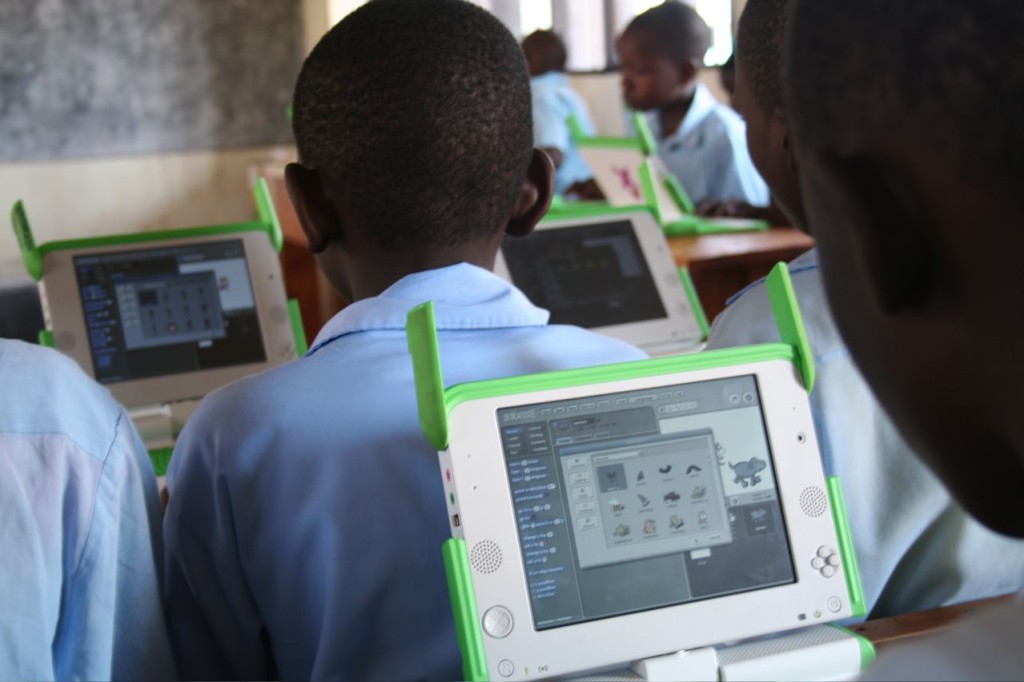
Learners attending a basic computer lesson. For educators and policymakers, AI represents both opportunity and risk. On one hand, it democratizes access to knowledge: students in remote areas with limited textbooks can now access instant explanations.
On a quiet evening in Kigali, Umuhoza Alice*, a mother of two secondary school students, is interrupted when her children bring her a math problem they can’t solve. They complain that it is too difficult and ask what to do.
Instead of urging them to keep trying with pen and paper, Alice suggests using artificial intelligence (AI). Curious, the children ask how. She pulls out her phone, opens an app, and within seconds a step-by-step solution appears on the screen. The homework, which could have taken hours of frustration, is solved in minutes.
Across town, Murenzi Jean-Paul*, a father of three in primary two (P2), five (P5) and six (P6), faces a similar situation. His children return from school with homework they find overwhelming. Rather than spend the whole evening struggling, Jean-Paul introduces the older ones to an AI-powered learning tool.
With just a few taps, the app explains the P6 math problem in simple language, breaking it down to their level. The P5 and P6 learners not only finish their homework faster but also gain the confidence to tackle similar questions the next day. It appears this parent has been doing this for quite some time.
Scenes like these are no longer rare in Rwanda. From primary classrooms to university lecture halls, artificial intelligence has quietly become part of the country’s education story. While many students and parents first encounter AI through free mobile apps or websites that provide step-by-step answers, the technology is now reshaping how learning itself is understood.
Exam Results in the Spotlight
The surge in AI use comes at a time when Rwanda has been closely examining performance in national exams. Primary Leaving Exams (PLE) and O’Level secondary (S3) results released this Tuesday revealed wide differences in district performance and highlighted persistent challenges in mathematics and science.
While some districts achieved pass rates above 90%, others trailed significantly behind, raising concerns about equity and quality.
For many families, this performance gap is not abstract. It plays out daily in the living room when children struggle with assignments that parents cannot always guide them through.
AI tools, with their instant explanations and worked-out solutions, are filling that gap. Yet, while the technology offers quick answers, questions are emerging about whether it strengthens learning or simply replaces it.
The AI Shortcut
Among secondary school and university students, the trend is even clearer. In group assignments at universities, students increasingly rely on AI to generate entire projects, sometimes with minimal effort to understand or improve the work. What once required hours of collaboration and discussion, can now be produced in minutes.
The same pattern has been observed in secondary schools, especially for mathematics and science. Teachers report that some students return correct homework but struggle to explain the steps during class discussions.
“The answers are perfect, but the reasoning is missing,” one Kigali teacher noted. “That is when you suspect AI did the work.”
For educators and policymakers, AI represents both opportunity and risk. On one hand, it democratizes access to knowledge: students in remote areas with limited textbooks can now access instant explanations.
On the other hand, it threatens to undermine critical thinking if learners lean on it for ready-made answers without engaging with the process.
A Double-Edged Tool
The Ministry of Education has acknowledged the dilemma and is moving toward structured solutions. KT Press has been informed that 150 teachers—five from each district— have undergone training in AI literacy.
The goal is to prepare a large pool of educators who can guide students not only in using AI, but in using it responsibly: as a supplement to learning, not a replacement.
According to education sector observers, and officials at the Ministry of Education, both parents highlighted above are unintentionally committing two wrongs.
First, by stepping in to complete their children’s assignments, they undermine the very purpose of homework, which is meant to test whether children have understood concepts taught in class.
Second, instead of using AI tools to deepen understanding and guide students through the process, they resorted to extracting ready-made answers.
In effect, the children may have submitted neat work but gained little in terms of actual learning—perhaps even rushing off to watch television instead of grappling with the lesson.
VIDEO – Here is a case of two siblings that been helped by their teachers to see how AI can be a force for good. One designed a platform that can do real-time translation, while the other came up with platform through which you can send messages to colleagues whole offline.
Looking Ahead to 2026
Starting in 2026, Education Minister Joseph Nsengimana says plans are underway to formally integrate AI literacy into the country’s education framework.
The approach will emphasize how students can use AI tools to enhance problem-solving, research, and creativity while maintaining academic integrity.
Early pilots are already considering classroom exercises where teachers must compare AI-generated solutions with their own, learning to critique and refine rather than simply copy.
This shift reflects a broader understanding: AI is not going away. If anything, its presence in classrooms and homes will only deepen. For a country striving to build a knowledge-based economy, preparing young people to use AI wisely may be as important as teaching them to read and write.
Back to the Dining Table
Back in Kigali, Alice* watches her children marvel at how quickly the app untangled their math challenge. For her, the relief is immediate—the homework is done, the evening is calm. But the larger question lingers: did her children truly learn the concept, or did the app simply hand them the answer?
Jean-Paul* shares the same worry when he sees his younger children breeze through assignments with AI assistance. While proud they can now complete tasks without tears, he wonders whether their foundation in critical skills is being built strongly enough for the future.
*Names of parents were changed and specific details left out to avoid attracting unnecessary attention onto these homes
