


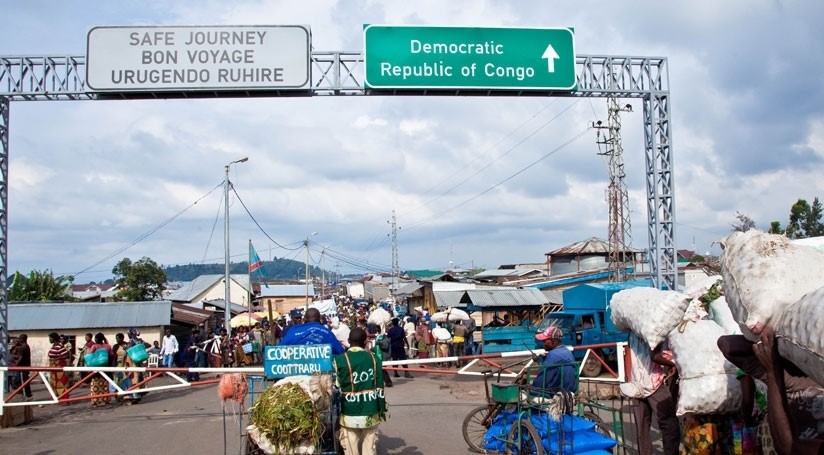
The Democratic Republic of Congo (DRC) has emerged as Rwanda’s most reliable export market, now taking in more than one-fifth of the country’s total exports.
The latest figures from the National Institute of Statistics of Rwanda (NISR) show that in the second quarter of 2025, exports to DRC reached US$ 69.9 million, or 20.2 percent of Rwanda’s total exports.
Breaking this down, domestic exports rose to US$ 21.5 million, up from US$ 14.9 million in the same period of 2024. These include agricultural produce, construction materials, and manufactured goods produced locally.
In contrast, re-exports fell to US$ 48.3 million, down from US$ 65.9 million a year earlier. Re-exports mainly consist of goods such as fuel, food, and consumer products imported into Rwanda and then traded across the border.
The ddecline is linked to tighter regional fuel supply chains, higher import costs, and shifting distribution routes that bypass Rwanda. At the same time, the steady rise in domestic exports shows Rwanda is building stronger demand for its own products in the DRC market.
So what does Rwanda send to DRC? Rwanda’s exports to Congo are a lifeline for communities and businesses, dominated by essential goods.
The flow is numerous, ranging from bags of Rwandan cement for construction, to sacks foodstuffs such as beans and maize, and packaged milk.
Alongside these staples are re-exported consumer items that fill market stalls, from petroleum products to bundles of second-hand clothing and plastic household wares to soft drinks and beer, all traveling by truck from Kigali to Goma and Bukavu, fueling cross-border trade and daily life.
Recent trends since February this year also point to the relative improvement in stability in eastern Congo and shifting market perceptions as factors behind this surge.
In the past, Rwandan products sometimes faced resistance in Congolese markets due to political tensions. Today, however, with consumer demand rising and supply chains adapting, Rwandan goods are increasingly seen not through a political lens but as affordable and readily available alternatives.
This change in perception, combined with proximity and lower transport costs, has allowed Rwandan products — from foodstuffs to manufactured items — to find a more secure foothold in DRC’s fast-growing market.
After the DRC, Rwanda’s other leading export destinations in Q2 2025 were China (US$ 40.9m), Belgium (US$ 14.4m), and Luxembourg (US$ 13.6m).
The United Arab Emirates, once Rwanda’s largest partner with over US$ 288 million in Q2 2024, saw its share collapse to just US$ 97.9 million this year.
Within the East African Community (EAC), exports to Uganda stood at US$ 7.5 million, Burundi US$ 5.6 million, Tanzania US$ 1.5 million, and Kenya US$ 1.0 million.
Altogether, the EAC absorbed a growing share of Rwanda’s domestic exports, reflecting stronger regional integration. However, re-exports to EAC countries fell sharply, highlighting changing dynamics in cross-border supply chains.
In just two years, DRC’s share of Rwanda’s exports has more than doubled — from 7.9 percent in 2023, to 10.2 percent in 2024, and now 20.2 percent in 2025.
With DRC absorbing nearly a significant amount of Rwanda’s re-exports while also expanding its demand for locally produced goods, it is firmly consolidating its place as Rwanda’s most important regional trade partner.
