





Kigali, Rwanda – Rwanda is turning to data to make better decisions in schools and improve learning for all students.
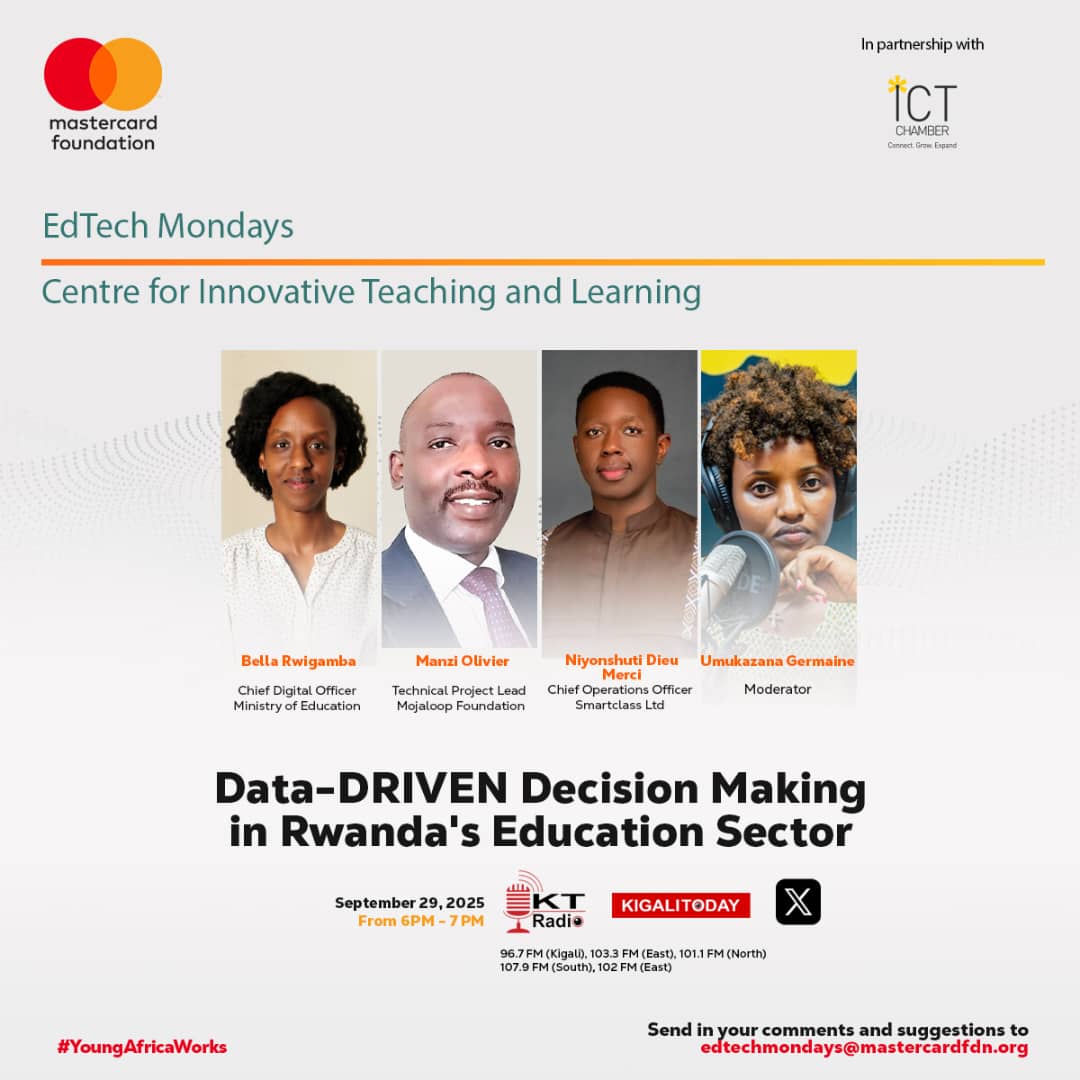
The September 29, 2025 edition of EdTech Mondays will discuss how using information from classrooms, teachers, and communities can help the country close education gaps and plan for the future.
Discussions will focus on how data can be used to guide resource allocation, improve teacher deployment, and ensure fairness between rural and urban schools.
Rwanda already has a high primary school attendance rate of 92.8% and youth literacy of 88% (NISR, 2024). However, digital literacy remains low at 12.8% nationally and only 6.6% in rural areas.
The program will also highlight ongoing initiatives such as the Ministry of Education’s digitization of school records and the Smart Classroom program, which has equipped 10% of primary schools and 45% of secondary schools with digital learning tools (UNESCO, 2021).
With 44% of schools still offline (MINICT, 2023), data is expected to play a key role in targeting investments where they are needed most.
The live talk show, as usual, will air this evening from 6:00 to 7:00 pm on KT Radio and stream on Kigali Today’s YouTube channel.
It is organized by the Mastercard Foundation Centre for Innovative Teaching and Learning in ICT in partnership with the Rwanda ICT Chamber.
Panelists will include Bella Rwigamba, Chief Digital Officer at the Ministry of Education; Manzi Olivier, Technical Project Lead at Mojaloop Foundation; and Niyonshuti Dieu Merci, Chief Operations Officer at Smartclass Ltd. The session will be moderated by journalist Umukazana Germaine.
EdTech Mondays is part of a wider Africa-wide series that also takes place in Kenya, Uganda, Ghana, and Nigeria, and is shared on CNBC Africa and the Mastercard Foundation’s Young Africa Works platforms.
By focusing on data-driven decision making, tonight’s edition aims to inspire teachers, policymakers, and innovators to work together in building a culture of data use that will help Rwanda achieve its ambition of becoming a knowledge-based economy.
