




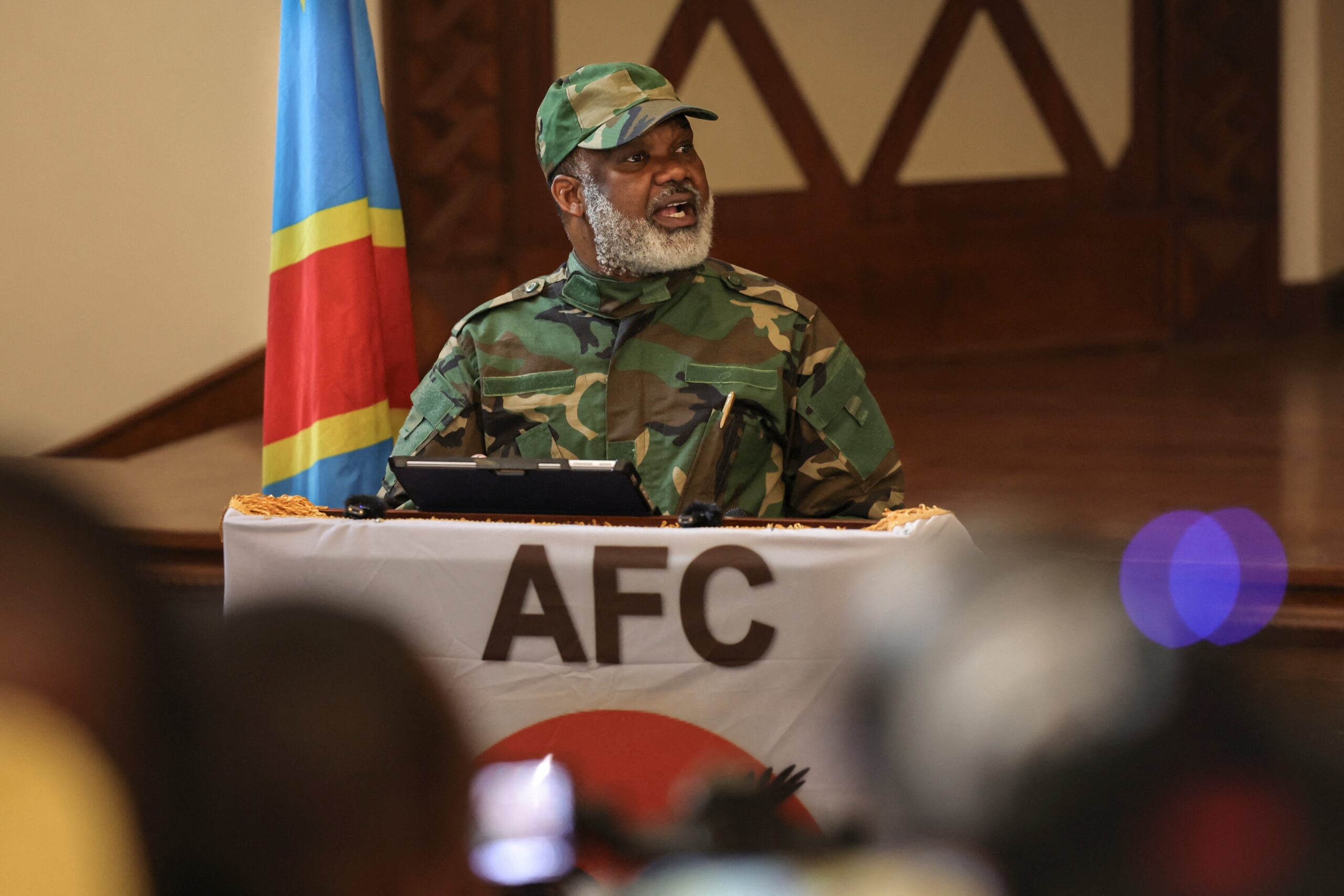
Corneille Nangaa speaking in Goma at a previous event
The Alliance Fleuve Congo (AFC/M23) rebel movement which controls North and South Kivu provinces of eastern DR Congo, has rejected the recent announcement by French President Emmanuel Macron regarding the planned reopening of Goma International Airport, calling the decision “premature, disconnected from reality, and made without consultation.”
In a statement issued by Corneille Nangaa, coordinator of the AFC–M23 coalition, the group expressed “astonishment” that the announcement was made from Paris during the International Humanitarian Conference on the Great Lakes Region, without consultation or consideration of realities on the ground.
“This decision is inopportune, disconnected from the situation on the ground, and taken without any prior consultation with the AFC/M23,” Nangaa said.
President Emmanuel Macron made the unexpected announcement about Goma Airport’s reopening on Thursday, October 30, during the International Conference for Peace and Prosperity in the Great Lakes Region, held in Paris. Seated next to DR Congo’s President Tshisekedi, Togo’s leader and delegates from many countries attended.
Macron told delegates that Goma International Airport would be reopened “in the coming weeks” to facilitate humanitarian flights and aid delivery to vulnerable communities affected by fighting in eastern DRC. He described the move as part of a broader effort to “restore vital infrastructure and humanitarian access” in conflict zones.
“The reopening of Goma airport for humanitarian operations will be an important step in restoring life and hope to the people of eastern Congo,” Macron said. “France and its partners are mobilizing to ensure humanitarian assistance reaches those who need it most.”
Macron also announced that the international community had mobilized €1.5 billion to support humanitarian and economic recovery efforts across the Great Lakes region, including in DRC, Rwanda, Burundi, and Uganda. He urged all parties to commit to “cease hostilities and guarantee access to humanitarian aid.”
For the AFC-M23 leader Nangaa, the decision contradicted the ongoing insecurity in North and South Kivu, where government forces and allied militias allegedly continue to bomb civilian areas, factories, bridges, and humanitarian aircraft.
According to Nangaa, it was contradictory to speak of reopening an airport under humanitarian pretenses while “the very humanitarian actors and civilians it is meant to serve remain under fire.”
The AFC–M23 also denounced what it described as the Kinshasa government’s financial blockade in Goma, claiming banks had been closed and access to personal savings restricted, making daily life “impossible for ordinary citizens.”
The group outlined several issues that, in its view, make any discussion of normalization premature:
Drone strikes allegedly conducted by government forces against civilian targets;
Destruction of humanitarian planes heading to Walikale and Minembwe;
Arbitrary closure of airspace in zones under M23 control to enable military attacks.
Nangaa said that areas under AFC–M23 administration are “peaceful and orderly”, in contrast to “the chaos maintained by Kinshasa.”
He accused what he termed “humanitarian lobbies” of exploiting displacement and suffering for financial and political ends, arguing that France should not lend legitimacy to such actors.
“France should not encourage those who profit from human suffering, but rather support solutions that bring lasting peace,” he said, urging Paris to adopt a more balanced approach in the Great Lakes region.
The statement concluded by reaffirming the group’s commitment to a peaceful resolution through dialogue, in line with frameworks such as the Doha process, and appealed to the international community to “support genuine peace efforts, not those fueling conflict.”
