




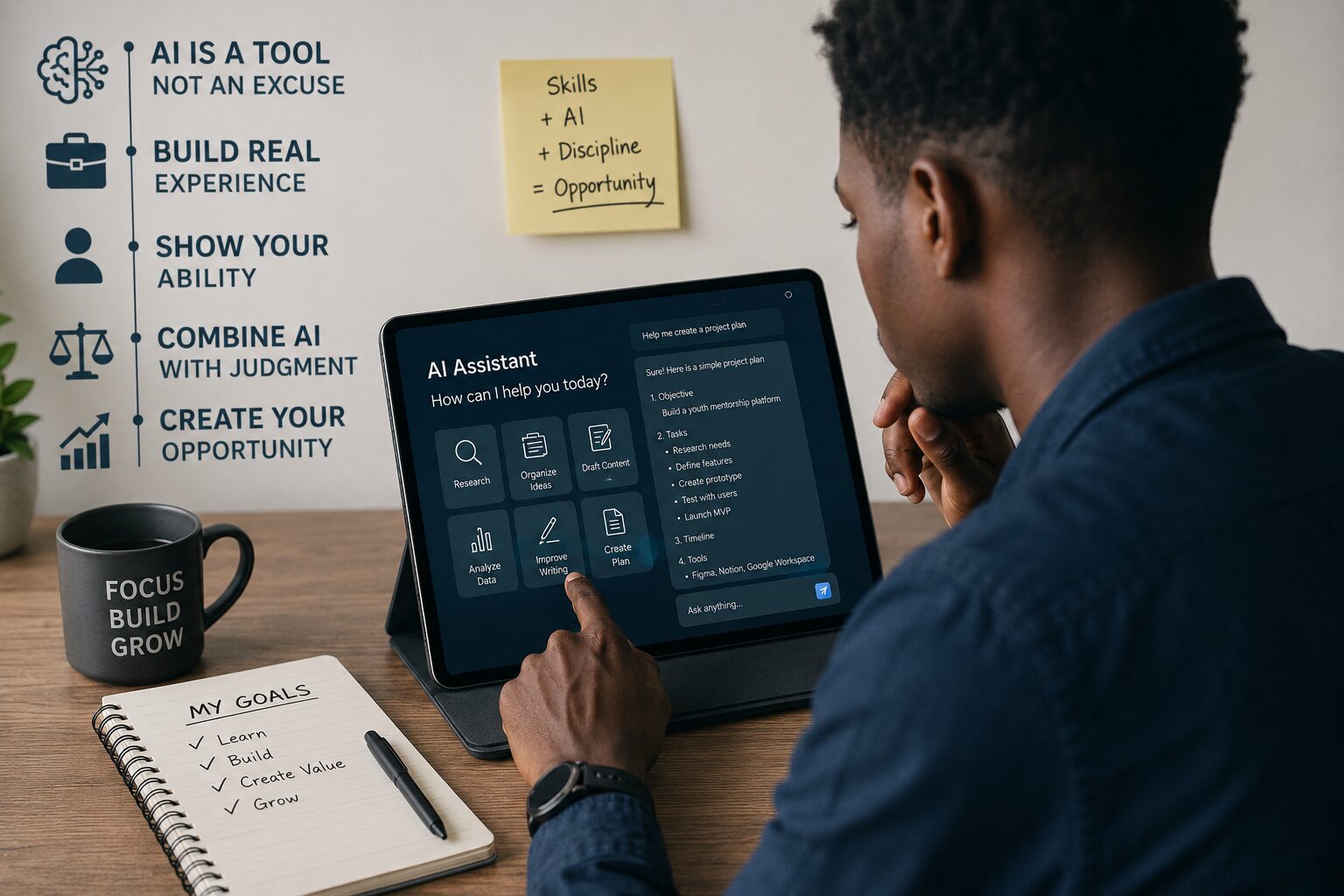
For young Rwandans, the message is simple: do not wait for AI to decide your future. Learn how to use it.
For many young graduates, the first step into work has always followed a familiar path: get a degree, find an internship, enter a junior role, gain experience, and slowly grow.
Artificial intelligence is now challenging that path.
This does not mean every young person should panic. It also does not mean AI will simply take everyone’s job. The real issue is more practical: AI is changing the type of work available at the entry level. Some basic tasks that once helped graduates learn inside organisations can now be done faster by digital tools.
That creates a new question for young professionals: if AI can do some junior tasks, how do young people prove they are still ready for the workplace?
The biggest mistake young people can make is to look at AI in only two ways. Some fear that AI will eat their jobs. Others see AI as an easy way out. Both views are incomplete.
Yes, AI can reduce the need for some tasks. But people who know how to use AI well will become more valuable. And yes, AI can make work easier. But easier should not mean lazier. It should mean faster learning, better thinking, and stronger output.
AI should be used as a tool, not as an excuse.
Many young graduates are still waiting for the old path to work exactly as it did before. They expect degree, internship, junior job, experience. But the labour market is changing. Employers are becoming more demanding. Even for junior roles, they want people who can show initiative, solve problems, communicate clearly, and use technology responsibly.
This is why young people need a new way in.
The new entry-level professional cannot only wait for someone to give them experience. They must start building proof of ability before the first formal job.
Today, that is more possible than ever. A young person can create sample projects. They can do freelance work. They can volunteer for a small business. They can build a portfolio online. They can publish analysis, create useful content, support community projects, or document practical work on platforms such as LinkedIn, YouTube, or a personal website.
This does not replace formal employment. But it shows seriousness.
A graduate who says, “I am looking for experience,” is very different from one who says, “Here is what I have already tried, built, tested, or improved.”
AI can help in this process. It can help a young person prepare research, organise ideas, create project drafts, analyse information, improve writing, design simple workflows, and practise communication. But the young person must remain the thinker. AI should support the mind, not replace it.
A portfolio built with AI is useful only if it reflects real understanding. If a young person cannot explain what they created, why they created it, and how it solves a problem, then the portfolio becomes another form of decoration.
That is why the future of entry-level work will not belong only to those who know AI tools. It will belong to those who combine AI with judgment.
Young professionals should ask themselves: What field am I entering? What problem do I want to solve? What can I build to show my ability? How can AI help me produce better work? How do I verify what AI gives me? How do I communicate the result clearly?
These questions matter more than simply saying, “I know ChatGPT.”
Employers do not only need prompt users. They need people who can understand a problem, ask better questions, check information, work with others, meet deadlines, and take responsibility. These are not old-fashioned skills. They are becoming more important because technology alone cannot provide judgment, trust, and discipline.
For young Rwandans, the message is simple: do not wait for AI to decide your future. Learn how to use it.
Use AI as a career amplifier, not as a shortcut. Use it to build proof, not excuses. Use it to become more creative, not more passive. Use it to prepare for opportunities, not to avoid effort.
The entry-level door may be changing, but it is not closed.
Young people who adapt early, build real examples of work, and combine AI fluency with discipline will still find a way in. The future will not reward those who fear AI or those who use it lazily. It will reward those who use it wisely.
The writer is a career and relationship clarity coach based in Kigali, Rwanda. www.sannankhan.com
