



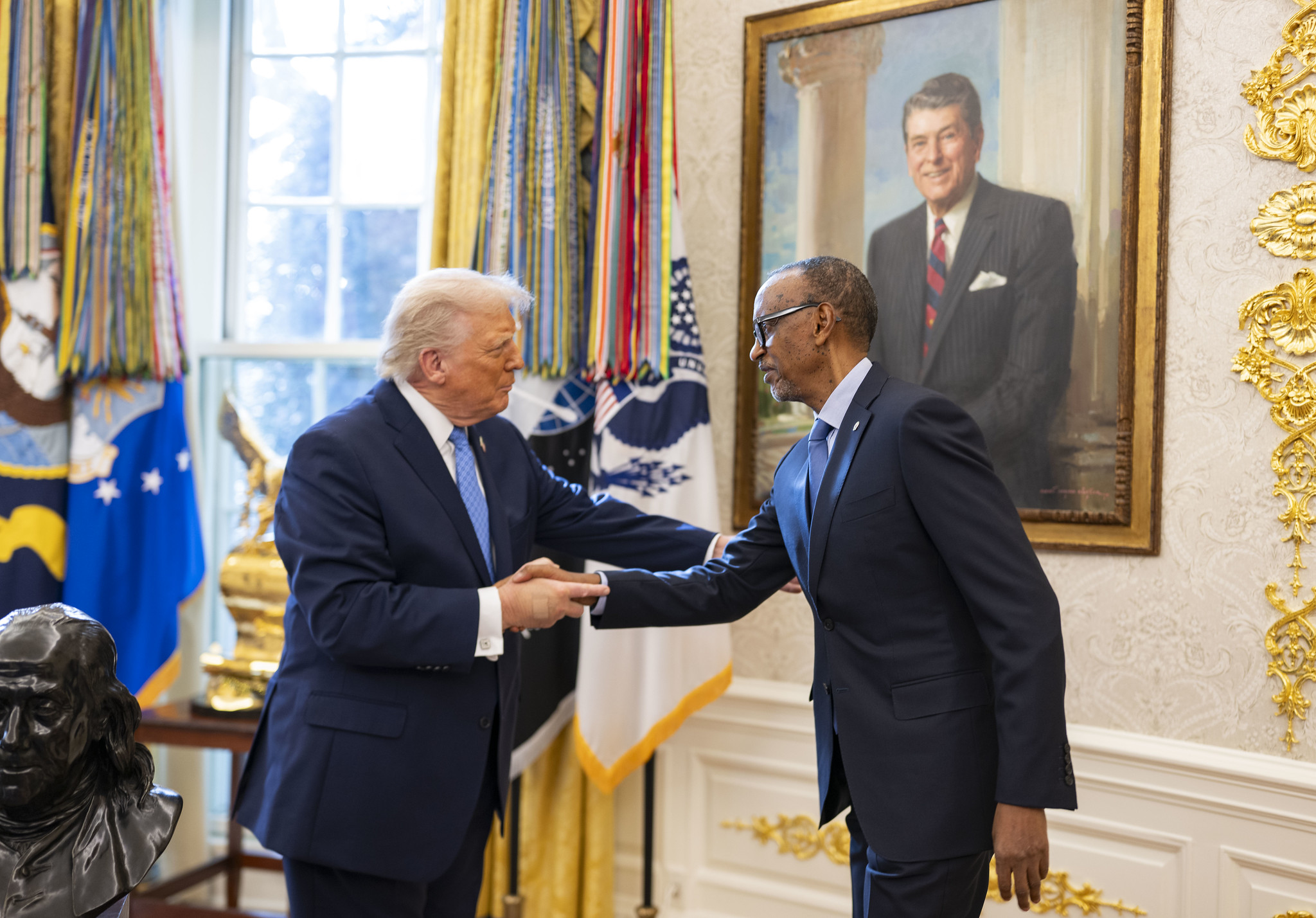
On December 4, 2025, President Kagame was hosted at the White House by President Trump for the signing of the Washing Accords. It was second time the two leaders have met bilaterally
In his recent address to the RPF-Inkotanyi Political Bureau, President Paul Kagame sharply criticized what he described as a carefully manufactured narrative aimed at driving a wedge between the Trump administration and Rwanda.
For those who have closely followed the crisis in the DRC, there is little doubt that a coalition of actors has worked relentlessly to promote the false claim that Rwanda has defied the U.S. and violated the Washington Accords.
As President Kagame pointed out, this narrative gained momentum after AFC/M23 captured Uvira on December 10, 2025, an event he described as the “pretext” these actors used to advance their respective agendas.
Crucially, Kagame stressed that the fall of Uvira was anything but unexpected. It followed months of troop build-ups and offensive operations by the Kinshasa coalition, including Burundian forces.
And indeed, fighting was already underway even as Trump, Kagame, and Tshisekedi met in Washington to sign the peace agreement on December 4, 2025.
According to Kagame, Rwanda had shared intelligence with the U.S. months before the signing ceremony, warning of these developments in South Kivu.
In his view, there was simply no credible basis for portraying the fall of Uvira, just days after the ceremony in Washington, as evidence that Rwanda had reneged on its commitments.
Yet that is precisely how many actors chose to frame it.
The Congolese government has been the principal architect of this narrative. Unable to achieve its military objectives on the battlefield, the Tshisekedi administration has instead pinned its hopes on international sanctions against Rwanda, wagering that economic pressure will somehow shift the military balance in its favor.
The strategy is a familiar reprise of the 2012 playbook. Sanction Rwanda to weaken M23 and, ultimately, restore genocidal forces to positions along Rwanda’s borders, with regime change in Kigali as the long-term objective.
To that end, Kinshasa has invested heavily in lobbying and media campaigns designed to portray Rwanda as the principal obstacle to peace while delaying its own obligations to stop arming and neutralize the genocidal FDLR.
The Western mainstream media has also played a significant role in reinforcing this narrative. Reuters and France 24, in particular, have repeatedly amplified Kinshasa’s claims while giving comparatively little attention to its documented collaboration with genocidal forces.
Humanitarian actors operating under MONUSCO, alongside the hundreds of NGOs spread across eastern Congo, have also contributed to this dynamic. Many have institutional incentives to portray the conflict in the bleakest possible terms because the continuation of the crisis sustains the funding on which their operations depend.
Against that backdrop, AFC/M23’s efforts to establish security and administrative order threaten not only the existing status quo but also the very rationale underpinning much of the international humanitarian presence.
Unsurprisingly, portraying the movement and its allies as the primary villains has become both politically expedient and institutionally convenient.
Human Rights Watch and Amnesty International deserve particular scrutiny. These organizations present themselves as impartial guardians of human rights, yet their reporting has consistently focused on alleged abuses by AFC/M23 while paying comparatively little attention to the anti-Tutsi atrocities committed by Kinshasa-backed militias, including the Wazalendo and the FDLR. This selective emphasis has contributed to a deeply unbalanced public understanding of the conflict.
Adding an “expertise” veneer to this narrative are former members of the UN Group of Experts who now operate as “independent” analysts. Jason K. Stearns is perhaps the most prominent example. Their analyses continue to shape policy debates in Washington and influence UN reporting, often presenting a one-sided interpretation of events on the ground while advocating sanctions against actors who are defending themselves against existential threats.
There also appear to be officials within the American political establishment who have either accepted this narrative at face value or found it politically convenient.
How else does one explain the persistent anti-Rwanda activism of American politicians, including senators, who have never visited either Rwanda or the DRC, yet express unwavering confidence in their understanding of one of Africa’s most complex conflicts?
This also raises important questions about the role of Trump’s senior adviser for African affairs, Massad Boulos. Few American officials possess a deeper understanding of this crisis. He has been centrally involved in both the Washington Accords and the Doha process.
Why, then, has he allowed such a misleading narrative to gain traction? Does he believe the Doha process, which is intended to address the underlying political grievances among Congolese actors, has become expendable? Or does he see value in allowing it to wither?
Whatever the answer, one thing is clear. Many of the actors driving this narrative understand that President Trump cannot personally follow every development in a conflict as complex as the one in eastern Congo. They are seeking to exploit the fact that his administration is preoccupied with multiple global crises, hoping to steer U.S. policy toward decisions that could ultimately unravel the very agreement Washington helped broker.
At this stage, the most effective way to preserve the Washington Accords may be to reconvene a heads of state meeting in Washington and establish an authoritative account of where the agreement stands. What exactly were the commitments undertaken by each party? Which obligations have been fulfilled, and which remain outstanding? Unless these questions are addressed directly, the dominant narrative will continue to shape policy.
If the Trump administration continues to rely on that narrative while escalating sanctions against Rwanda, the peace that appeared within reach in Washington on December 4 may once again slip beyond the region’s grasp.
