



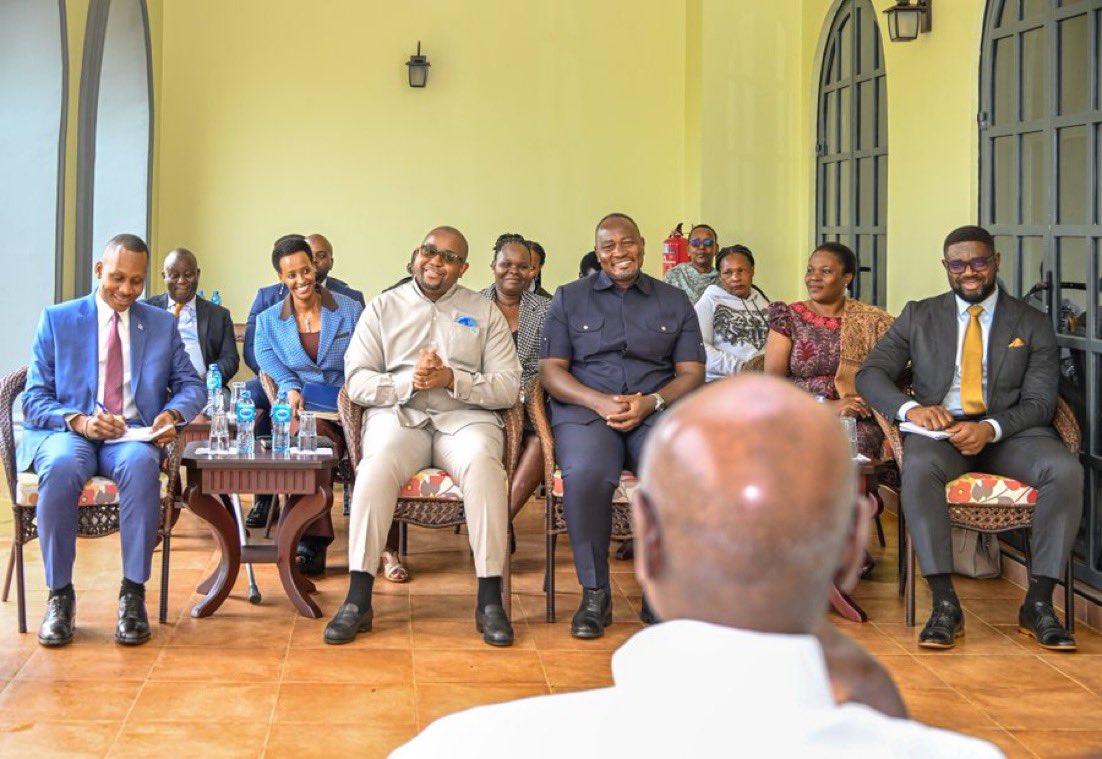
Uganda’s President Yoweri Museveni on July 13 received high-level Congolese delegation led by Minister Floribert Anzuluni with ‘special message’ from President Felix Tshisekedi
Kinshasa is telling two stories about the same militia, and both cannot be true.
For years, the Congolese government has dismissed the Democratic Forces for the Liberation of Rwanda as a fiction conjured by Kigali to justify its military presence in eastern Congo.
Government spokesman Patrick Muyaya has called it a “false pretext” and, more recently, a “recycled pretext,” asking why fighters who fled Rwanda in 1994 should still frighten its government three decades later.
He has reduced the group, memorably, to its economic function; “The FDLR is coltan. The FDLR is gold.”
Foreign Minister Thérèse Kayikwamba Wagner has been equally blunt, denying any state support for the militia and insisting that any collaboration with Congolese soldiers is the work of rogue individuals, not policy.
And since early 2025, Kinshasa’s standard answer to why it hasn’t neutralized the group has been geographic: the FDLR, Kinshasa has argued, sits inside territory controlled by the AFC/M23 rebel alliance, placing it beyond the Congolese army’s reach.
That excuse is now doing awkward work. A demobilization protocol, signed by Victor Byiringiro, the FDLR’s interim political leader, is being carried by a Congolese Minister Floribert Anzuluni through Uganda, Togo, Burundi, Tanzania, Belgium and France as proof that Kinshasa has finally delivered on its Washington Accord commitments.
But if the FDLR has spent the past year and a half sealed off behind M23 and Rwandan lines, the obvious question is how Congolese officials reached its leadership at all — let alone secured a signature on a formal surrender document.
Either the “inaccessible territory” excuse was never quite true, or the protocol required exactly the kind of contact with Rwanda’s proxies that Kinshasa has always denied having.
Reporting on a July 2026 UN Group of Experts assessment, supplies an answer that undercuts both of Kinshasa’s positions at once.
Investigators describe the FDLR not as a besieged remnant but as a force of roughly 10,000 fighters undergoing a rebrand, shedding its toxic name for locally flavored aliases — its main military wing renamed Bataillon Jungle, other factions calling themselves FDP-R and FPP — while keeping the same commanders, structure and objectives intact.
The point, per the report, was to look Congolese rather than Rwandan, easing the group’s embedding into the Wazalendo militia network that fights alongside the Congolese army.
More damaging still is what the UN experts report about the FDLR’s relationship with the Congolese state itself.
The report describes an April 7, 2026 meeting in Pinga between senior FARDC generals and top FDLR-FOCA commanders, at which both sides reportedly agreed to keep cooperating despite Kinshasa’s public claims of confrontation.
It documents an alleged weapons delivery by Congolese helicopter to FDLR-linked forces fighting M23 in Masisi, and describes a standing liaison arrangement: an FDLR-FOCA representative said to be based not in the bush but in Kinshasa, flying on FARDC military aircraft and in direct contact with Byiringiro.
If even a portion of that holds up, the “we cannot reach them, they are behind Rwandan lines” defense collapses on its own terms.
A militia with a liaison officer working out of the capital and moving on the national army’s own planes is not a group Congo has no access to — it is a group Congo has had a functioning channel to all along. That reframes the surrender protocol less as a diplomatic breakthrough than as the public unveiling of an arrangement that may have existed quietly for some time.
Additionally, Kinshasa today feigns ignorance of the fact that the FDLR leader who reportedly initialled the surrender is actually called Gaston Iyamuremye, with aliases “Lieutenant-General” Victor Byiringiro,bByiringiro Victor Rumuli, Victor Rumuri, Michel Byiringiro, Rumuli Gaston, and Rumuri Augustin Iyamuremye.
What remains unresolved is not whether Kinshasa wants credit for ending the FDLR file — clearly it does — but whether the underlying claims about access, contact and control can all be true simultaneously. They cannot.
A government that spent a year blaming geography for its inaction, then produced a negotiated surrender without explaining how the geography was overcome, owes the public an account of what actually changed. Until it gives one, “surrender” remains a word doing more diplomatic work than factual work.
