

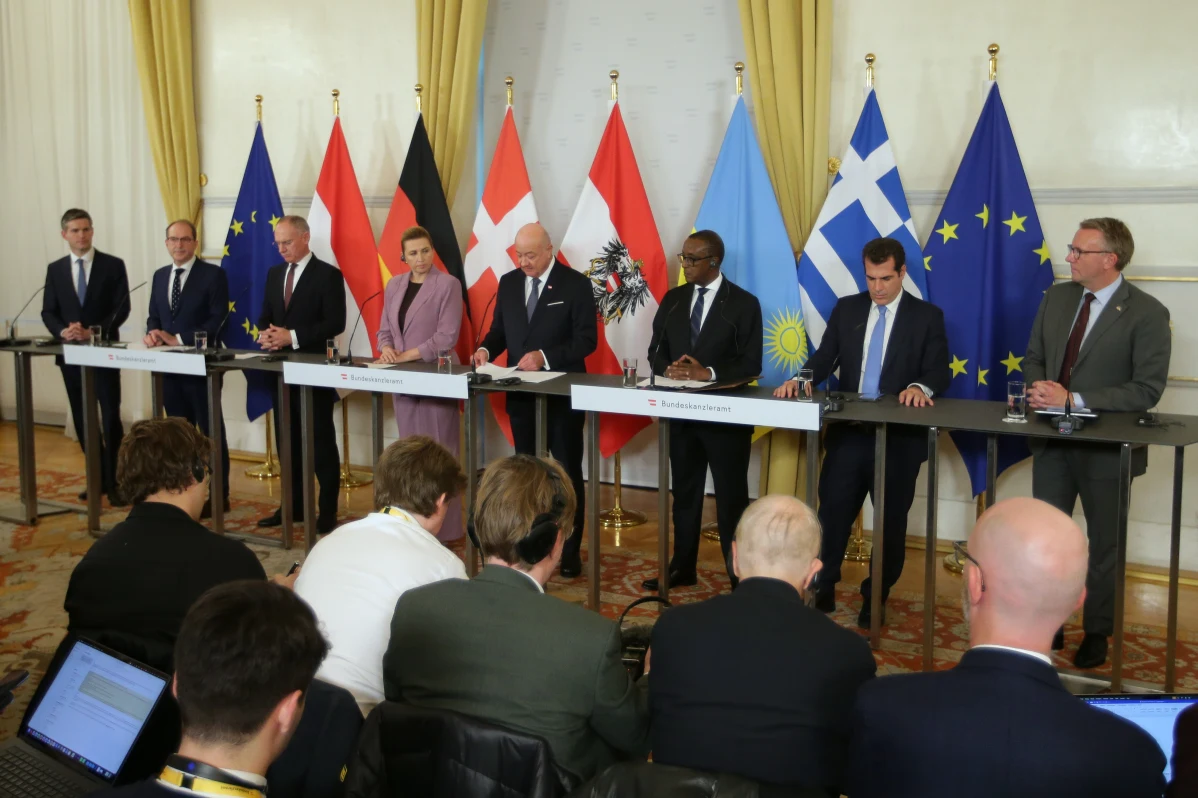
Danish Prime Minister Mette Frederiksen (c), Austrian Chancellor Christian Stocker, Interior Minister Gerhard Karner, German Interior Minister Alexander Dobrindt, Dutch Foreign Minister Tom Berendsen and Rwanda’s Interior Minister Vincent Biruta (r) attend a press conference in Vienna, Austria, November 16, 2026 | Photo: Leonhard Foeger / Reuters
Europe, the West in general, have long been two faced about Rwanda. With the announcement of “immigration return hubs” partnership between Rwanda, and five EU member states, will the EU finally acknowledge Rwanda as it actually is, rather than echoing, or even amplify the country’s detractors?
There will be lawyers quietly rubbing their hands in glee at the legal challenges that will almost certainly be raised to prevent foreign migrants being sent to Rwanda. At least some, if not all these challenges will allege a lack of protection for human rights in the country.
That Rwanda is a nation of laws, with a governance that many around the continent envy, is indisputable. Yet few nations than Rwanda, come under greater scrutiny and condemnation, for lack of the very principles they not only observe but champion. This is self evident for anyone who cares to look at what happens on the ground in Rwanda, or simply follows any objective judgement and research.
For the last few years for instance, the World Justice Project (WJP), has ranked Rwanda number one in sub Saharan Africa for rule of law. Assessments included, fundamental rights, open government, civil and criminal justice. The Chandler Institute of Governance, put Rwanda sixty-two out of 133 countries, first in Africa, for Leadership and Foresight and second globally for Long Term Vision.
In the same breath, the same government is labelled “repressive,” lacking “freedom of expression” allagedly allows “state security forces and civilian officials to commit human rights abuses” apparently with “impunity” no less, and most bizarre of all, “forced labour.”
Europe has not only knived in all the travesty of distortion of the facts, it has indulged in it. The policy seems to have been to use and take full advantage of Rwanda’s achievement in governance, in private while publicly condemning that governance, or responding to its condemnation with deafening silence.
There are now EU sanctions against individual members of the Rwanda Defence Force (RDF), for what the Western world alleges is Rwanda’s involvement in the crisis in the DRC. The allegation is that Rwanda supports the rebel AFC/M23 rebel movement.
The rebel group came into being as Kinyarwanda-Speaking Congolese took up arms to protect its community, primarilly in Eastern Democratic Republic of Congo (DRC) from decades of discrimination and murderous persecution by the Congolese state.
The rebel movement has now broadened its grievances to include the poor or lack of governance throughout the entire DRC, and rebranded itself the FRN. None dispute that the cause of the FRN is just, or any dispute that their persecution has intensified, in large measure because of the introduction of genocide ideology by the so called Forces for the Liberation of Rwanda or FDLR.
Formed by the planners and perpetrators of the 1994 Genocide Against Tutsi, in neighbouring Rwanda, the FDLR has been embraced by successive Congolese heads of state, becoming integrated into the Congolese armed Forces (FARDC).
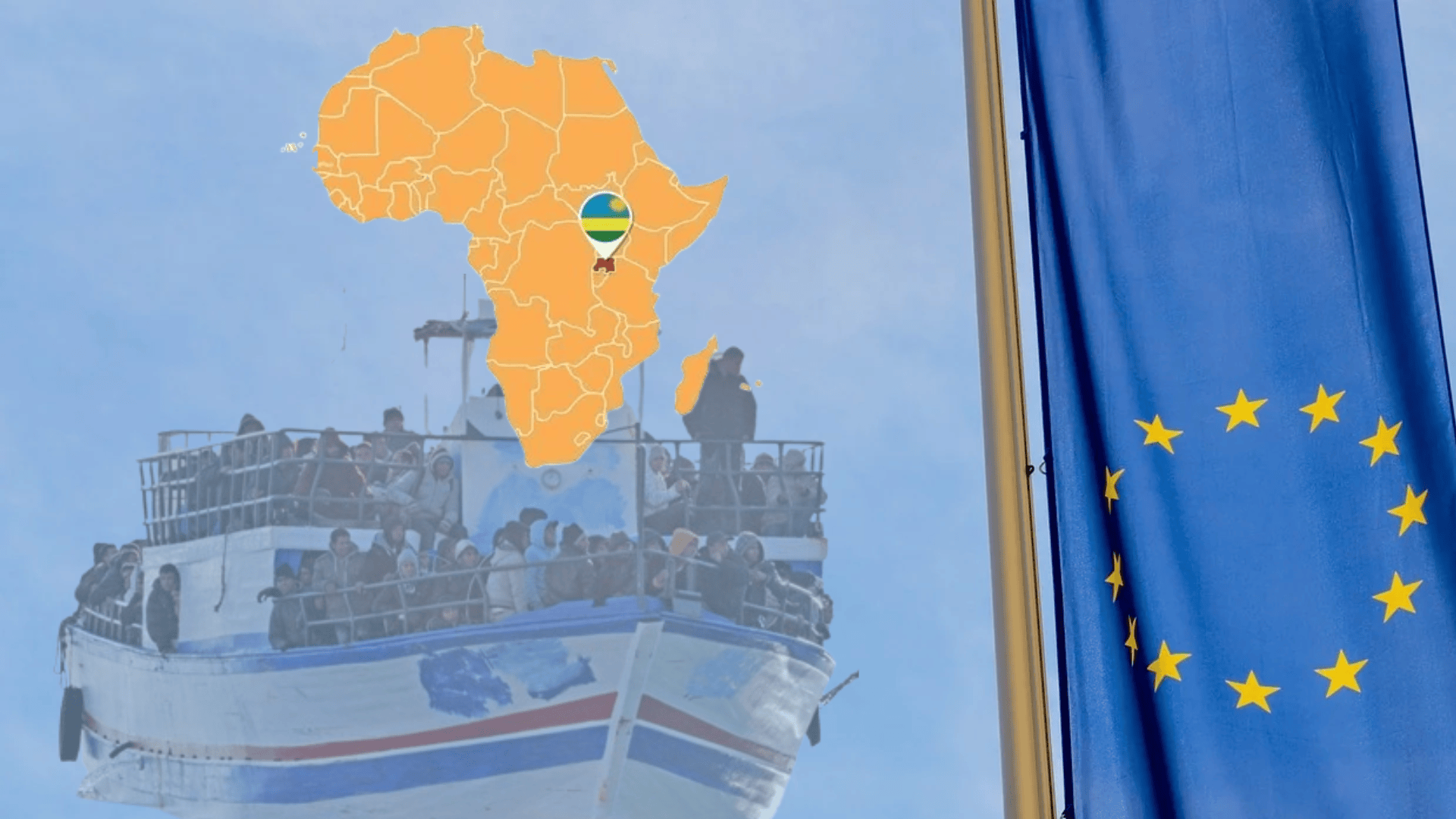
The EU and Rwanda have initiated talks that could lead to establishing hubs in Rwanda
For decades, the FDLR, whose stated reason for existence is to return to Rwanda, and in their words, “finish where they left off” has for decades launched attacks against Rwanda. Rwanda has had in effect to put its forces on alert, along the border with the DRC, for the last thirty years. These much talked about defensive measures, are what are alleged to be Rwanda’s involvement in the DRC conflict.
Rwanda points to its right and determination to defend its territory, and has consistently urged the world to look at the underlying causes of the inter-Congolese conflict. The Western world however, prefers to echo the Congolese President’s claim that Rwanda is “the agressor.”
Even as persecution of members of Kinyarwanda-Speaking Congolese has reached levels of virtually unimaginable depravity, where they are lynched in broad day light, because they “look Tutsi,” some of them beaten into semi consciousness, burned alive and cannibalised, the West looks the other way, or imposes sanctions against Rwanda in response.
For Rwanda, what the West demands is nothing less than allowing the FDLR and their supporters in the DRC, and now Burundi, to enter Rwanda, and “finish where they left off.” President Kagame has made his country’s position clear. “If I have to choose between facing an existential threat and being confronted with sanctions,” he has said, “I will take up arms to confront the existential threat, without taking the sanctions into account.”
“The only reason to side with the Democratic Republic of Congo is corruption” wrote American foreign policy and government adviser, Michael Rubin. “The Democratic Republic of the Congo is believed to hold some $24 trillion in rare earths and strategic metals underground. In theory, the DRC could be to the 21st Century economy, what Saudi Arabia, with its vast oil reserves, was to the 20th Century…” he continues.
And there, writ large, is the West’s reluctance to name the cause of suffering for the people of the DRC, as self inflicted wounds, and instead indulge the venal and utterly ineffectual DRC head of state, in the absurdity of laying all of DRC’s ills at Rwanda’s door.
But for how long will the EU have its cake and eat too? The proposed “immigration return hubs” agreement with Rwanda, is just one more example of members of the EU acknowledging the country’s adherence to international principles of governance, privately, while wagging paternalistic fingers in public.
They seek a partnership with Rwanda, because while it has not the wealth to be found in the EU, its exemplary governance, rule of law, and yes, respect for the freedom and rights of the individual, make it a place where any migrant can rediscover their human dignity.
Once the legal challenges come flooding in, as they almost certainly will, will the EU finally, quietly, discard its perfidy towards Rwanda, and acknowledge the truth about the kind of country to which they will be proposing to send their unwanted migrants?
