Equity Group Chief Executive Officer James Mwangi (R) and IFC Vice President for Africa Ethiopis Tafara exchange deal document following the signing as executives from both sides look on
Equity Group Holdings and the International Finance Corporation have signed a new partnership agreement aimed at scaling financing for agriculture, small businesses and the creative economy across Africa, in what both institutions described as a major push to create decent jobs on the continent.
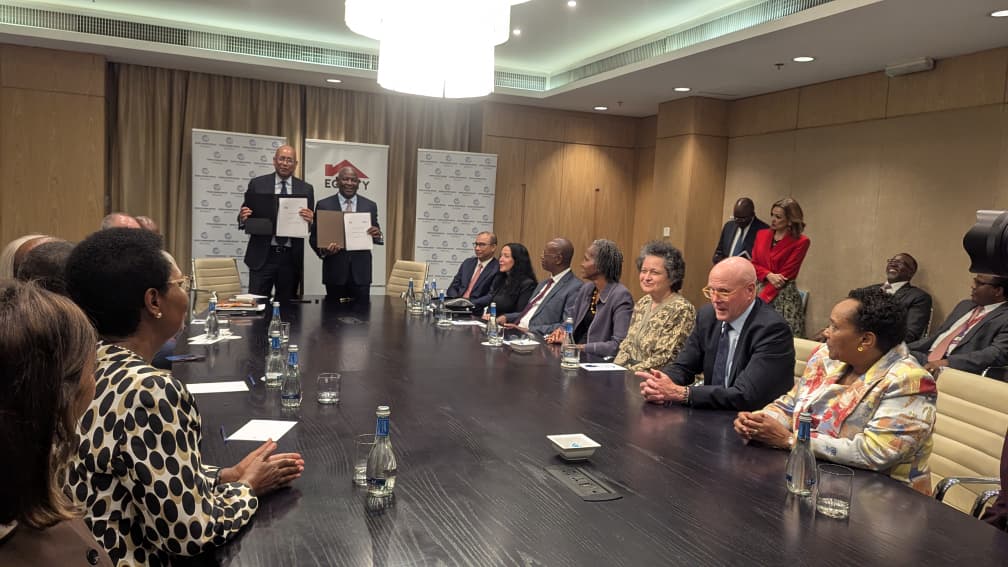
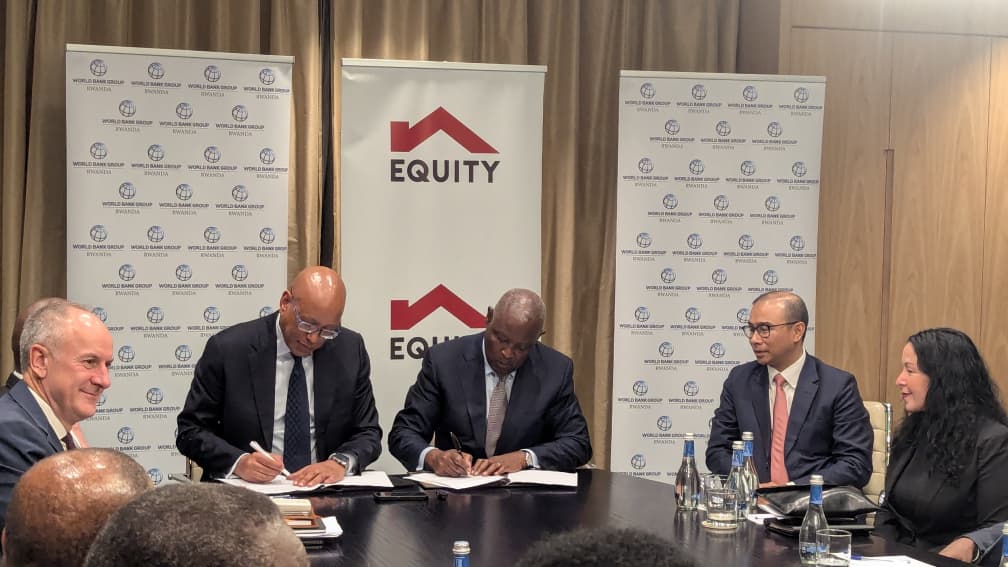
The Memorandum of Understanding (MoU) was signed at the Kigali Marriott Hotel by Equity Group Chief Executive Officer James Mwangi and IFC Vice President for Africa Ethiopis Tafara.
The agreement establishes a framework for collaboration focused on improving access to finance for farmers, agricultural cooperatives and micro, small and medium enterprises (MSMEs) operating within priority agricultural value chains across Eastern and Central Africa.
It will also target Africa’s fast-growing creative economy through the Africa Creative Economy Transformation Agenda (ACETA).
Speaking after the signing ceremony, Mwangi said the partnership builds on a long-standing relationship between the two institutions, with IFC already holding a 7 percent stake in Equity Group and supporting the bank through multiple financing facilities.
“This is one of many agreements we have signed with IFC. IFC is a 7 percent shareholder of Equity Group and we already have about $400 million loan facility from IFC,” Mwangi said.
“But this time we said we want to do something very big to create jobs on the African continent.”
Mwangi said the partnership will focus on three strategic sectors: agriculture, MSMEs and the creative industry.
“We said we pick on three things. Agriculture as a big focus with a view of increasing productivity and return to farmers by 40 percent. The second area is micro, small and medium enterprises — de-risking them through capacity building and providing guarantees so that they can get loans,” he said.
“The third one we have taken is the creative sector on the African continent. We are calling it the African Creative Economy Transformation Agenda.”
According to Mwangi, the broader ambition is to shift African youth into what he described as “modern economies” powered by innovation, technology and digital systems.
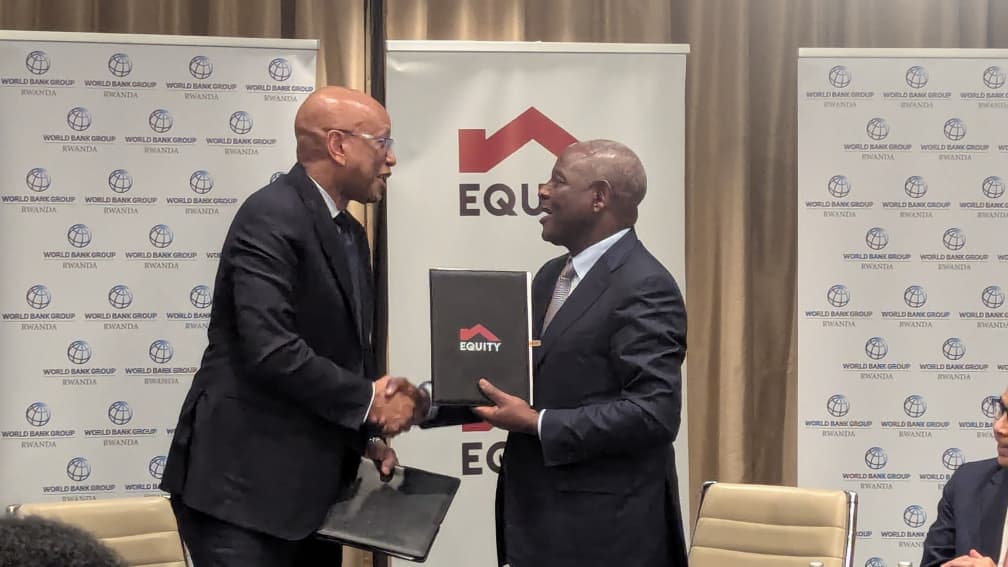
Equity Group Chief Executive Officer James Mwangi (R) and IFC Vice President for Africa Ethiopis Tafara exchange deal document following the signing
“The goal is to create jobs for young people without taking them to traditional sectors. We will take them to modern economies,” he said.
Mwangi also pointed to Rwanda’s growing digital infrastructure as a model the partnership hopes to leverage.
“Rwanda is leading in providing digital public infrastructure. We know of the digital IDs, the national switch, the open system, the citizen wallet. We want to leverage on that using innovation and creativity to create a modern economy of trade,” he said.
The Equity Group CEO revealed that the bank has set an ambitious target of growing agriculture financing to 30 percent of its total loan book by 2030, up from an African banking average of just 3 percent.
“We have set this target because agriculture contributes 30 percent of the GDP of most African economies, provides about 45 percent of all foreign exchange earnings and livelihoods to about 70 percent of the population,” Mwangi noted.
“As an African organization, we have gone to IFC and said, help us ensure we match the GDP contribution of our economies to the funding of those economies.”
He said Equity Group has committed its entire $16 billion balance sheet to support the initiative, backed by IFC guarantees and technical support mechanisms intended to reduce lending risks, especially for smallholder farmers with limited credit history.
“We are willing to support the initiative with our balance sheet of $16 billion because IFC is helping us with credit risk sharing guarantees,” Mwangi said.
The initiative will also rely heavily on technology-driven agricultural financing models.
IFC Vice President Tafara explained that agri-tech firms will play a critical role in collecting farmer data, assessing financing needs and helping banks make informed lending decisions.
“For example, ag-tech companies are very good at using technology to figure out what farmers need in terms of seeds, fertilizer and mechanization,” Tafara said.
“They collect that data and make it available to banks like Equity Bank. On the strength of that better data, banks are prepared to lend to these smallholder farmers.”
Tafara said IFC would support the process through guarantees, concessional financing and blended finance models to help reduce risks associated with lending to underserved sectors.
“Partnering with us is in itself a form of taking risk away because of who we are as an institution,” he said.
“We can provide guarantees where we say, go ahead and lend, and if there are defaults, we provide a guarantee against those defaults.”
He said the partnership is designed to move beyond isolated transactions into a continent-wide program capable of delivering large-scale impact.
“This is really about a program and scale. We’re trying to create jobs focusing on sectors that create the greatest number of jobs and doing it with a partner that has presence throughout Africa,” Tafara added.
Tafara noted that similar agricultural financing models have already been piloted successfully in countries such as Senegal and Morocco, where farmer productivity reportedly increased by between 20 and 40 percent.
Mwangi further disclosed that Equity Group is already implementing other agriculture-focused partnerships with organizations including International Fund for Agricultural Development, World Food Programme and Food and Agriculture Organization.
He also referenced recent agreements signed with the French government during the Africa Forward Summit held in Nairobi, including initiatives focused on geographic indications and traceability for agricultural exports such as tea.
“The first one we did was tea, and we increased the value and price of tea in Kenya by between 50 and 70 times by giving traceability and creating a premium product,” Mwangi said.
Both institutions indicated that while Equity Group will be a major implementing partner, the program is expected to expand to additional partners across Africa as efforts intensify to address unemployment, financial inclusion and economic transformation on the continent.