


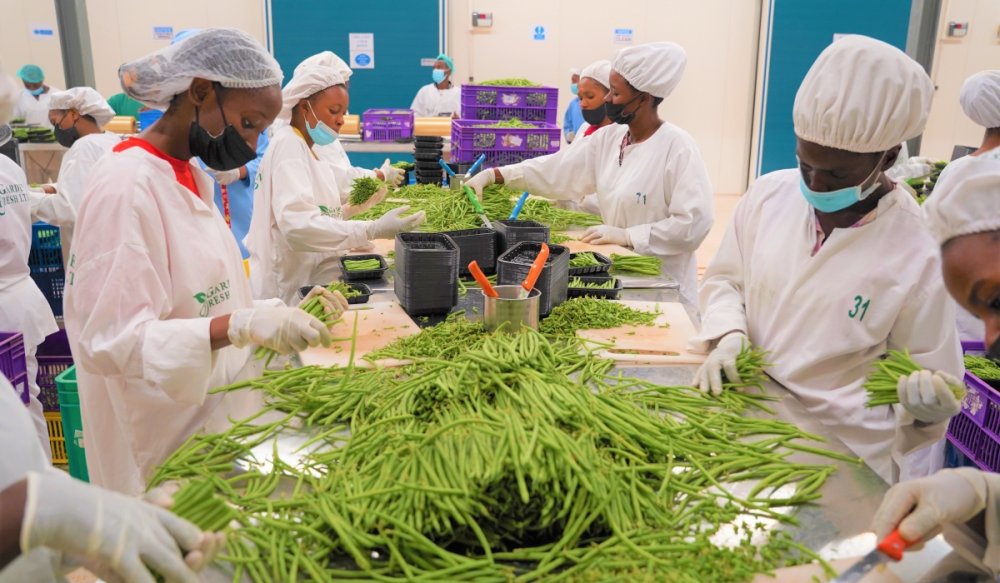
Workers at a facility in Kigali preparing produce destined for export
KIGALI, Rwanda — Rwanda’s trade relationship with China has been following a pattern familiar across much of the developing world.
Chinese factories supplied machinery, electronics, construction materials and manufactured goods. Rwanda, like many African countries, bought far more than it sold.
Today, that relationship is beginning to look different.
New trade data from the National Institute of Statistics of Rwanda (NISR) show that China has emerged not only as Rwanda’s largest source of imports but also as its largest export destination, marking a significant shift in the country’s external trade patterns and suggesting that Kigali is gradually narrowing a longstanding trade imbalance with the world’s second-largest economy.
The figures point to a broader transformation underway in Rwanda’s economy — one in which the country is becoming more integrated into global markets while simultaneously strengthening its position as a regional trading hub.
The most striking development is the pace at which exports to China have grown.
In the first quarter of 2026, Rwanda exported nearly US$95 million worth of goods to China, accounting for 25.8 percent of all domestic exports and making China the country’s largest export destination. Just a year earlier, China represented less than five percent of Rwanda’s exports.
The rise has been extraordinary.
In April 2024, Rwanda exported only US$6.38 million worth of goods to China. By April 2025, that figure had increased to US$10.37 million. Twelve months later, exports had surged to US$47.74 million in a single month, bringing China within less than US$1 million of overtaking the Democratic Republic of Congo as Rwanda’s top export market before eventually moving into first place.
The transformation appears closely linked to a major policy shift introduced by Beijing in December 2024, when China granted Rwanda and other least-developed countries full tariff-free access to the Chinese market.
The measure lowered costs for exporters and improved the competitiveness of Rwandan products such as coffee, tea, chili, gemstones and minerals in one of the world’s largest consumer markets.
For Rwanda, the impact has been immediate.
The country is increasingly finding customers in China for products that previously struggled to gain significant market share there.
Yet China remains far more important as a supplier than as a customer.
Imports from China reached approximately US$355.5 million during the first quarter of 2026, accounting for 26.7 percent of Rwanda’s total imports and making China by far the country’s largest source of imported goods.
The resulting trade deficit remains substantial, estimated at roughly US$261 million during the quarter.
But economists often pay as much attention to direction as to size.
For years, Rwanda’s exports to China remained relatively small while imports continued to expand. The latest figures suggest the relationship is entering a new phase, one in which Chinese demand for Rwandan goods is growing rapidly enough to begin reducing the imbalance.
In practical terms, China is no longer simply selling to Rwanda.
It is increasingly buying from Rwanda as well.
The shift comes as Rwanda’s export geography undergoes one of its most dramatic realignments in recent memory.
For years, the United Arab Emirates dominated Rwanda’s export sector, largely because of its role as a global trading hub for minerals.
In April 2024, exports to the UAE exceeded US$100 million.
By April 2026, that figure had fallen to just US$18.2 million.
At the same time, China and the Democratic Republic of Congo have emerged as the two major engines driving Rwanda’s export growth.
The contrast is striking.
China’s rise reflects deeper integration into global markets and stronger access to Asia’s largest economy.
The growth of exports to eastern Congo reflects something entirely different: Rwanda’s increasing role as a regional commercial gateway.
Trade with eastern Congo has expanded rapidly following improved stability in areas controlled by the AFC/M23 movement across North and South Kivu.
The cities of Goma and Bukavu alone represent a market of millions of consumers who rely heavily on goods entering through Rwanda.
Earlier trade data showed that Rwanda’s exports to DR Congo increased by more than 141 percent year-on-year, while re-exports moving through Rwanda into eastern Congo also expanded sharply.
Today, Rwanda serves as a critical supply corridor for food products, fuel, construction materials and other essential goods entering large parts of eastern Congo.
The result is a trade structure increasingly supported by two powerful but very different forces.
One is China. The other is eastern Congo. One connects Rwanda to global demand. The other anchors Rwanda’s role in regional commerce.
Together, they are reshaping the country’s economic landscape.
That may ultimately be the most important lesson from the latest figures.
While China has become Rwanda’s largest supplier and largest export destination, the broader trend is not one of growing dependence on a single market. Rather, Rwanda appears to be diversifying the sources of its export growth even as it deepens commercial ties with Beijing.
For policymakers, that distinction matters.
Countries benefit most from trade relationships that create opportunities on both sides of the ledger — generating export earnings while also providing access to critical imports.
The latest data suggest Rwanda is moving gradually in that direction.
The trade deficit with China remains large, and Beijing’s economic weight in Rwanda continues to grow.
But for perhaps the first time, China is emerging not only as the country from which Rwanda buys the most goods, but also as one of the places where Rwanda is increasingly selling them.
For a nation seeking to expand exports, earn foreign exchange and strengthen its position in global markets, that represents a notable shift — and potentially the beginning of a more balanced economic relationship with one of the world’s most influential trading powers.
