


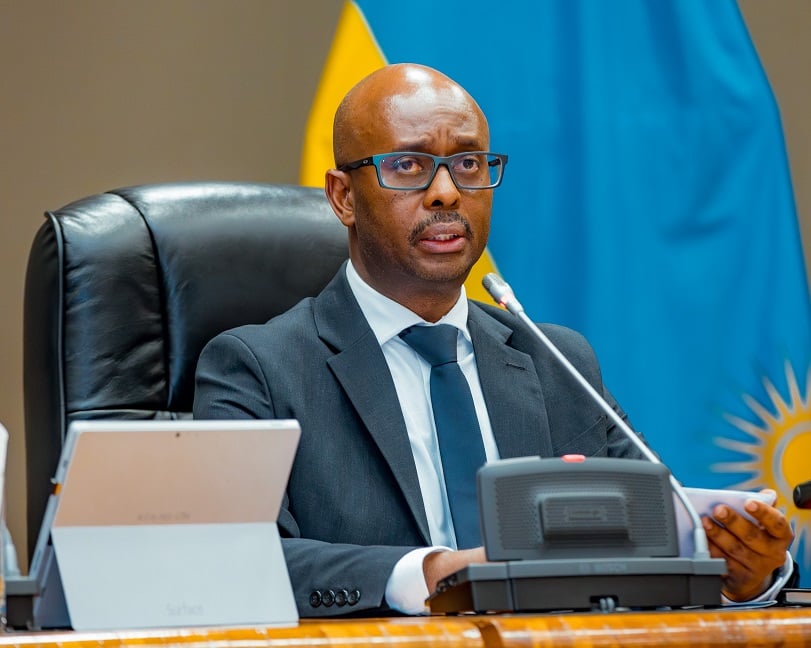
Finance Minister Yusuf Murangwa during the session on Tuesday
More than half of Rwanda’s Savings and Credit Cooperatives (SACCOs) have been affected by embezzlement or theft, according to Finance and Economic Planning Minister Yussuf Murangwa.
Presenting to the Chamber of Deputies on Tuesday, Minister Murangwa disclosed that 238 out of 416 SACCOs—equivalent to 57%—have suffered financial losses due to fraud or mismanagement, often involving their own employees or leaders.
He attributed the majority of these losses to the lack of digital systems, noting that many of the affected SACCOs were still operating with paper records and manual bookkeeping, which created loopholes for theft.
Each of the country’s sectors has a SACCO, used by
To address this problem, the government launched a national effort to digitize SACCO operations.
By August 2024, all 416 SACCOs had been fully integrated into a centralized digital platform, with 47 newly upgraded in that year alone.
Responding to questions from MPs, Murangwa shared examples of significant theft cases:
- SACCO Jabana lost RWF 430 million due to staff misconduct.
- SACCO Mugunga in Gakenke District was defrauded of RWF 167 million, which has not been recovered.
- In Gasabo District, Isoko SACCO was robbed of RWF 80 million by its former manager, who later fled the country.
- In Rusizi, SACCO Butare lost RWF 23 million, and in Bweyeye Sector, RWF 24 million was stolen.
“Most of these incidents happened because SACCOs lacked digital systems. They relied on paper files, with poor internal control and oversight, which made theft easy for those in charge,” Murangwa said.
He added that in many cases, embezzlement was not just the work of rogue employees but involved collusion with managers and even members. The root problem, he said, was both technical weaknesses and a lack of integrity among some staff.
The Minister also disclosed that 19 SACCOs had failed to return member savings, including funds earmarked for VUP beneficiaries and health insurance contributions meant for RSSB accounts.
To keep such SACCOs operational, the government provided emergency loans through the National Bank of Rwanda. Some of these institutions have since repaid their debts and improved their operations.
A special task force established in 2019 was also credited with helping to recover RWF 2.2 billion from individuals who had misappropriated SACCO funds. Many related cases were followed up and resolved quickly through the courts.
Still, many challenges remain. Of approximately 500 individuals involved in embezzlement cases, only 153 have fully repaid the stolen funds. Others have repaid partially or nothing at all.
Around 103 suspects are still at large, having fled justice and disappeared.
“One of the biggest obstacles is recovering assets. Many of the perpetrators do not have any registered property, making it extremely difficult to recover what was stolen,” Murangwa explained.
He emphasized that introducing digital systems across the SACCO network was a critical step toward reducing fraud, strengthening oversight, and restoring public confidence.
As Rwanda continues to promote financial inclusion through community-based financial institutions, the revelations serve as a sobering reminder that transparency, technology, and accountability must go hand-in-hand with access to credit.
