


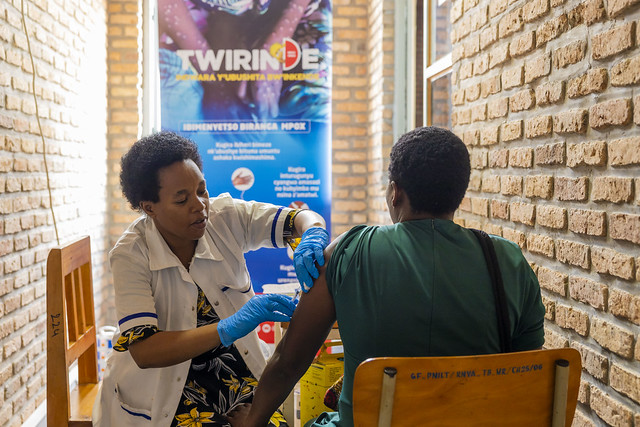
A patient receives MPOX vaccine as part of the country’s MPOX vaccination campaign, particularly targeting high-risk groups (Photo by Health Ministry)
Kigali, Rwanda — The cost of healthcare in Rwanda is climbing sharply as hospitals, clinics, and pharmacies adjust their prices to cope with mounting operational expenses, rising import costs, and increased patient demand.
Major health facilities, including King Faisal Hospital, private clinics, and public health institutions, report that the price of both medical consultations and essential medicines has risen — in some cases for the first time in nearly a decade.
Since 2017, the prices for healthcare services and products in Rwanda have increased dramatically.
Understanding the Long-Term Increase
According to the latest Consumer Price Index (CPI) for July 2025, from the National Institute of Statistics of Rwanda (NISR), healthcare costs have gone up by over 70% in the past eight years.
To be more precise, outpatient services — such as visiting a doctor or undergoing laboratory tests — have almost doubled, rising by about 93.6%.
Meanwhile, the cost of medical products like medicines and equipment has increased by 87%, and hospital services, including inpatient care and surgeries, have risen by nearly 81%.
These figures mean that what used to cost 100 Rwandan francs in 2017 now costs nearly 200 francs in 2024 for outpatient services.
The increases reflect the many pressures facing the healthcare system, including rising global prices for imported medicines and equipment, higher wages for medical staff, and growing demand for services.
Recent Trends
The steep rise over several years is not the only concern. Prices continue to climb steadily year after year and even month to month.
Comparing July 2025 to July 2024, outpatient services became about 12.7% more expensive, medical products went up by 14.3%, and hospital services increased by nearly 12%.
On a monthly basis, from June to July 2025, prices still rose by around 1% to 1.5% in these categories.
This ongoing trend shows that healthcare costs are not stabilizing but continuing to rise.
Hospitals and clinics are facing increasing operational costs, which they must cover by charging higher fees.
Hospitals Struggling to Keep Up
At King Faisal Hospital, the country’s leading referral hospital, management has revealed to Parliament that the institution has lost over Rwf 12 billion in recent years.
This financial strain comes partly because hospital fees have not kept pace with soaring costs for medicines, equipment, and staff salaries.
Many facilities have been using pricing structures set years ago, which are no longer sustainable.
Private clinics, too, admit that they have charged fees based on prices from 2017 or earlier.
Yet, the cost of imported medicines and lab supplies has soared due to factors like global inflation, higher shipping costs, and fluctuating exchange rates. These pressures make it difficult for clinics and hospitals to maintain quality services without raising prices.
The Impact on Medicines and Pharmacies
Medicines have seen some of the sharpest price increases. Pharmacies report that both branded and generic drugs have become significantly more expensive in recent years. The reasons include rising global costs for raw materials used to produce medicines, higher transport fees, and currency changes that make imports more costly.
For patients, this means that even buying common medicines has become quite expensive, adding to the burden of rising consultation and hospital fees.
Public Health Institutions Feeling the Pressure
Public health facilities are not immune to these challenges. At CARAES Ndera Mental Hospital, Rwanda’s national psychiatric referral center, admissions have surged by 26% in the past year alone.
To meet this increased demand, the hospital has had to spend more on medicines, food for patients, and staff wages, leading to an overspend of more than Rwf 819 million.
This situation is echoed across many public hospitals, which are trying to provide services with limited budgets while costs continue to rise.
What This Means for Ordinary Rwandans
The steady increase in healthcare costs has serious implications for ordinary Rwandans.
As prices rise, some patients may delay seeking treatment or skip it altogether because they cannot afford the fees. This can lead to worsening health problems, more complicated illnesses, and greater costs down the line.
For many families, paying for doctor visits, hospital stays, and medicines has become a major financial challenge. The situation risks pushing vulnerable groups, including the elderly and low-income households, further into hardship.
