


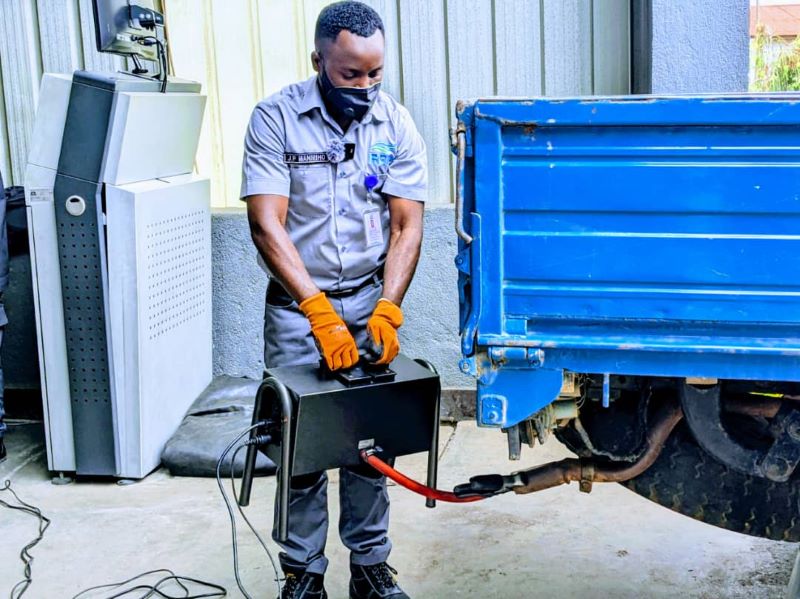
A vehicle being tested at the REMA and Police testing facility in Kigali
The Rwanda Environment Management Authority (REMA) has reported that over 7,000 vehicles have been tested under its new national emissions control program.
The program was launched to combat air pollution, specifically targeting harmful fine particulate matter (PM2.5) emitted by vehicles, which poses serious health risks.
Testing began in early August, and since the service was integrated into the Irembo platform on August 25, an additional 1,500 vehicles have been processed through the online application and payment system.
REMA notes that motorcycles, which account for 47% of vehicle air pollutants, are not yet part of the testing scheme but will be included in a dedicated system at all technical control centers once requirements are finalized.
READ MORE – Choking on Progress: Rwanda’s Air Quality 5-Times Worse Than Global Health Limit
The authority emphasizes that vehicle exhaust contains dangerous chemicals that can lead to severe health issues, including lung cancer.
The testing uses different technologies for petrol and diesel vehicles to ensure they meet emissions standards based on their year of manufacture.
This initiative is a key part of the government’s strategy to improve air quality, especially in urban areas like Kigali where pollution levels often reach unhealthy heights.
Air quality standards differ depending on the year of manufacture of the vehicles.
Vehicles made in 1992 and earlier must emit no more than 5 micrograms per cubic meter (m³).
Vehicles made between 1992 and 2004 must emit no more than 2.5 micrograms/m³.
Vehicles manufactured in 2005 or later must emit below 2.5 micrograms/m³.
Different machines are used to measure emissions. Cars using petrol are tested with a device called OPUS, while diesel cars are checked for smoke opacity.
Another tool, the RPM Probe, is inserted into the vehicle’s exhaust pipe to measure chemical pollutants and their impact on the atmosphere.
