


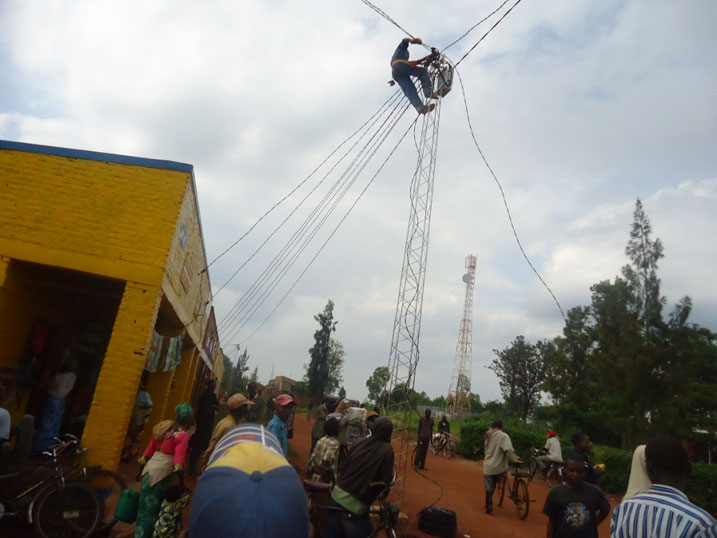
Whenever a grid line reaches a rural region, there is instant transformation as economic activities spring up. Towns are usually born from there
Kigali – Rwanda has reached an electrification milestone few would have imagined twenty-five years ago..
If the current pace continues, universal access at a full 100 percent could be attained by 2029, or latest a year later.
At a Cabinet meeting chaired by President Paul Kagame on Monday, the change was noted with satisfaction, as described by the final cabinet resolutions.
Yet behind the celebration lies a persistent concern: the cost of electricity, which remains a heavy burden on households, industries, and commercial users alike.
While the grid now reaches millions more Rwandans, many are questioning whether the government will cut or increase tariffs as the country approaches near-universal access.
From Rarity to Reality
The Monday Cabinet highlighted that electricity access has increased more than 42-fold over the past 25 years—a pace unmatched in much of Africa.
Rural and urban communities alike have benefited, with schools, hospitals, businesses, and homes now connected to reliable power.
The government’s long-term vision of energy as a driver of inclusive growth has been realized in part, but affordability remains the next frontier.
Tariffs Under Scrutiny Across All Sectors
Industries have long argued that electricity costs are crippling their competitiveness. Small industries consuming less than 220,000 kWh per year currently pay Rwf 134 per kWh, medium industries (220,000–660,000 kWh) pay Rwf 103, and large industries (over 660,000 kWh) enjoy Rwf 94.
Comparisons with regional neighbors underscore the challenge: Ugandan factories can pay as low as Rwf 68 per kWh during off-peak periods, and in Kenya, large industries pay around Rwf 87 off-peak.
For Rwandan manufacturers, these differences translate to thinner profit margins, higher export prices, and difficulties attracting investment.
Residential users have also experienced tariff increases over time. Households consuming between 15 and 50 kWh now pay Rwf 212 per kWh, while those exceeding 50 kWh pay Rwf 249.
Even as lifeline tariffs for the lowest-consumption households remain at Rwf 89, many ordinary users still feel the pinch, particularly amid rising costs of living.
Commercial and service-sector users have not been spared either: tariffs for hotels, broadcasters, telecom towers, and data centers have been periodically revised to reflect operational costs, with some facilities benefiting from reductions while others faced hikes.
Government Response
Recognizing the mounting pressure, the Rwanda Development Board (RDB), the Ministry of Infrastructure, and the Rwanda Utilities Regulatory Authority (RURA) last week convened a high-level consultative meeting with private sector leaders.
Finance Minister Yusuf Murangwa, attended in person, signaling the government’s serious intent to examine the tariff framework.
This is not the first time Rwanda has adjusted electricity tariffs. In January 2020, RURA raised rates for residential and industrial users while reducing costs for critical facilities like hospitals and data centers.
The increases were aimed at maintaining the financial sustainability of the Rwanda Energy Group (REG), covering the cost of imported fuels, foreign currency payments to independent power suppliers, and ongoing network expansion and maintenance.
At that time, an annual government subsidy of Rwf 10.5 billion helped cushion the impact.
A Delicate Balancing Act
Today, Rwanda faces a nuanced challenge. On one hand, near-universal access will require continued investment in generation, transmission, and distribution—costs that may necessitate tariff adjustments.
On the other, the private sector and households alike are calling for relief. Potential solutions under consideration include time-of-use pricing for industrial users, special incentives for high-volume consumers, and adjustments across residential and commercial sectors to ensure fairness and affordability.
The energy landscape is further complicated by rising operational costs, including fuel imports, currency fluctuations, and ongoing efforts to reduce electricity theft and network losses, which have recently been lowered from 23% to 19%.
REG officials emphasized that the cost of production currently averages Rwf 186 per kWh, highlighting the tightrope the government must walk between affordability and sustainability.
The Ministry of Infrastructure is expected to announce a new tariff framework in the coming months. Whether it will prioritize industrial competitiveness, household affordability, or a balanced approach across all sectors remains uncertain.
What is clear, however, is that Rwanda’s next energy chapter will not be defined solely by access. Affordability for all—residential, commercial, and industrial users—will be the decisive factor in sustaining economic growth, attracting investment, and delivering on the promise of universal electricity access.
