


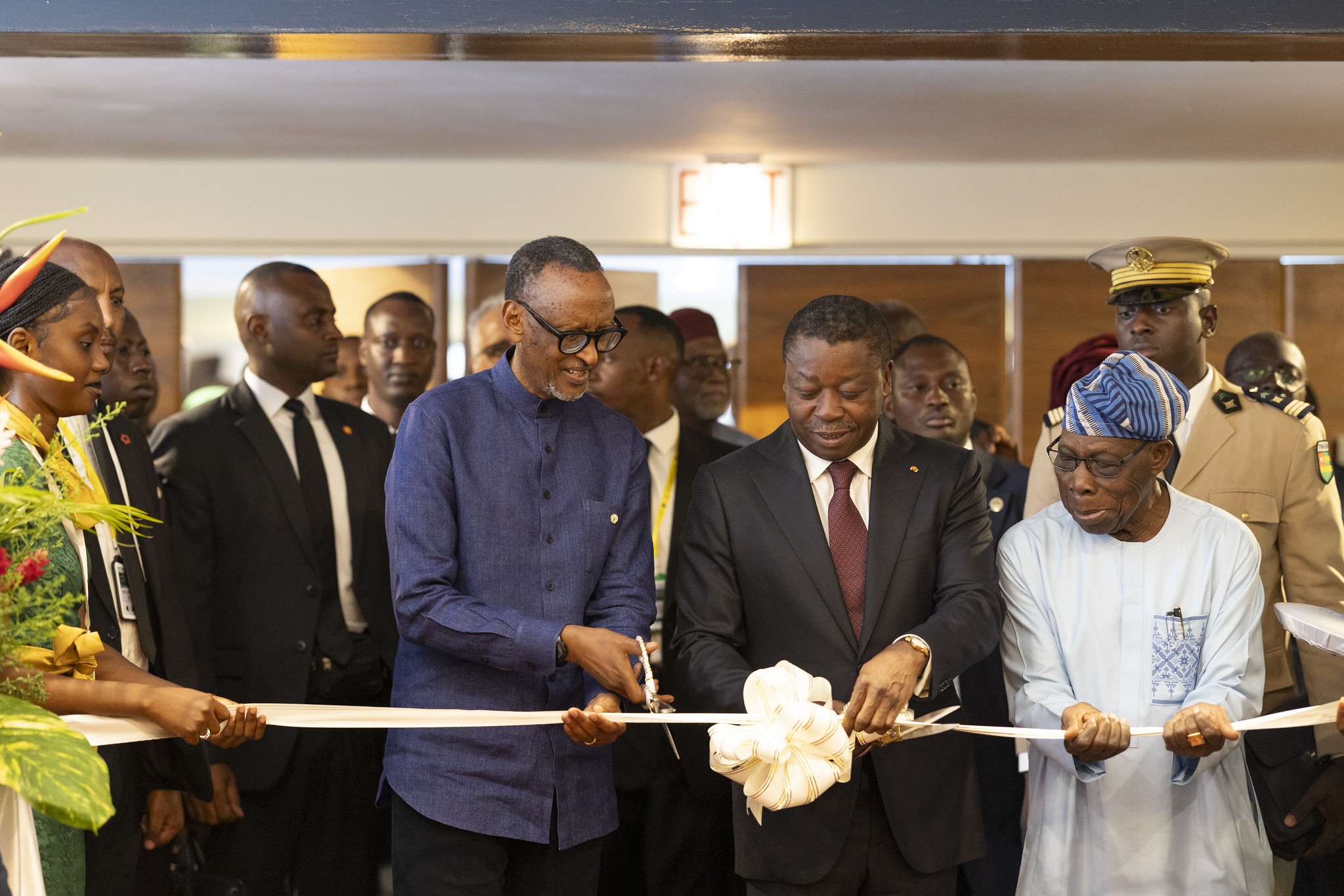
President Kagame and Togolese President Faure Essozimna Gnassingbé open the Expo, together with former Nigerian President Oluṣẹgun Ọbasanjọ
LOMÉ, Togo — African leaders have spoken of integration, open borders and a continent connected by trade. Yet for many travelers, flying between two African cities still means routing through Europe or the Middle East.
Addressing that contradiction on Monday, President Paul Kagame of Rwanda urged African governments to move beyond declarations and accelerate reforms that would make air travel across the continent cheaper, simpler and more accessible.
Speaking at the opening of the African Air Transport Convention and Expo 2026 in Lomé, the Togolese capital, Kagame argued that aviation has become a test of Africa’s ability to translate long-standing ambitions into measurable results.
“We know what has to be done. We just have to do it,” he told delegates gathered from across the continent.
The summit was officially opened by Togolese President Faure Essozimna Gnassingbé and attended by several African leaders, including former Nigerian President Oluṣẹgun Ọbasanjọ, alongside regulators, airline executives and investors seeking ways to unlock growth in Africa’s aviation sector.
MORE PHOTOS from the African Air Transport Convention and Expo 2026 in Lomé
Kagame’s remarks reflected a broader frustration that has increasingly surfaced in discussions about African integration. While the continent is home to nearly one-fifth of the world’s population, it accounts for only a small share of global air traffic.
Industry campaigners have long argued that restrictive regulations, high operating costs and fragmented markets have prevented African aviation from reaching its potential.
The consequences extend far beyond airports.
Poor air connectivity, Kagame said, weakens trade, discourages investment and limits the ability of businesses to operate across borders. In a continent seeking to deepen economic ties through initiatives such as the African Continental Free Trade Area, the difficulty of moving people and goods remains a significant obstacle.
At the center of the debate is the Single African Air Transport Market, an African Union initiative designed to create a more integrated aviation market by reducing restrictions on airlines operating across the continent.
Kagame described the framework as sound but said implementation has lagged behind commitments.
“What it now needs are clear timelines and measurable outcomes,” he said.
President Kagame also emphasized the need for greater investment in aviation infrastructure, including airports, maintenance facilities and fuel supply chains.
Rather than viewing Africa as a risky destination for capital, he argued, investors should see aviation as a strategic sector capable of driving economic growth.
Development banks, sovereign wealth funds, institutional investors and private capital, he said, all have a role to play.
But money alone, Kagame cautioned, will not solve the problem.
Taxes and charges imposed on air travel across Africa remain among the highest in the world, raising ticket prices and limiting passenger growth. Reducing those costs, he said, is essential if the continent hopes to expand air travel and improve competitiveness.
He also called for greater regulatory alignment among African countries, arguing that a single market can function effectively only when rules and standards are consistent across jurisdictions.
Drawing on Rwanda’s experience, Kagame pointed to the country’s visa-on-arrival policy for all Africans and other travelers as an example of how removing barriers can stimulate economic activity.
The decision, he said, was driven by a simple objective: encouraging people to visit, build connections and pursue opportunities.
According to Kagame, the results included increased tourism, stronger business activity and expanded air links.
His message carried a broader theme that resonated throughout the conference: Africa’s future growth will depend not only on infrastructure and investment but also on political choices that favor openness over fragmentation.
With Africa’s population projected to continue growing rapidly over the coming decades, demand for travel, trade and mobility is expected to rise alongside it.
“Air connectivity opens immense opportunities and possibilities,” Kagame said.
For many delegates in Lomé, the challenge is no longer identifying the obstacles. It is whether African governments can muster the political will to remove them.
As discussions continue throughout the week, aviation leaders will be looking for signs that the continent’s long-standing vision of seamless air travel is finally moving from aspiration to implementation.
