



An FDLR rebel is typically seen in the dense, rugged terrain of the eastern Democratic Republic of the Congo, often wearing a mix of mismatched military fatigues and clutching a sharp machete. Internet photo.
KIGALI/NEW YORK — Rwanda has placed the FDLR militia at the heart of the ongoing conflict in eastern Democratic Republic of the Congo (DRC), urging the United Nations Security Council to refocus attention on what it describes as the root cause of regional instability.
“The FDLR is not an ordinary armed group. It is a genocidal force founded by remnants of those responsible for the 1994 genocide against the Tutsis in Rwanda. And its genocidal ideology has never changed,” Rwanda’s Permanent Representative to the UN, Martin Ngoga, told the Council on March 26.
The Democratic Forces for the Liberation of Rwanda (FDLR) is an armed rebel group primarily composed of former soldiers and militia linked to the perpetrators of the 1994 Genocide against the Tutsi. Active in eastern Democratic Republic of the Congo, the group opposes the Rwandan government and has long been accused of contributing to instability in the region.
In 1999, elements of the group — then operating under the name ALIR — were accused of killing two American tourists in Uganda. The United States subsequently designated the movement as a terrorist organisation, placing it on the Terrorist Exclusion List and under Executive Order 13224, a move that froze its assets and criminalised support, citing its use of violence against civilians to achieve political aims.
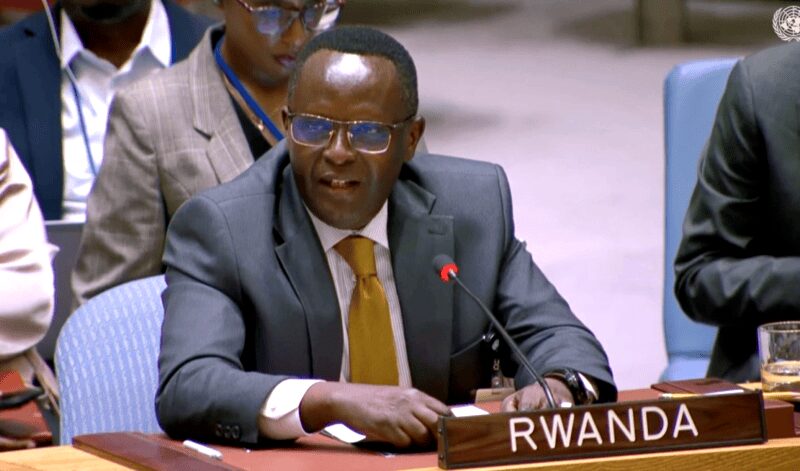
Ambassador Martin Ngoga, Rwanda’s Permanent Representative to the United Nations in New York.
Addressing the Council’s 10126th meeting on the DRC, Ngoga argued that failure to confront the FDLR and its ideology has distorted international understanding of the conflict and undermined efforts to achieve lasting peace.
“The conflict in eastern DRC is not of Rwanda’s making,” he said. “Rwanda’s concern has always been the FDLR and the genocidal ideology it carries — an ideology that is now spreading in public discourse.”
The meeting comes as eastern Congo faces a worsening security and humanitarian crisis, with numerous armed groups operating across the region despite decades of international intervention.
Ngoga said Rwanda continues to be unfairly blamed for the instability, while the presence and influence of the FDLR remain insufficiently addressed. He warned that ignoring the group’s role risks prolonging insecurity both within the DRC and across the region.
He stressed that neutralising the FDLR is essential to any credible political solution, calling on the international community to confront not only the group’s military activities but also the spread of its ideology, including hate speech.
Rwanda maintains that its security measures along the border are defensive and will remain in place until credible guarantees are in place.
Ngoga also used his remarks to criticise the United Nations Organization Stabilization Mission in the Democratic Republic of the Congo (MONUSCO), questioning both its reporting and effectiveness.
He said UN briefings often present an imbalanced account of the conflict, disproportionately focusing on some actors while downplaying the role of other armed groups and elements within Congolese forces.
Despite being one of the UN’s largest and longest-running peacekeeping missions, MONUSCO has struggled to fulfil its core mandate, particularly the neutralisation of armed groups such as the FDLR, after more than two decades of deployment.
Rwanda called for greater accountability and transparency in peacekeeping operations, warning that without accurate reporting and implementation of mandates, prospects for lasting peace will remain limited.
UN officials briefing the Council highlighted persistent insecurity in eastern DRC, marked by ongoing violence, mass displacement and widespread human rights violations. The mission continues to face significant operational challenges amid a complex web of armed groups and regional tensions.
Speakers at the session broadly welcomed the role of the African Union and regional initiatives, underscoring that African-led solutions offer the most viable path to resolving the conflict.
Rwanda reiterated its support for ongoing efforts under the Washington Accord and the Qatar agreement, urging the Security Council and international partners to back these initiatives.
The session once again exposed deep divisions within the international community over the drivers of the conflict. While some member states continue to accuse Rwanda of involvement, Kigali maintains it is being unfairly targeted and insists that addressing the FDLR and its ideology is central to any sustainable resolution.
Ngoga said Rwanda supports a peaceful and political resolution to the situation in the Democratic Republic of the Congo, with a clear focus on addressing the root causes of the region’s protracted challenges, and remains committed to engaging constructively to achieve a durable and sustainable solution.