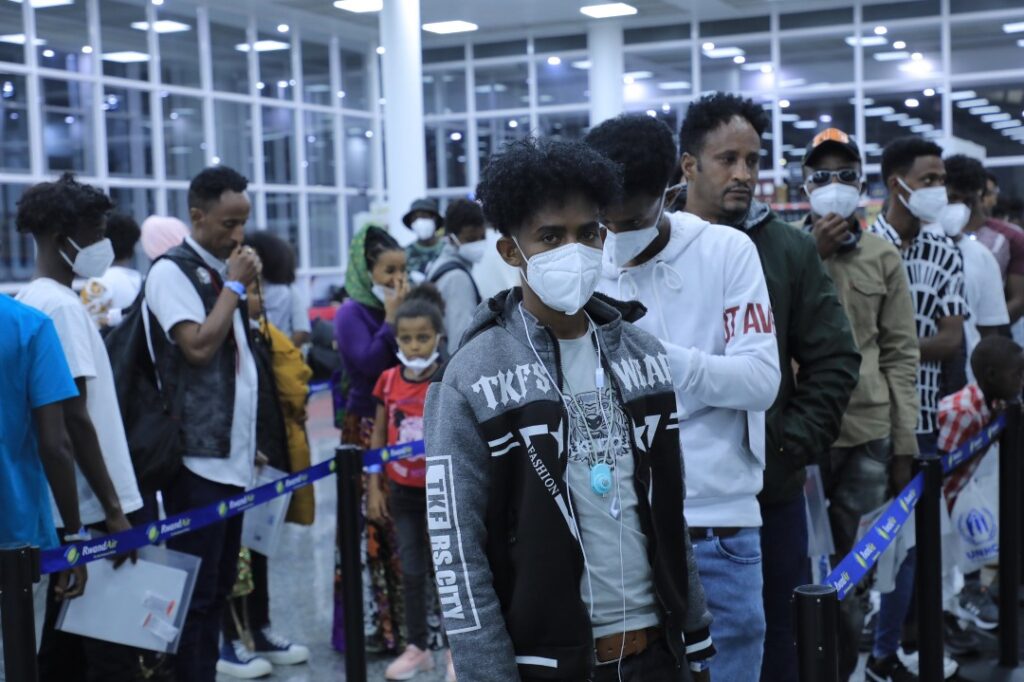
The Emergency Transit Mechanism (ETM) has enabled thousands of vulnerable African migrants evacuated from detention centres in Libya to receive temporary protection in Rwanda.
KIGALI – The ongoing discussions with Italy on migration are rooted in the country’s long-standing refugee protection model and humanitarian record, Government Spokesperson Yolande Makolo has said.
Though discussions remain at an early stage and no agreement has been reached, Rwanda’s engagement is informed by decades of hosting refugees and providing temporary protection to vulnerable migrants across Africa.
“There is no agreement yet. We’re still in discussions, and one of the ideas we’re exploring is around the Emergency Transit Mechanism in Gashora, which has already provided a safe place for vulnerable migrants while durable solutions are found,” Makolo said.
Her comments come after Italy announced it had opened negotiations with Rwanda over plans to establish a migrant return hub as part of a broader European strategy to accelerate the return of irregular migrants who have exhausted legal avenues to remain in Europe.
Rwanda is among three African countries, alongside Uganda and Ghana, where Italy says preliminary discussions are underway on pilot return centres that would be jointly managed by European countries and funded by the European Union.
Italian Prime Minister Giorgia Meloni’s government hopes the first centres could become operational by 2027, subject to agreements with host countries and support from the European Commission.
While Italy has outlined its plans, Makolo clarified that discussions with Rwanda are still exploratory and are centered on expanding a humanitarian model that the country has operated successfully for several years.
“Our experience has taught us what it means for people to lose everything and seek safety elsewhere. That is why Rwanda has remained open to refugees and committed to helping people rebuild their lives with dignity,” she said.

Government Spokesperson Yolande Makolo has said that Italy migration talks build on proven refugee protection model.
Established in partnership with the African Union and the UN Refugee Agency (UNHCR), the Emergency Transit Mechanism (ETM) has enabled thousands of vulnerable African migrants evacuated from detention centres in Libya to receive temporary protection in Rwanda before being voluntarily repatriated or resettled in third countries.
Makolo said Rwanda’s approach to migration is deeply influenced by its own history, having experienced mass displacement before and after the 1994 Genocide against the Tutsi, as well as three decades of hosting refugees from neighboring countries.
Currently, Rwanda hosts more than 100,000 refugees, mainly from the Democratic Republic of Congo and Burundi, under policies that allow them to work, access healthcare and integrate into local communities while awaiting durable solutions.
She said that experience has naturally positioned Rwanda as a reliable partner in international efforts to respond to forced migration, arguing that irregular migration requires collective action rather than isolated national responses.
“Irregular migration is a global challenge, and Rwanda has always done its part. The Emergency Transit Mechanism has shown that this model works. It has saved lives, protected families and offered hope to people with nowhere else to turn,” she said.
Makolo also sought to distinguish the ongoing discussions from the now-cancelled UK-Rwanda migration partnership, saying Rwanda’s objective has always been humanitarian rather than political.
“There will always be criticism, but we know we’re doing this for the right reasons. We want to be part of a practical and humane solution to one of the world’s biggest migration challenges,” she said.
She added that Africa should play a greater role in protecting vulnerable migrants on the continent instead of watching thousands of young people risk their lives trying to reach Europe through dangerous migration routes.
“We don’t want Africans making dangerous journeys across the desert and dying in the Mediterranean. We want them to find safety, opportunity and a future here on the African continent,” Makolo said.
Italy says the proposed return centres would receive irregular migrants who have exhausted legal avenues to remain in Europe before facilitating their return to their countries of origin.
Rome also hopes to complement the initiative with broader investment and development partnerships under its Mattei Plan for Africa.
For Rwanda, however, officials insist the discussions are ultimately about building on an existing humanitarian model, one they say has already demonstrated that protecting vulnerable migrants can go hand in hand with providing orderly, dignified pathways toward lasting solutions.