


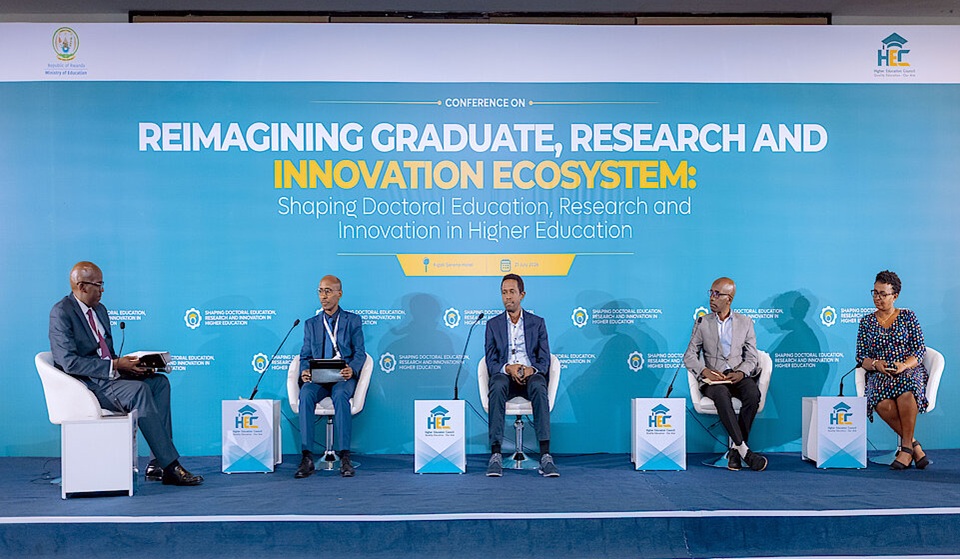
National Conference on Reimagining Graduate, Research and Innovation Ecosystem: Shaping Doctoral Education, Research and Innovation in Higher Education, held on 21 July 2026 in Kigali. The conference brought together policymakers, university leaders, researchers, development partners and industry representatives to exchange ideas and identify practical approaches to strengthening doctoral education and research in Rwanda.
The Government has more than doubled the approved staffing of the Rwanda Higher Education Council (HEC), increasing its establishment from about 42 positions in 2020 to 97 under a new organisational structure approved in August 2026 via Order of the Prime Minister Dr. Justin Nsengiyumva.
The new structure adds 55 positions, representing an increase of about 131%, as HEC faces growing pressure to improve service delivery and oversight of Rwanda’s expanding higher education sector.
The changes come as HEC has appeared before Parliament amid public concerns over slow service delivery, particularly in areas under its regulatory mandate.
The country is also facing labour force crisis where by the quality of professionals leaving higher institutions of learning have repeatedly been found to be wanting.
HEC is not the ministry responsible for running Rwanda’s entire education system. The Ministry of Education (MINEDUC) sets national policies, laws and budgets for the education sector, while specialised semi-autonomous agencies implement specific aspects of those policies.
Within this framework, HEC regulates higher education by accrediting universities and other higher learning institutions, approving degree programmes and curricula, monitoring quality standards and verifying foreign academic qualifications.
Public institutions such as the University of Rwanda (UR) and Rwanda Polytechnic (RP), by contrast, are primarily responsible for delivering teaching and training.
Other agencies have similarly defined responsibilities. The Rwanda Basic Education Board (REB) handles functions including primary and secondary school teacher placement and the provision of textbooks, while the National Examination and School Inspection Authority (NESA) administers national examinations such as P6, S3 and S6 and conducts school inspections. The Rwanda TVET Board (RTB) oversees technical and vocational education and training, including specialised curricula and the expansion of vocational training centres.
This division of responsibilities makes HEC’s role particularly important because its work is largely focused on regulating and assuring the quality of higher education, rather than providing classroom instruction.
Under the 2020 structure, HEC had about 42 approved positions. The new structure creates 97 positions across its offices, departments and specialised divisions.
The expansion significantly strengthens functions that were previously handled by relatively small teams.
The new structure, for example, creates a 40-member Accreditation and Quality Enhancement Department for General Education, an 11-member department for polytechnics, a 16-member Academic Recognition and Internationalization Department, and an 11-member Digitalization and Research function.
It also introduces dedicated divisions for equivalence, digitalisation, research and innovation, internationalisation and student welfare, while expanding the institution’s capacity for post-quality-enhancement activities.
The restructuring addresses capacity challenges that have affected HEC as it regulates an increasingly complex academic sector.
HEC has to audit and monitor higher learning institutions, assess programmes and curricula, conduct quality assurance, accredit institutions and programmes, and verify academic qualifications. A limited workforce and shortages of specialised expertise can place significant pressure on these processes, potentially contributing to delays in inspections, accreditation and other services.
To reinforce its technical capacity, HEC has also relied on external subject-matter experts to support specialised evaluations where the required expertise is not sufficiently available internally.
The Government’s latest intervention therefore goes beyond simply increasing the number of employees. It creates specialised positions in areas such as academic quality enhancement, financial sustainability, ICT and multimedia, construction, agriculture and food processing, manufacturing and mining, as well as research and innovation.
The new structure also strengthens digital capacity through a seven-member Digitalization Division, including software developers, a business intelligence analyst, a systems and development specialist and a network and information security specialist.
The Government has also moved to update HEC’s remuneration framework. Unlike the 2020 order, which included detailed salary provisions, the 2026 order provides that HEC salaries are determined under the salary structure approved by Cabinet on March 4, 2026.
The new Prime Minister’s Order No. 020/03 of August 7, 2026 repeals the 2020 Prime Minister’s Order No. 101/03 that previously determined HEC’s organisational structure, salaries and fringe benefits.
The expansion is intended to give HEC greater capacity to respond to the demands of Rwanda’s growing higher education system and strengthen quality assurance and regulatory services nationwide.
