





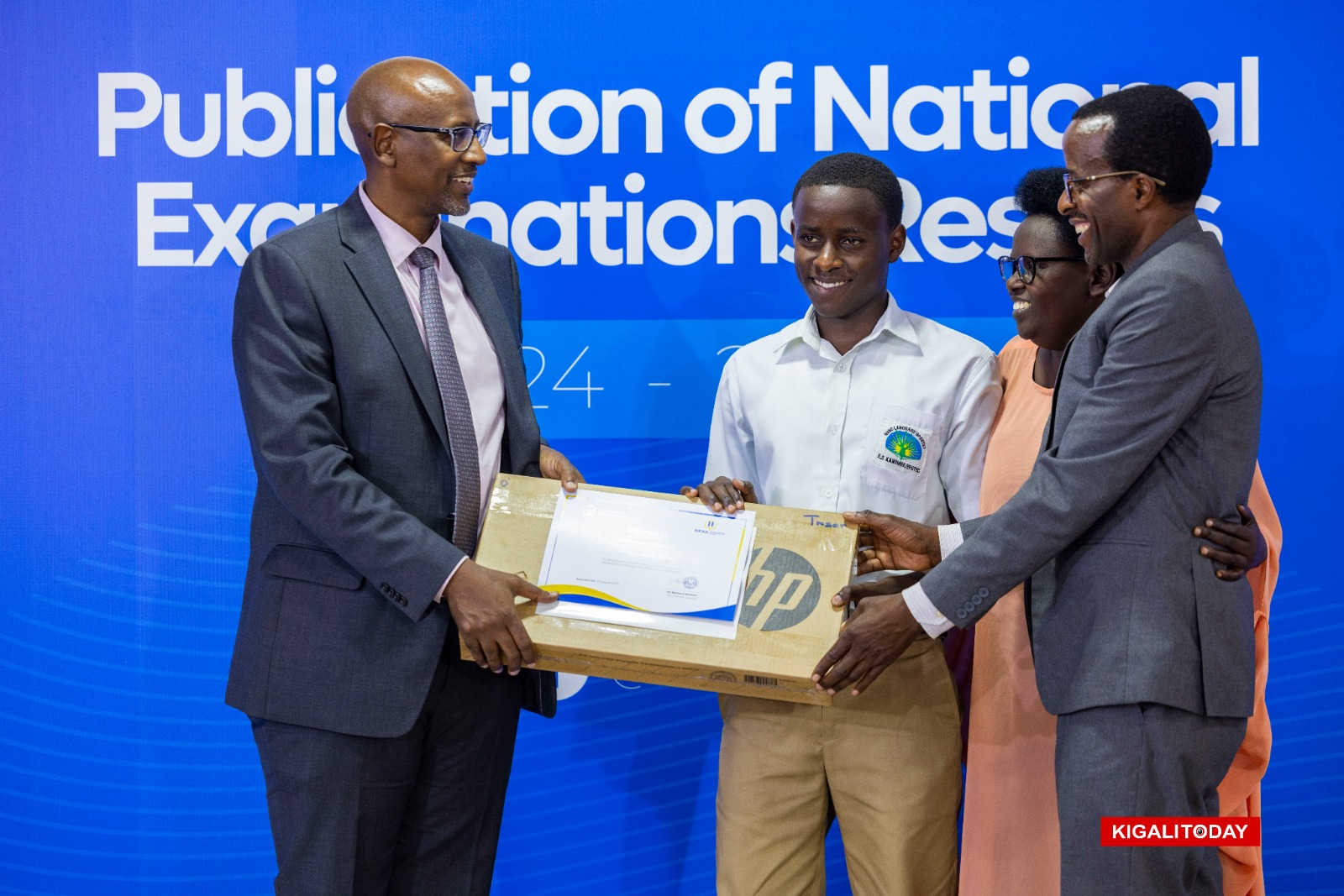
Education Minister Joseph Nsengiyumva awards best O’Level student OIZERE HENOCK ALBERT who scored 98.67% as his proud parents look on
At the announcement of national exam results last year, the Education Ministry used a different grading. The changes became permanent.
It was a radical change, in bid to raise the country’s education standards.
The system is beginning to see tangible results from a bold and controversial policy: students must now score over 50% and above to pass national exams to next level – primary to O’Level, and to A’Level.
This represents a significant change from the previous system, where learners could pass some subjects while failing others, allowing minimal overall performance to be considered a pass.
The new policy was introduced to push students and schools to raise their academic standards and improve the quality of learning across the country.
By requiring students to achieve at least half of the total marks in each subject, the Ministry of Education aims to ensure that learners genuinely understand the material, rather than merely scraping through.
The first full year under this system shows that the reform is already having an impact.
The 2024 results were released at fanfare event this Tuesday by Education Minister Joseph Nsengiyumva and the National Examination and School Inspection Authority (NESA). The best students were also rewarded
In the Primary Leaving Examinations (PLE), out of 219,926 candidates, 166,334 passed, representing an overall pass rate of 75.64%.
Girls slightly outperformed boys, with a 53.2% pass share compared to 46.8% for boys. The best-performing district reached a 97.09% pass rate, reflecting strong regional disparities.
For the Ordinary Level (O-Level) examinations, 148,702 candidates sat, of whom 95,674 passed, yielding a 64.35% pass rate.
The gender performance was balanced, with 50.2% male and 49.8% female pass share. The highest district pass rate stood at 91.3%, showing concentrated excellence in select areas.
The numbers indicate a gradual reduction in failing students and a clustering of scores in higher ranges, suggesting that learners and teachers are beginning to rise to the new challenge.
Under the previous system, where students at different levels were just expected to get minimal percentages in key subjects, was meant to have as many students as possible within the “passing” crowd, basically be lenient to have many passes. Even then, according to figures, many still failed to get the minimal expected.
PLE Comparison – 2023/2024 vs 2024/2025
| Score Range | 2023/2024 Candidates | % (2023/24) | 2024/2025 Candidates | % (2024/25) |
|---|---|---|---|---|
| 0 – 10 | 126 | 0.06% | 36 | 0.02% |
| 10 – 20 | 1,392 | 0.62% | 64 | 0.03% |
| 20 – 30 | 13,900 | 6.24% | 976 | 0.44% |
| 30 – 40 | 45,148 | 20.27% | 10,916 | 4.96% |
| 40 – 50 | 58,315 | 26.18% | 41,574 | 18.91% |
| 50 – 60 | 43,677 | 19.61% | 61,301 | 27.88% |
| 60 – 70 | 27,500 | 12.34% | 51,116 | 23.25% |
| 70 – 80 | 18,041 | 8.10% | 30,570 | 13.90% |
| 80 – 90 | 11,964 | 5.37% | 17,880 | 8.13% |
| 90 – 100 | 2,703 | 1.21% | 5,467 | 2.49% |
However, the new stricter pass mark also means that a significant number of students must repeat their year. The Education ministry says the number of those failing to get the required pass is far less now.
Many primary school students who sat the PLE, may need to repeat, while another significant number of who sat S3 students at lower secondary level (O’Level) may also have to repeat.
To support these learners, schools are now required to offer special remedial classes, ensuring students get the extra help needed to meet the new standard. This approach reflects a focus not only on accountability but also on support and learning reinforcement.
The policy sparked debate about the future path for students who fall below the 50% threshold.
At a recent government forum, an attendee suggested that these students could be sent to vocational training institutes (Imyuga) instead.
The Ministry of Education quickly rejected the idea, noting that vocational programs are designed for students pursuing specialized skills, not as a substitute for foundational academic learning.
‘Vocational training centers are not meant for failures,” is the response the speaker was given to the applause of the whole audience.
Officials stress that the purpose of the higher pass mark is not to punish learners, but to set clear expectations for what students should know and to encourage parents, teachers, and schools to work together to meet these expectations.
Education observers say the policy is beginning to change behaviors in schools and households.
Teachers are focusing more on ensuring students understand core concepts, schools are providing additional support to weaker learners, and parents are more engaged in monitoring homework and school performance.
The reform is also influencing how schools approach teaching, with an emphasis on mastery of subjects like mathematics, science, and languages.
O’Level Grading System
| Letter Grade | Descriptor | Percentage Range |
|---|---|---|
| A | Excellent | 80 – 100 |
| B | Very Good | 75 – 79 |
| C | Good | 70 – 74 |
| D | Satisfactory | 65 – 69 |
| E | Adequate | 60 – 64 |
| S | Minimum Pass | 50 – 59 |
| F | Fail | 0 – 49 |
