


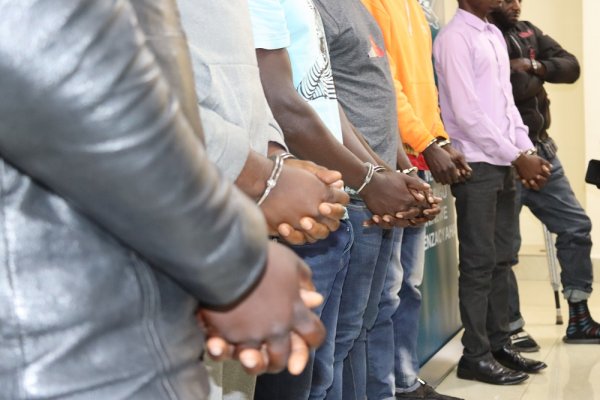
Suspects are paraded by RIB, a scene very common
When a shopkeeper in Kigali loses his entire day’s earnings to a thief, or when a farmer watches his crops destroyed overnight, the path to justice has usually meant waiting months — sometimes years — for a court judgment.
Now, Rwanda is introducing a new shortcut: suspects can admit guilt through a plea bargain, and victims can demand compensation right in the process.
The change comes after the Supreme Court issued fresh practice directions in September 2025, spelling out exactly how plea bargains and victim–offender mediation should work.
These instructions do more than announce policy — they operationalize the law, giving judges, prosecutors, lawyers, and victims a clear roadmap on how to negotiate deals, approve them, and enforce compensation.
For the first time, victims are not just witnesses but can demand compensation directly during the process.
What a Plea Bargain Means
Plea bargaining is a deal between the suspect and the prosecution. Instead of facing a long trial, the suspect admits guilt and, in return, gets lighter charges or a reduced sentence.
Take the example of a young man accused of stealing from a shop, or a senior government official accused of embezzlement. Instead of risking a heavy sentence after trial, he could say, “Yes, I stole,” and agree to pay back the shopkeeper.
The prosecutor then requests a lighter punishment, perhaps community service or a shorter jail term.
The courts have been carrying a heavy load of cases. At the end of June 2024, the case backlogs represented 59% of all cases pending in courts, that is 44,779 case backlogs out of 76,273 pending cases.
On the other hand however, the government cannot have resources at all times meant for the judiciary to hire whatever number of judges and prosecutors, or for incarcerations.
Plea bargaining is meant to speed up justice and reduce the backlog.
But the new Supreme Court directives go further. They insist that suspects must understand their rights, cannot be pressured into deals, and must be properly represented by lawyers if they want them.
Just as important, they recognize victims. The farmer whose harvest is destroyed, or the parent whose child is assaulted, now has the right to speak up in the process, request compensation, and ensure their voice is heard.
What Makes Rwanda’s Approach Different
Many countries already use plea bargaining — the United States, South Africa, and Kenya among them. Rwanda’s approach is unusual because it builds in strong victim participation, as the guidelines show.
If a motorbike rider is beaten and loses his source of income, he can sit in the negotiations and demand repayment for his hospital bills.
Even if the victim chooses not to attend, prosecutors are required to consult them before signing any agreement.
Another difference is that a judge must give final approval. The judge checks that the deal is fair, that the suspect was not forced, and that any promises — like compensation — are clearly written. If not, the deal is rejected and the case goes back to trial.
The directives are clear that plea bargaining is not a “free escape” for offenders. Prosecutors are barred from tricking suspects by threatening harsher charges.
If the suspect hides information or lies, the deal is cancelled. And if victims feel shortchanged, they can refuse to endorse compensation terms — forcing the case to proceed in court.
The rules also protect suspects. If someone agrees to a plea under threats, confusion, or without legal help, they can ask for the agreement to be reviewed.
Lessons from Elsewhere
Globally, plea bargaining is a common tool. In the United States, studies show that the majority of criminal cases are resolved this way, but victims have little direct influence.
Rwanda’s model goes further by combining efficiency with restorative justice — making sure that offenders are held accountable while victims get reparations.
In practice, this means a thief might get a shorter sentence but must repay what he stole. A fraud suspect could avoid a drawn-out trial if he agrees to compensate those he cheated. A violent offender might reduce his prison term by showing remorse and covering medical costs for the victim.
These are not soft escapes — they are structured ways of delivering justice that is quicker, fairer, and more responsive to those harmed.
By introducing plea bargaining and victim–offender mediation together, Rwanda is signaling a shift: justice is no longer only about punishing wrongdoers, but also about repairing the harm they cause.
